How the wet-hair check works
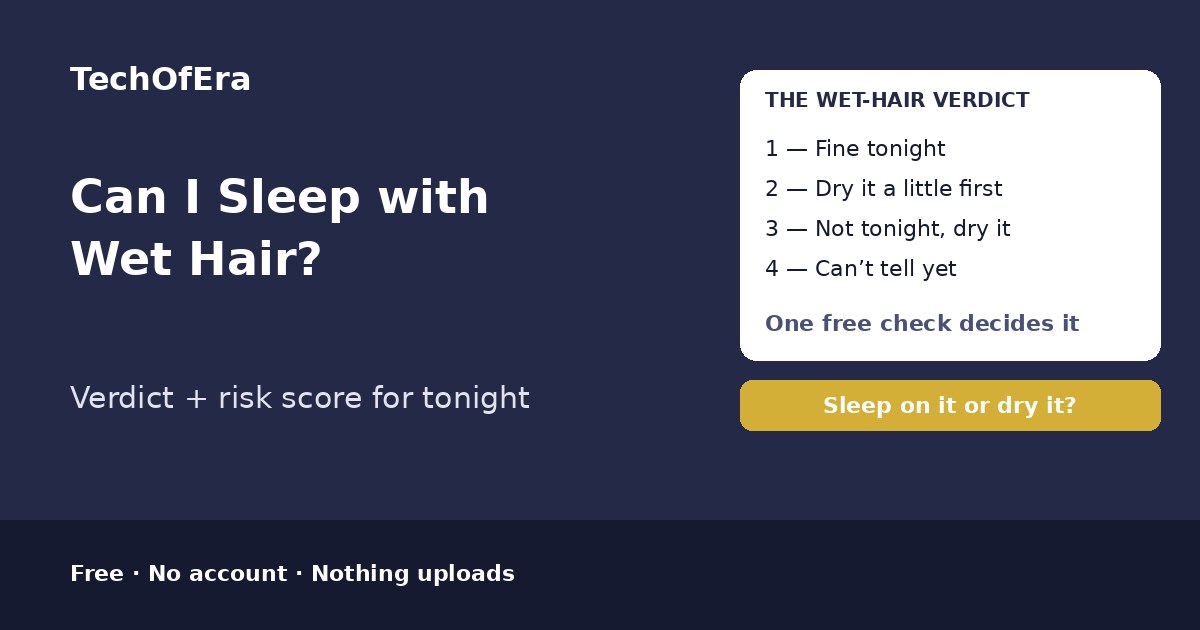
Sleeping with wet hair is a trade-off, not a yes-or-no question. Wet hair does not give you a cold — colds are caused by viruses — but wet hair is at its weakest, and eight hours of tossing on a pillow in that fragile state grinds it down, while the damp pillow feeds the fungi and bacteria behind dandruff and itchy scalp. This checker weighs all of it — how wet your hair is, what kind of hair it is, whether it is colour-treated, your scalp condition, your pillowcase, how often you sleep with wet hair, your climate and your health — and gives you a verdict: fine tonight, dry it a little first, not tonight, or can't tell yet, plus an overnight risk score out of 15.
To use it:
- Say how wet your hair is right now. Soaking wet and dripping, damp through but not dripping, mostly dry with just the ends or roots damp, or dry because you washed it hours ago. Soaking wet is the biggest single risk; mostly dry is fine tonight.
- Say what kind of hair you have. Fine, thick, long, curly or coily, or short. Long, curly and colour-treated hair breaks more easily when wet; short hair dries fast and has little length to tangle.
- Say whether your hair is colour-treated or bleached. Colour-treated, bleached or chemically treated hair is more fragile than natural hair, and the most likely to break when wet.
- Say how your scalp is. Dandruff or an itchy scalp, sensitive and easily irritated, or healthy with no dandruff, itch or flakes. Dandruff and itch mean the scalp needs drying first.
- Say what your hair will rest on. A cotton pillowcase, a silk or satin pillowcase, a microfibre towel wrapped round your hair, or a hair scarf. Silk or satin beats cotton for wet hair, because wet hair slides instead of snagging.
- Say how often you sleep with wet hair. Tonight only, a few nights a week, or every night. One wet night is nothing to fear; every night is a habit worth breaking, because the damage adds up over weeks.
- Say what your climate is like. Hot and humid, cold and damp, dry with low humidity, or mild most of the year. Humid climates make a damp pillow worse, because the hair and the pillow dry slowly.
- Say whether you have any health issues that matter here. A weakened immune system, allergies or asthma, or none. A weakened immune system makes a damp scalp riskier, because fungal overgrowth is harder to fight.
The four verdicts, and what each one means
Fine tonight — go to sleep
Mostly dry hair, a healthy scalp and a one-off wet night: the overnight risk is low, 2 or less out of 15. Wet hair does not give you a cold, and one mostly-dry night does not damage hair. Sleep as normal, and let it dry on the pillow.
Dry it a little first
Damp hair, or a few risk factors stacked up: the overnight risk is medium, 3 to 5 out of 15. Five minutes of drying takes most of the risk away — dry the roots with a towel or a quick blow-dry, leave the style loose, and use a silk pillowcase or scarf if you have one.
Not tonight — dry it first
Soaking wet hair, or enough risk factors stacked up: the overnight risk is high, 6 or more out of 15. Sleeping on it would grind the hair down and leave the pillow damp all night. Dry the roots properly, detangle gently, and do not go to bed with it still wet through.
Can't tell yet
Not enough answers to judge: the checker needs to know how wet your hair is, what kind of hair it is, and how often you sleep with wet hair. Mostly-dry hair on a healthy scalp is fine tonight, and soaking wet, colour-treated hair every night is not — and without those answers it cannot tell which one yours is.
The risks at a glance
The table below is the whole argument in one place — what wet hair actually does overnight, who it hits hardest, and the quick fix for each risk:
| Risk | What happens overnight | Who it hits hardest | Quick fix |
|---|---|---|---|
| Breakage | Wet hair stretches and snaps more easily; friction from tossing on the pillow grinds it down. | Colour-treated, bleached, fine or long hair | Dry the roots first; keep the style loose |
| Tangles and frizz | Wet strands snag on cotton and each other, and dry into kinks and frizz by morning. | Long, curly or coily hair | Loose braid or twist; silk pillowcase |
| Dandruff and fungal scalp | Fungi such as Malassezia thrive in the warm, moist scalp a wet night creates. | Dandruff-prone scalps; nightly wet hair; humid climates | Dry the roots; dandruff shampoo 2–3 times a week |
| Damp pillow and mildew | The pillow absorbs water and stays damp for hours; over months it can grow mildew. | Nightly wet hair; thick hair; humid climates | Dry the roots; wash the pillowcase often; air the pillow |
| Catching a cold | No risk: colds are caused by viruses, and wet hair contains no virus. | Nobody — this one is a myth | None needed |
What makes this checker different
The pages that rank for this search are articles — a Sleep Foundation explainer, a Healthline piece with two doctors, a Sleepopolis guide with a dermatologist and a trichologist, a Kiehl's hair-care page, and a TrenderHQ myth-buster quoting the Cleveland Clinic. None of them asks how wet your hair is tonight, what kind of hair it is, whether it is colour-treated, what pillowcase you use, or how often you do this — and none of them gives you a yes-or-no verdict for tonight with a risk score and the next steps. There is no dedicated interactive checker in the results at all. This page is that answer: eight questions, an instant verdict, the blockers named, and the next steps. It is also different from the live neighbours on this site: Should I Wash My Hair Every Day? Checker is about how often to wash, not whether to sleep on wet hair tonight; Is It Safe to Sleep with a Fan On? Checker is about airflow in the bedroom, not hair; and Is My Sleep Schedule Bad? Checker is about when you sleep, not what your hair is doing while you do. This checker is only about going to bed with wet hair tonight.
When is this the right check?
When you have just washed your hair late at night and you are standing in the bathroom wondering whether to dry it or just go to bed — because the answer is different for mostly-dry short hair and for soaking wet, colour-treated curls, and guessing wrong either way costs you. When your mother or grandmother warned you that wet hair gives you a cold — because it does not, and the checker says so plainly, with the real risks named instead. When your hair keeps breaking and you sleep on it wet most nights — because the breakage adds up over weeks, and the fix may be five minutes of drying, not a new product. And when your scalp itches or flakes after wet nights — because the damp pillow may be feeding it, and the checker says so instead of guessing.
Honest limitations
A self-assessment, not medical advice
This checker cannot feel how wet your hair is or see your scalp. It cannot tell whether flaking needs a dermatologist. If your scalp is sore, flaking heavily, or losing hair, see a dermatologist.
Without the wetness, the score is a guess
The risk score starts from how wet your hair is, and without it the checker treats it as damp — the middle answer — and says so in the result, rather than pretending it measured it.
“Damp” is a judgement, not a measurement
Most people judge wetness by touch, and what feels damp to one person feels soaking to another. If you are not sure, the checker treats “damp” as the middle answer — and says so in the result.
The risk score is a planning estimate
The risk score out of 15 and the verdicts on this page are the checker's own planning estimates drawn from the wet-hair guidance, not a prescription for any one person. Your hair, your scalp and your climate all change them: try the advice for a few weeks, then adjust.
Other things count too
This checker does not ask about swimming and chlorine, hats and helmets, hair length beyond the broad types, or medicines that change oil production — all of which change how wet hair behaves overnight. The verdict is about the eight answers, not the whole picture.
Rules from official sources, dated November 2026
The rules here are the wet-hair guidance from the Sleep Foundation, Healthline's doctors, Sleepopolis's dermatologist and trichologist, Kiehl's and the Cleveland Clinic, as they read in November 2026. Guidance changes: recheck with a dermatologist if anything about your scalp or hair changes.