How the hair-wash check works
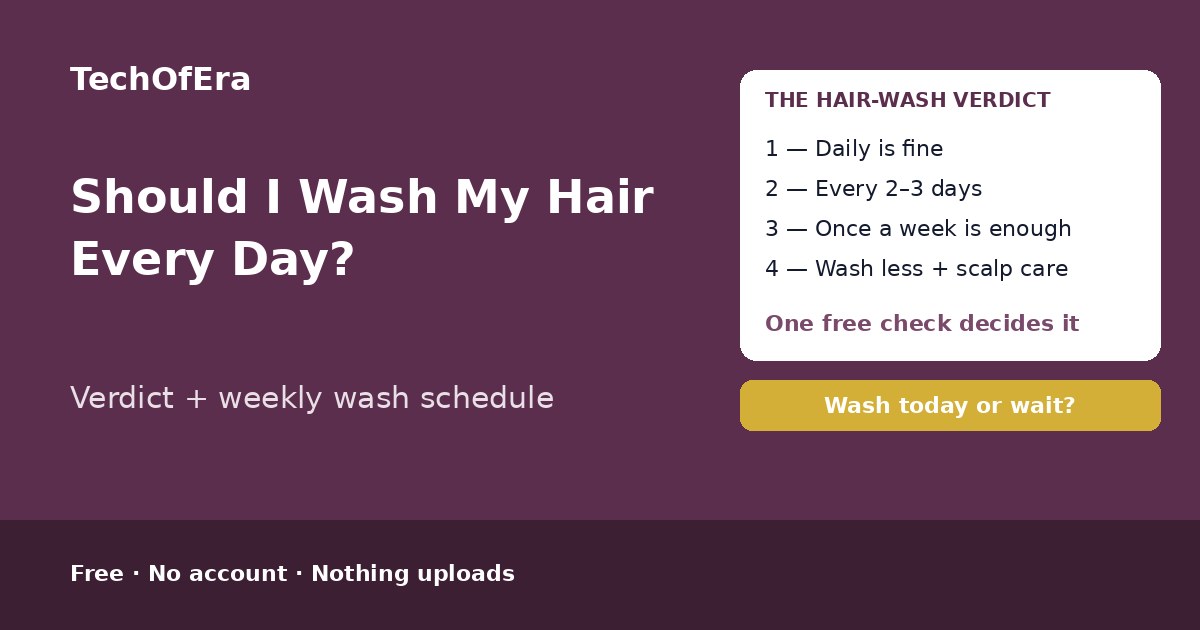
Washing your hair every day is a trade-off, not a yes-or-no question. Daily washing removes buildup and keeps the scalp healthy — but it strips the oils that dry, curly, coily and colour-treated hair needs, and the signs are dryness, frizz, breakage and colour fading fast. This checker weighs all of it — your hair type, how fast your scalp gets oily, how often you work out and sweat, styling products, water type, colour treatment, dandruff or itch, and climate — and gives you a verdict: washing every day is fine for you, every 2–3 days is your sweet spot, once or twice a week is enough, or wash less and look after your scalp, plus a personal wash schedule.
To use it:
- Say what your hair type is. Straight, wavy, curly, or coily and tightly curled. Straight hair shows oil fast because it slides straight down the strand; curly and coily hair stays drier for longer, because the oil takes its time travelling down the bends.
- Say how fast your scalp gets oily after washing. Oily within a day, oily after 2–3 days, balanced after 3–4 days, or dry and rarely oily. Oily within a day points to daily washing; a dry scalp rarely needs it.
- Say how often you work out and sweat. Sweaty most days, 3–4 times a week, 1–2 times a week, or rarely or never. Sweat builds up on the scalp and traps dirt, so it needs washing out — and it is the reason active people wash more often.
- Say how much styling product you use. Heavy products most days, a little on some days, or none at all. Heavy products build up on the scalp and the hair, and buildup is the main reason to wash more often.
- Say whether your tap water is hard or soft. Hard water — limescale on the taps — leaves mineral buildup that makes hair feel coated, dull and heavy. Soft water leaves no buildup to wash out.
- Say whether your hair is colour-treated or bleached. Colour-treated or bleached hair fades and dries out with every wash, so the less you wash it, the longer the colour lasts. Natural hair has nothing to protect.
- Say whether you have dandruff, an itchy scalp or flakes. Dandruff or an itchy scalp, dry flakes but not dandruff, or none of these. Dandruff overrides the hair-type schedule: the scalp needs a medicated shampoo 2–3 times a week, even when the hair type would go longer.
- Say what your climate is like. Hot and humid, cold and dry, mild most of the year, or varying a lot through the year. Hot and humid makes hair greasy faster; cold and dry dries it out, so stretching washes helps.
The four verdicts, and what each one means
Yes — washing every day is fine for you
Fine or oily hair, daily sweat, heavy styling, or a hot climate: washing every day or every other day suits you. Daily washing is generally fine and safe, and it keeps buildup off the scalp. Use a gentle shampoo, condition the ends only, and rinse with lukewarm water.
Every 2–3 days is your sweet spot
A balanced scalp, wavy or straight hair, and moderate sweat and styling: washing every 2–3 days keeps the hair clean without stripping it. On the days between, dry shampoo can freshen the roots if they look flat.
Once or twice a week is enough
Curly, dry or colour-treated hair that needs its natural oils: washing once or twice a week is enough. Condition well, detangle gently while the conditioner is in, and let the oils reach the ends.
Wash less — and look after your scalp
Coily or very dry hair where washing strips the oils that keep it from breaking: wash about every two weeks, moisturise the ends between washes, and keep the scalp clean with a gentle shampoo on wash day. Rinse with water only after a sweaty day.
Your weekly wash schedule
Whatever the verdict, this is the week the checker is aiming for — the schedule it builds from your answers:
- Daily washing: wash whenever it suits you. Morning or evening — the schedule is every day, so pick the time that fits your routine and stick to it.
- Every other day: Monday, Wednesday, Friday and Sunday. Four washes a week, with a rest day between each one. Dry shampoo on the roots can carry a flat day.
- Every 2–3 days: Monday, Wednesday and Friday. Three washes a week, evenly spaced. Wash sooner if the roots look oily or feel heavy; stretch a day longer if they still look clean.
- Twice a week: Monday and Thursday. Two washes, three days apart. Condition well on wash day, and moisturise the ends between washes.
- Once a week: pick a day, for example Sunday. One wash, the same day each week, so the routine is easy to keep. Protect the hair at night — a silk pillowcase or a loose braid helps.
- Every two weeks: every second Sunday. One wash a fortnight, with water-only rinses after sweaty days. On wash day, shampoo the scalp gently and condition well — never wash coily hair rough or dry.
- Try the new schedule for two weeks. One wash proves nothing: two weeks of the new interval shows whether the roots stay clean and the ends stay healthy. If the scalp itches, flakes or gets sore, see a dermatologist.
What makes this checker different
The pages that rank for this search are articles — a Verywell Health explainer reviewed by a doctor, a Medical News Today guide, a Katie Couric piece with dermatologists, and a Hair.com schedule by hair type. None of them asks how fast your scalp gets oily, how often you sweat, whether your water is hard, or whether your hair is colour-treated — and none of them gives you a yes-or-no verdict on daily washing with a weekday schedule you can follow. There are two small calculators in the results, a Hair Wash Frequency Calculator and a Hair Wash Planner, but neither frames the answer as a verdict on daily washing, neither gives a weekday wash schedule with presets, and neither weighs hard water against colour treatment. This page is that answer: eight questions, an instant verdict, the blockers named, and the next steps. It is a self-assessment, so it says plainly what it cannot know: it cannot feel how oily your scalp is or see your hair type.
When is this the right check?
When you are not sure whether washing every day is helping or harming your hair — because the answer is different for oily straight hair and for dry coily hair, and guessing wrong either way costs you. When your hair looks greasy by lunchtime and you wonder whether daily washing is the cause — because dermatologists say you cannot train your scalp to produce less oil by washing less, so the fix is washing when it needs it, not fighting it. When you have curly or colour-treated hair and the ends feel dry no matter what you do — because the fix may be washing less, not a new product. And when you have dandruff and you are not sure whether to wash more or less — because the scalp comes first, and the checker says so instead of guessing.
Honest limitations
A self-assessment, not medical advice
This checker cannot feel how oily your scalp is or see your hair type. It cannot tell whether flaking needs a dermatologist. If your scalp is sore, flaking heavily, or losing hair, see a dermatologist.
Without your hair type, the interval is a guess
The wash interval starts from your hair type, and without it the checker falls back to a middle value of about every 2–3 days. The verdict drops to low confidence until the hair type is known — answer it first.
“Oily within a day” is a judgement, not a measurement
Most people judge oiliness by looking in the mirror, and what looks oily to one person looks fine to another. If you are not sure, the checker treats “oily after 2–3 days” as the middle answer — and says so in the result, rather than pretending it measured it.
The wash interval is a planning estimate
The wash interval and the weekly schedule on this page are the checker's own planning estimates drawn from the hair-washing guidance, not a prescription for any one person. Your scalp, your hair and your climate all change them: try the schedule for two weeks, then adjust by a day at a time.
Other things count too
This checker does not ask about swimming and chlorine, hats and helmets, hair length, or medicines that change oil production — all of which change how often hair needs washing. The verdict is about the eight answers, not the whole picture.
Rules from official sources, dated November 2026
The rules here are the hair-washing guidance from the American Academy of Dermatology, the Cleveland Clinic, Verywell Health's dermatologists, Medical News Today and Hair.com by L'Oréal, as they read in November 2026. Guidance changes: recheck with a dermatologist if anything about your scalp or hair changes.