How the fan-and-sleep evidence works
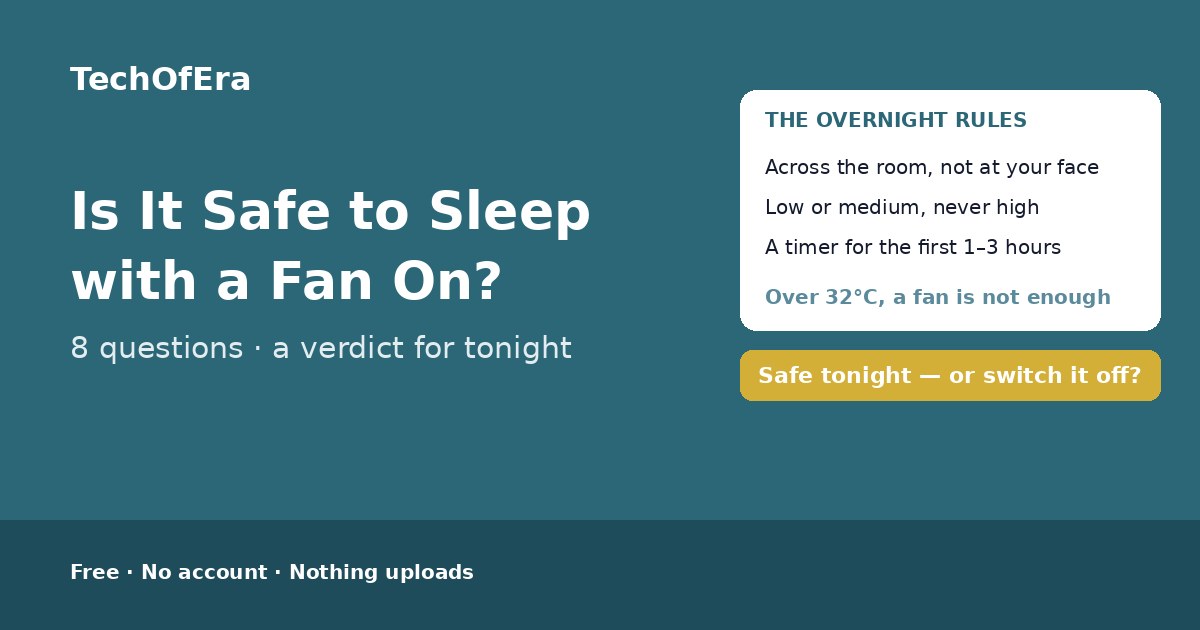
Sleeping with a fan on is generally safe for most people, according to the Sleep Foundation and Verywell Health — it keeps the bedroom cooler and less stuffy, and the steady sound helps many people sleep. A fan does not give you a cold: colds are caused by viruses, not moving air, and there is nothing toxic about a fan. The predictable downsides are dry eyes, a dry or stuffy nose, a stiff neck, and stirred-up dust that can bother allergies or asthma — and all four are mostly about where the fan points and how fast it runs. The Sleep Foundation puts the ideal bedroom temperature at roughly 15–19°C (60–67°F), and a fan is at its best when it moves air through a warm room without sitting on one spot. This checker runs your exact setup — fan type, direction, speed, timer, room temperature, airways, children in the room and noise — against that evidence, and names every fix.
To use it:
- Say what kind of fan it is. Ceiling, pedestal, tower, box or window — the type matters less than where it points, but a window fan can pull in pollen, and a pedestal fan close to the bed is the one most likely to blow straight at you.
- Say where it points and how fast it runs. Across the room or oscillating, on low or medium, is the overnight setup every source recommends. Straight at your face on high is the combination that dries your eyes and nose, stirs up the most dust, and wakes you with a stiff neck.
- Say whether it runs on a timer. One to three hours is usually enough cooling — your body temperature drops as the night goes on, so you need the fan least in the small hours.
- Pick your bedroom temperature tonight. This decides the verdict: in a cool or comfortable room a fan is a comfort tool, in a hot room it earns its keep, and over 32°C (90°F) a fan on its own is not enough — and can increase body temperature.
- Say whether you have allergies, asthma, dry eyes or sinus problems, whether a child sleeps in the room, and whether the noise helps or bothers you. Each one changes the verdict: dust and drying change the airflow advice, a baby under 12 months means indirect airflow only, and noise that bothers you means turning the fan down or switching it off.
Fan type, direction and speed — what tonight looks like
The table below is the checker’s own summary of the evidence above — the same rules the verdict uses, in one place. The two things that matter most are where the fan points and how fast it runs; the fan type mostly decides how easy it is to get those two right.
| Fan type | Where it points | Speed | Tonight |
|---|---|---|---|
| Ceiling | Across the room | Low | Comfortable — gentle air movement through the whole room; the setup the evidence is most relaxed about. |
| Tower, oscillating | Oscillating | Low–medium | Comfortable — the airflow moves instead of sitting on one spot; the easiest overnight setup. |
| Pedestal | Across the room | Medium | Usually comfortable — keep it a couple of metres from the bed so the breeze arrives softened. |
| Window fan | Intake, blowing in | Any | Cooling, with a catch — pulls in outside air, and pollen with it; run it on exhaust if you have allergies. |
| Any fan | At your face | High | Most likely to cause problems — dries eyes and nose fastest, stirs up the most dust, and is the loudest; aim it away and turn it down. |
| Any fan | At your body | High | Stiff neck risk — cold air on one spot all night can cause muscle contractions; point it across the room or oscillate. |
| Any fan | Across the room | Low, with a timer | The overnight default — indirect, low, and off after the first one to three hours. |
What makes this checker different
The pages that rank for this search are articles — Verywell Health, the Sleep Foundation, Saatva, Live Science and Welltory — and they all explain the same general answer: usually safe, watch the dust, aim it away from your face. None of them asks about your setup. There is no free, standalone checker that takes your fan type, where it points, its speed, whether it runs on a timer, your bedroom temperature, your allergies or dry eyes, whether a child sleeps in the room and whether the noise helps or bothers you — and gives you a verdict for tonight: safe, safe with tweaks, or not tonight — with every fix named and the evidence behind it. This page is that answer: eight questions, an instant verdict for your exact night, the changes named, and the next steps.
A different question from the other fan checkers
This checker is about one thing: sleeping with a fan running overnight. It is not about which way a ceiling fan should spin in winter — that is a heating question, answered by the Should I Reverse My Ceiling Fan in Winter? Checker. And it is not about using a fan heater in a bathroom — that is an electrical-safety question, answered by the Can I Use a Fan Heater in the Bathroom? Checker. If your question is one of those, use the checker built for it.
When is this the right check?
On the first warm night of the year, when the fan comes out of the cupboard and you are not sure how to set it. When you wake up with gritty eyes or a stuffy nose after a fan night and want to know which setting caused it. When allergies or asthma flare at night and you are wondering whether the fan is moving the dust. When a baby starts sleeping in your room and the fan needs a different setup. And on a heatwave night, when the question is not whether the fan helps but whether it is enough on its own — because over 32°C it is not.
Honest limitations
A self-assessment, not medical advice
This checker cannot measure your bedroom temperature, see how dusty the fan blades are, or know how dry your eyes get overnight. If you are worried about your sleep or breathing, talk to your doctor.
The fan is not the only thing in the room
Dust on the blades, pollen through an open window, a pet sleeping on the bed and a dry radiator all change the night — and this checker only asks about the fan. Clean the room, not just the fan.
Extreme heat is a health question, not a fan question
Over 32°C (90°F) a fan can increase body temperature. This checker says “not tonight” and tells you to cool the room — but dizziness, confusion or sickness on a hot night need help, not a different fan setting.
A fan does not cool the air
A fan moves air across your skin so you lose heat faster — it does not lower the room temperature. In a hot room that is enough; in a very hot room it is not, and no fan setting changes that.
Babies need their own check
This checker only asks whether a baby sleeps in the room and how the airflow reaches them. The baby’s whole sleep setup — position, surface, cot contents, room and warmth — is a separate question, answered by the Baby Safe Sleep Checker.
Evidence from named sources, dated November 2026
The verdicts rest on the Sleep Foundation, Verywell Health, Live Science and CDC guidance on fans in extreme heat, as they read in November 2026. Guidance changes: recheck if your health or your home changes.