How the sleep-schedule check works
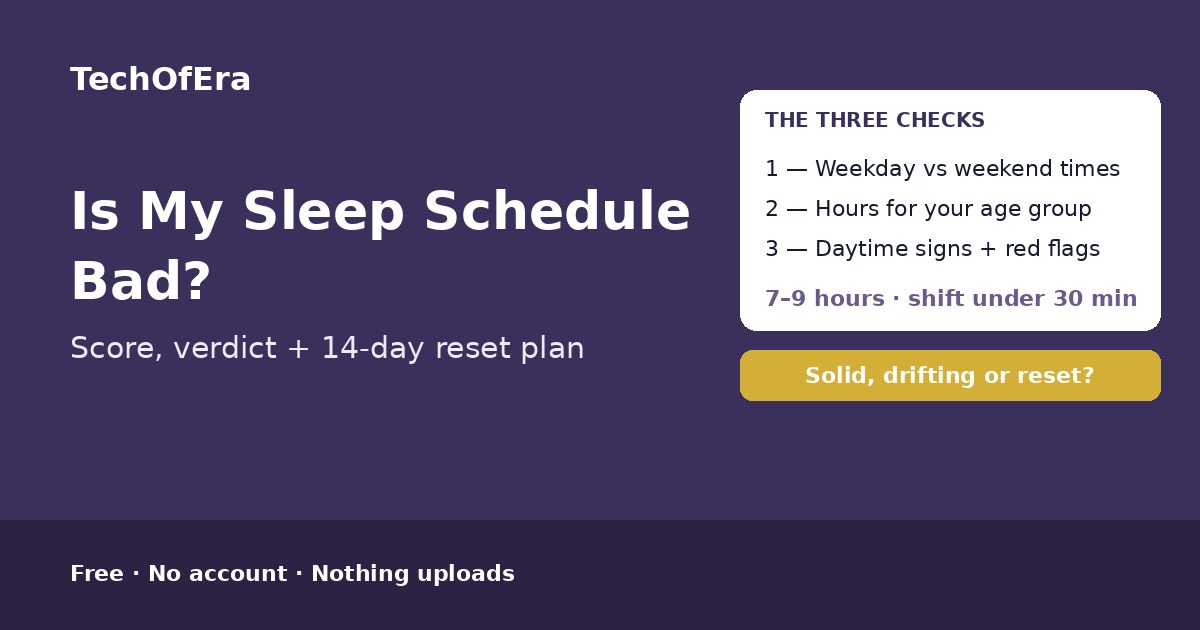
The National Sleep Foundation and the American Academy of Sleep Medicine say adults aged 18–64 need 7–9 hours a night (8–10 for teenagers, 7–8 for ages 65 and over) — and the AASM now includes schedule regularity alongside duration in its clinical sleep guidance. In a 2024 study of 60,977 UK Biobank adults, the most regular sleepers had a 20–48% lower risk of dying than the least regular group, after adjusting for how long they slept. But a number of hours is not a verdict: a steady 7 hours outperforms an irregular 8, and a schedule that looks fine on weekdays can still be wrecked by a three-hour weekend lie-in. This checker combines four clues — how long you sleep on weekdays, how far your weekend times drift from your weekday times, how long you take to fall asleep, and the daytime signs — and gives you a score out of 100, a verdict, and the target schedule your own wake time calls for.
To use it:
- Pick your age group. The recommended hours are 8–10 for ages 14–17, 7–9 for adults aged 18–64, and 7–8 for ages 65 and over. The checker scores your weekday sleep against the range for your age.
- Enter your weekday bed and wake times. The times you actually keep, not the ones you wish you kept. Your weekday wake time is the anchor — the whole schedule hangs on it.
- Enter your weekend bed and wake times. The lie-in is where social jet lag lives: a weekend wake time two or more hours later than your weekday wake time shifts your body clock like a westward flight.
- Say how long you take to fall asleep. The average adult takes 10–20 minutes. Under 5 minutes usually means sleep deprivation, not efficiency — and over 30 minutes most nights is worth raising with a clinician.
- Say whether you work shifts, and tick any daytime signs. Rotating shifts change the rules, because a rotating roster cannot hold a single fixed schedule. And the daytime signs — the alarm, the snooze, the afternoon slump, the dozing off — are the body’s own report card.
What makes this checker different
The pages that rank for this search are guides and bedtime calculators — a long article that tells you to keep regular hours, and a tool that takes your wake time and gives you bedtimes in 90-minute cycles. Neither one asks what your schedule actually is, and neither one tells you whether it is bad. There is no free, standalone checker that takes your weekday and weekend bed and wake times, how long you take to fall asleep, your age group, whether you work shifts, and the daytime signs — and gives you a score, a verdict (solid, drifting, needs a reset, or see a clinician), and a 14-day reset plan built on your own anchor wake time. This page is that answer: eight questions, an instant verdict for your exact schedule, the blockers named, and the next steps. It is a self-assessment, so it says plainly what it cannot know: it cannot watch you sleep, and where a red flag is present it says so instead of giving you a schedule tweak.
When is this the right check?
On a Monday morning, when the weekend lie-in has left you feeling like you flew home from the wrong time zone — because that is social jet lag, and this checker measures it in minutes. When you keep promising yourself an earlier bedtime and it never sticks — because the fix is the wake time, not the bedtime, and this checker works the target out from your own anchor. When you fall asleep the moment your head touches the pillow and call it good sleep — because under 5 minutes usually means sleep deprivation, not efficiency. When you work rotating shifts and every article assumes a 9-to-5 life — because the checker scores shift work differently instead of marking you down for a schedule you cannot hold. And whenever the hours look fine on paper but the days still feel heavy — because the daytime signs are the check the hours cannot give you.
Honest limitations
A self-assessment, not medical advice
This checker cannot watch you sleep. It cannot check when you actually fell asleep, how often you woke, or what your body clock is doing. If you snore loudly, gasp, fall asleep during the day, or cannot fall asleep most nights, talk to your GP or doctor.
The score is a guide, not a diagnosis
A score of 92 does not mean your sleep is perfect, and a score of 58 does not mean you are ill. The score weighs the hours, the regularity, the onset and the daytime signs together — but only a clinician, and only with a proper assessment, can say whether a sleep problem needs treatment.
Shift work is scored differently — and loosely
A rotating roster cannot hold a single fixed schedule, so the checker halves the penalty for weekend drift when you work shifts. That is a judgement call, not a clinical rule: shift workers’ sleep is genuinely harder to score, and this checker says so.
Teenagers have a later body clock
A teenager’s body clock runs naturally later — a 23:00 bedtime is not a failure. The checker scores teenagers against the 8–10 hour range, but it cannot tell whether a late bedtime is biology or a phone in bed. The regularity rules still apply either way.
Two weeks, not two nights
The body clock moves at roughly an hour a day at best. Three nights of a new schedule tells you nothing — hold it for two weeks before judging whether it works. If you follow a fixed schedule for three to four weeks and still feel exhausted, talk to your GP or doctor.
Rules from official sources, dated November 2026
The rules here are the National Sleep Foundation and American Academy of Sleep Medicine sleep-duration recommendations and regularity guidance, as they read in November 2026. Guidance changes: recheck with your GP or doctor if anything about your sleep changes.