How the sleep-with-socks check works
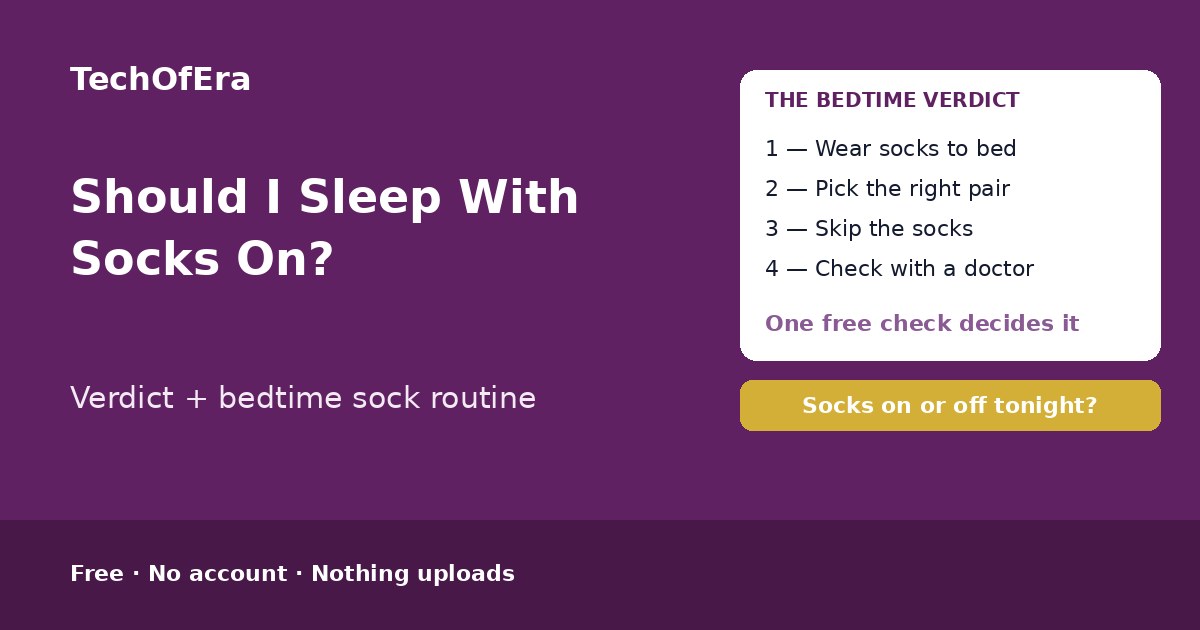
Sleeping with socks on is a trade-off, not a yes-or-no question. Warm feet help you fall asleep faster — they open the blood vessels in the skin, which lets heat leave the body and drops your core temperature, the signal that it is time to sleep. But socks can also overheat you, and for people with diabetes or poor circulation they can hide an injury and delay healing. This checker weighs all of it — how your feet feel at bedtime, how long it takes you to fall asleep, circulation conditions, hot flashes or night sweats, the socks you would wear, how warm your bedroom is, whether you wake in the night because of your feet, and the state of the skin on your feet — and gives you a verdict: wear socks to bed, wear socks but pick the right pair, skip the socks tonight, or check with your doctor first, plus a personal bedtime sock routine.
To use it:
- Say how your feet usually feel at bedtime. Icy cold and hard to warm up, cool but not freezing, comfortable, warm, or warm and sweaty. Icy feet at bedtime are the clearest reason to wear socks.
- Say how long it usually takes you to fall asleep. Under 15 minutes, 15–30 minutes, 30–60 minutes, or over an hour. Taking 30 minutes or more is where warm feet help most.
- Say whether you have a circulation condition. None of these, diabetes, peripheral artery disease (poor circulation in the legs), Raynaud's, or more than one of these. Diabetes or peripheral artery disease changes the answer — check with a clinician first.
- Say whether you get hot flashes or night sweats. None, sometimes — a few nights a month — or often, most nights. Hot flashes most nights are a reason socks can help, in a thin, breathable pair.
- Say what socks you would wear to bed. Loose and breathable in cotton, wool or bamboo; loose and synthetic; tight-fitting; compression socks; or thick thermal socks. Loose, breathable natural fibres are the pair the guidance points to.
- Say how warm your bedroom is at night. Cold — under 16°C (60°F); cool — 16–19°C (60–67°F); comfortable — 19–21°C (67–70°F); or warm — over 21°C (70°F). A cool bedroom is where socks work best.
- Say whether you wake up in the night because of your feet. No, you sleep through; yes, your feet feel cold; yes, you feel too hot and kick the covers off; or you wake up having kicked your socks off. Waking with cold feet is the exact problem socks are for; waking too hot is the reason to skip them.
- Say what the skin on your feet is like. No problems, dry skin or cracked heels, foot sores that heal slowly, or athlete's foot or a fungal infection. Dry skin or cracked heels are a reason socks can help — over moisturiser, every night.
The four verdicts, and what each one means
Yes — wear socks to bed
Cold feet at bedtime, and slow to fall asleep — or Raynaud's, or hot flashes most nights, with no circulation risk. Put on a loose, breathable pair of cotton, wool or bamboo socks before bed, and a fresh pair every night. In one small study, people wearing bed socks fell asleep 7.5 minutes faster and slept 32 minutes longer.
Wear socks — but pick the right pair
Socks are likely to help you, but something about the pair, the room or the sweating needs fixing first: swap to loose, breathable natural fibres, keep the bedroom cool at 60–67°F (15–19°C), and choose a thinner pair if your feet sweat. If you wake up having kicked the socks off, they were too warm for the night.
Skip the socks tonight
Your feet are already warm or sweaty, and socks would add heat your body is trying to shed — overheating works directly against the cooling your body needs to fall asleep. Let your feet breathe overnight, and warm them before bed another way: a warm foot bath, slippers, or a hot water bottle near your feet.
Check with your doctor first
Diabetes, peripheral artery disease, or foot sores that heal slowly change the answer: socks can reduce circulation to the feet and delay healing, and tight socks can hide an injury. Ask your clinician whether sleeping in socks is safe for you, and what to check on your feet each morning. Do not sleep in compression socks unless they were prescribed.
Your bedtime sock routine
Whatever the verdict, this is the evening the checker is aiming for — the routine it builds from your answers:
- Pick the right pair before bed. Loose, breathable, natural fibres — cotton, merino wool, bamboo or viscose — loose enough to leave no mark on your ankle in the morning. A fresh pair every night, never the ones you wore in your shoes all day.
- Put them on before you get into bed. Warm feet are what trigger the drop in core temperature, so the socks need to be on while you are still winding down — not after you are already cold under the covers.
- Keep the bedroom cool, about 60–67°F (15–19°C). Socks warm your feet so your core can cool; a warm room fights that. If the room is over 21°C (70°F), cool it first, and skip the socks until it is cooler.
- If your skin is dry, moisturise first. Put moisturiser on your feet, then clean cotton socks over the top, every night — the socks hold the moisture in and help cracked heels heal.
- If you wake up too hot, kick them off. That is your body telling you the pair was too warm for the night. Try a thinner pair tomorrow, or skip the socks and warm your feet before bed instead.
- Never sleep in compression socks unless they were prescribed. They do their work when you are upright; lying down, they can block blood flow to the feet. Take them off at bedtime.
- Try the new routine for a week. One night proves nothing: a week of socks shows whether you fall asleep faster and wake up less. If nothing changes, the socks were not the problem — and if you take over an hour to fall asleep most nights, raise it with a clinician.
What makes this checker different
The pages that rank for this search are articles — a Cleveland Clinic explainer from a sleep medicine specialist, a GoodRx benefits-and-risks page, a Healthline guide, a Medical News Today explainer, a Sleep Report deep dive, and a Mattress Clarity guide. None of them asks how your feet feel at bedtime, whether you have diabetes, what socks you would wear, or how warm your room is — and none of them gives you a verdict for your night. There is no free, standalone checker that takes your feet, your circulation, your socks and your room and turns them into a verdict with a bedtime routine. This page is that answer: eight questions, an instant verdict, the blockers named, and the next steps. It is a self-assessment, so it says plainly what it cannot know: it cannot feel how cold your feet are, measure your core temperature, or check your circulation.
When is this the right check?
When your feet are icy every night and you lie awake waiting for them to warm up — because that is the exact problem socks solve, and the fix costs nothing. When you take 30 minutes or more to fall asleep and you have never tried socks — because one small study found 7.5 minutes faster, and a week of trying costs nothing. When you have diabetes or poor circulation and you are not sure whether socks are safe for you — because the answer for you is not the same as the answer for a healthy adult, and the checker says so instead of guessing. And when you keep waking up having kicked your socks off — because that tells you the pair was too warm, and the fix is a thinner pair or none at all.
Honest limitations
A self-assessment, not medical advice
This checker cannot feel how cold your feet are, measure your core temperature, or check your circulation. It cannot tell whether socks are safe for you if you have diabetes or poor circulation. If you have diabetes, peripheral artery disease, or foot sores that heal slowly, talk to a clinician.
The 7.5-minute figure comes from six people
The study behind the headline numbers — 7.5 minutes faster to fall asleep, 32 minutes longer asleep — had six participants, all young men, all in a cool room. The authors say outright the work needs repeating with a larger sample. Treat the numbers as a signal, not a settled figure.
“Cold feet” is a feeling, not a measurement
Most people judge their feet by how they feel, and two people can mean different things by “icy”. If you are not sure how cold your feet are, the checker treats “cool” as the middle — and says so in the answer, rather than pretending it measured it.
Without your bedroom temperature, the routine is a rule, not a plan
The bedroom temperature decides whether socks help or overheat you, and guessing it wrong by a few degrees changes the answer. The checker still works without it, but it gives the cool-room rule instead of a tailored routine — and the verdict drops to low confidence until the room is known.
Other sleep problems are out of scope
This checker asks about feet, socks and temperature. It does not ask about insomnia, sleep apnoea, restless legs, or medicines that disturb sleep — all of which can keep you awake no matter what you wear on your feet. If you take over an hour to fall asleep most nights, or you fall asleep during the day, talk to a clinician.
Rules from official sources, dated November 2026
The rules here are the sleep guidance from the Cleveland Clinic, GoodRx, Healthline and Medical News Today, as they read in November 2026. Guidance changes: recheck with a clinician if anything about your health, your circulation, or your sleep changes.