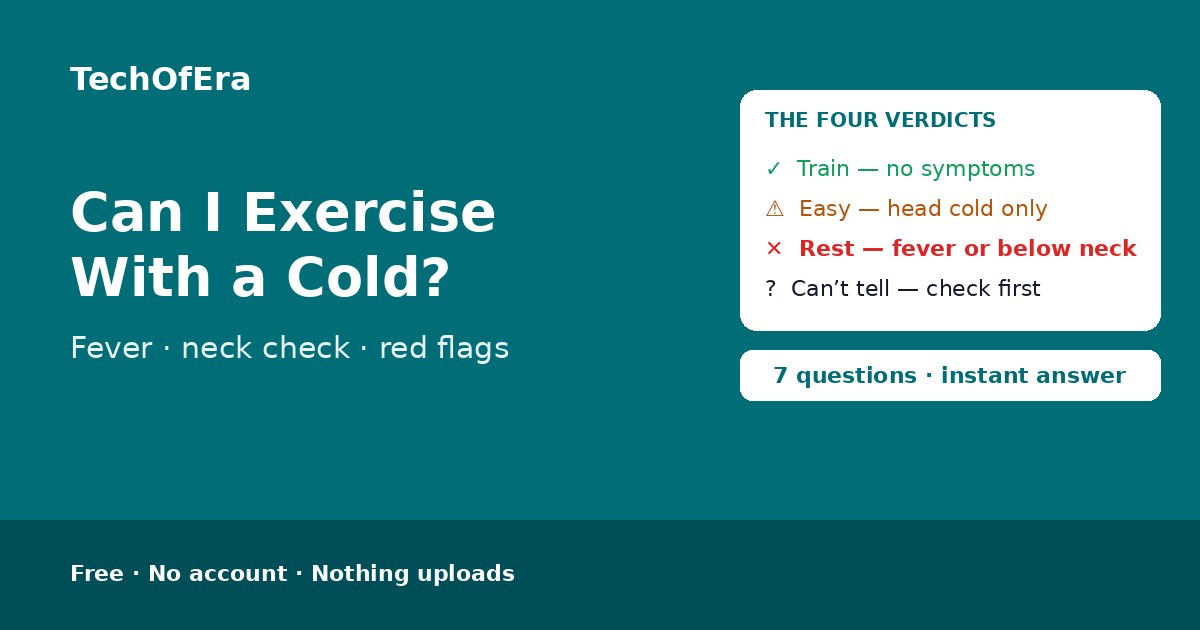
How to decide whether to exercise with a cold
Sports doctors have used the same rule of thumb for decades — the neck check. It sorts symptoms into two groups. Symptoms above the neck — a runny or blocked nose, sneezing, a mild sore throat — may allow light exercise if you feel up to it. Symptoms below the neck or whole-body — fever, chest congestion, a hacking cough, wheeze, body aches, vomiting or diarrhoea — mean rest until they have gone. It is a clinical convention rather than the result of a trial: the 2022 International Olympic Committee consensus statement notes there is little research to support a sound scientific approach to return to sport after respiratory illness. But it matches how illness works: a head cold is a local infection in your upper airway, while fever and aches mean the infection has gone systemic, and your whole body is now fighting it. This checker asks exactly what decides it.
To use it:
- Take your temperature. Fever is the hard line: 38°C (100.4°F) or above means rest, whatever else is true. Feeling feverish is not a measurement — take your temperature before deciding, and do not use paracetamol or ibuprofen to make a fever “pass” the check.
- Sort your symptoms by the neck. Nose and throat only, with no fever, is the one case where light exercise is usually fine. Anything in the chest, the body or the stomach means rest.
- Watch for the red flags. Chest pain or tightness, a racing or irregular heartbeat, unusual breathlessness, lightheadedness or fainting during or after a viral illness are not rest-day questions — they can be signs of heart inflammation (myocarditis). Stop exercising and seek urgent medical help.
- Downgrade the session, not just the decision. With a head cold, swap intervals, a long run, heavy lifting or a race for an easy session — about half your usual effort, shorter than usual, conversational pace. Use the ten-minute rule: if you feel worse after ten minutes, stop.
- Train solo. A mild cold is still contagious. Skip the gym and group classes while you have symptoms — a walk, a light jog outdoors, or gentle movement at home instead.
- Come back gradually. After a fever, wait at least 24 hours after it has fully gone, without fever-reducing medicine, and only when symptoms are improving. Start easy and build back over several days — symptoms often clear before the body has fully recovered.
Symptom situations and what to do at a glance
The table below is built from the same rules as the checker, so it can never disagree with your verdict. Where the symptom sits — above or below the neck — decides together with fever.
| Symptom situation | Verdict | What to know |
|---|
What makes this checker different
The pages that rank for this search are guides — thorough explanations of the neck check, the 38°C fever line, and the 24-hour rule for coming back — but they leave you to work out what that means for the symptoms you have right now: whether your cough is from the chest or just a tickle, whether feeling shivery counts as a fever, whether a gym session is different from a solo jog, and whether asthma or a recent bout of flu changes the answer. They also rarely name the red flags — chest pain, a racing heartbeat, unusual breathlessness — that override the rule entirely. This page is that answer: seven questions, an instant verdict, the reason named, and the red flags stated plainly instead of buried in the text — with nothing to install, no account, and nothing uploaded. It is a self-assessment, so it says plainly what it cannot know: a web page cannot take your temperature, listen to your chest, or know your medical history, so anything you mark “Not sure” stays on the list until you confirm it.
When is this the right check?
Whenever you wake up with a cold and a training session on the plan: the blocked nose on a run day, the sore throat the morning of a gym class, the fever that arrived overnight before a race. Also whenever you are coming back after flu or COVID-19 and want to know whether today is the day — the checker ramps you back gradually instead of letting you jump straight into a hard session. And whenever the symptoms are new and you are not sure what counts: a tickle in the throat versus a cough from the chest, feeling shivery versus a real fever, tiredness versus being wiped out. If the answer is “rest”, the checker names the return rule too — 24 hours fever-free without medicine, symptoms improving, then easy sessions first.
Honest limitations
A self-assessment, not a diagnosis
This checker works only from the answers you enter. It cannot diagnose you — no web page can take your temperature, listen to your chest, or know your medical history. If an answer is wrong, the verdict is wrong. When in doubt, rest — or ask a clinician.
The neck check is a rule of thumb
Sports doctors have used the neck check for decades, but it is a clinical convention, not a tested guideline. The 2022 IOC consensus notes how little data there are on returning to sport after respiratory illness. Treat it as sensible guidance, not a medical clearance.
Red flags override everything
Chest pain or tightness, a racing or irregular heartbeat, unusual breathlessness, lightheadedness or fainting during or after a viral illness can be signs of heart inflammation. Those are not rest-day questions — stop exercising and seek urgent medical help.
Easy means easy
Moderate exercise during a mild head cold did not make colds worse in the best-known experiment — but that was moderate exercise. A threshold session, a long run or a race with a cold is not moderate, and the checker never clears one.
Fever medicine does not clear you
Paracetamol and ibuprofen can lower a temperature, so do not use them to make a fever “pass” the neck check. The return rule is 24 hours fever-free without medicine, with symptoms improving.
Rules from sports-medicine sources
The rules here follow Mayo Clinic guidance, the 2022 IOC consensus statement on acute respiratory infections in athletes, Weidner et al. (1998), and American College of Cardiology return-to-exercise guidance, as they read in November 2026. Guidance can be revised, so re-check if a new edition appears.