How to Fix Stick Drift on Xbox Controller (Series X/S) in 2026

Your character walks left when you are not touching the stick. Your camera creeps sideways in menus. Your aim drifts off target for no reason you can see. That is stick drift — and on Xbox it is a hardware problem wearing a software disguise, which is why so many guides waste your time with the wrong fixes.
The honest verdict up front: start with a 10-minute firmware update, recalibration, and test. If your controller is still inside its warranty window, claim it before you open anything. Cleaning can buy you months, but it cannot un-wear a stick — the only permanent fix for a worn stick is replacing the stick module or moving to a controller whose sticks cannot wear out that way. Everything below follows that order, so you do not spend money fixing the wrong thing.
Is It Really Stick Drift, or Something Else?
Test outside a game first: if the stick moves on its own in the Xbox dashboard, with your hands off the controller, it is drift. If it only happens in one game, it is probably that game's settings, not your controller — Xbox Support itself points to dead-zone settings when drift shows up in a single title.
Drift is the stick reporting movement you did not make. Three lookalikes get mistaken for it constantly:
- A game setting. A tiny dead zone, a sensitive aim curve, or a camera setting can make a healthy stick feel twitchy. If a second game feels fine, your controller is fine.
- Input lag. Lag is delay — you press, and the result arrives late. Drift is movement with no press at all. If offline play feels late rather than self-moving, read our input-lag guide for Xbox instead.
- A physical stick fault that is not drift. A stick that catches, squeaks, or does not spring back to centre has a spring or cap problem. Cleaning rarely fixes that; it needs a part, not a wipe.
Run this 2-minute diagnosis before touching anything else: put the controller on a flat surface, hands off, and watch the dashboard. Then try a second game, and if you have one, a second controller. If the same stick misbehaves in menus, in two games, and no other controller does it, you have confirmed drift. For a number rather than a feeling, use a free browser gamepad tester — it shows raw stick position as a percentage. As a rule of thumb, under 5% at rest is normal, and over 10% is a real problem worth fixing. A healthy stick rests at centre; a drifting one sits off-centre or wanders while untouched.
Why Does My Xbox Controller Keep Drifting?
Wear, not age on a calendar. The Xbox Wireless Controller reads stick position with a potentiometer: a small wiper slides across a resistive carbon track as you push the stick. Every push wears that track a little, and the wear sheds conductive dust onto the contacts. Eventually the sensor reports a position the stick is not actually in — and the console, quite reasonably, moves your character. The potentiometers used in most modern stick modules are rated for around 2 million cycles (per iFixit's teardown analysis) — heavy daily play reaches that wear limit far sooner than occasional use.
That is why drift tracks hours and pressure, not months owned. A controller played dozens of hours a week in shooters will wear faster than one used for an occasional single-player session, and why dust, crumbs, and grime around the stick base make it worse: debris adds false readings on top of the wear. It is also why drift is not a fault you caused by dropping the controller once, and why it affects every modern controller design that uses the same potentiometer sticks — it is a wear mechanism, not an Xbox-only curse. The same mechanism is behind stick drift on PS5 and Joy-Con drift on Switch, where the smaller sticks wear faster still.
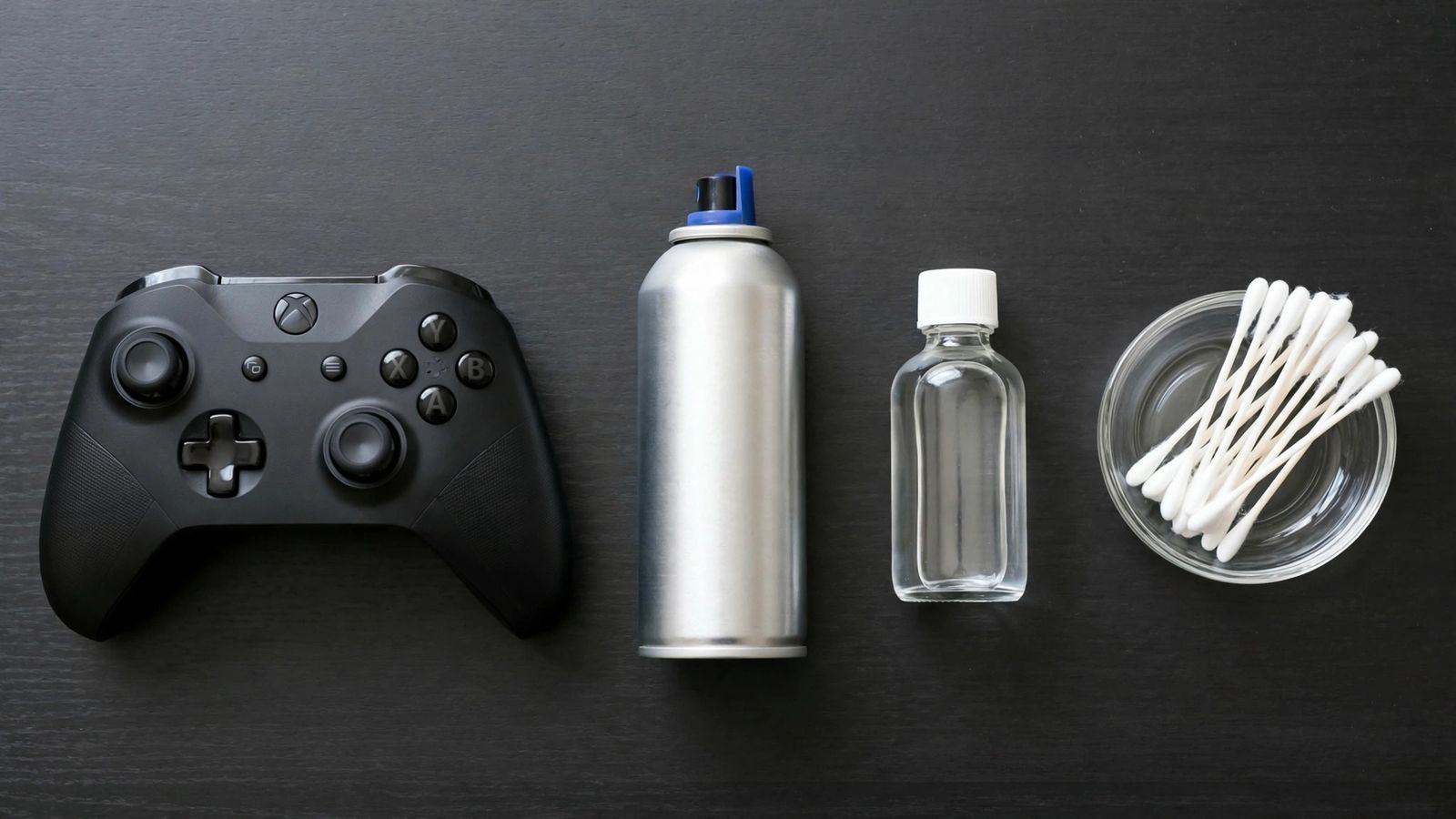
Understanding the cause changes the fix. Anything that only removes dust — compressed air, a swab, contact cleaner — can only help while dust is the problem. Once the carbon track itself is worn through, no amount of cleaning restores it. That distinction is the whole article: clean first, because dust is cheap to rule out, but do not keep cleaning a worn stick and expecting a different result.
What Should I Try First?
Do the free, warranty-safe steps in this order — they rule out software and connection glitches before you blame hardware.
- Update the firmware. Open the Xbox Accessories app on your console or Windows PC, select your controller, and install any firmware update. Microsoft has shipped firmware updates that improve stick calibration, and it costs nothing to rule out. Update before you try anything else.
- Restart and re-pair. Hold the Xbox button for 5–10 seconds until the controller turns off, wait a few seconds, then hold it again to power back on. If drift only appears over Bluetooth, re-pair cleanly and move interference sources (routers, USB 3.0 devices) away from the console.
- Test wired. Play a few minutes over a USB cable. If drift vanishes wired but returns on Bluetooth, you have a connection problem, not stick wear. If drift follows the controller to another device — a PC, a second console — the fault is in the controller itself.
One warning about a fix you will see recommended everywhere: recalibration cannot fix drift caused by normal wear and tear — Microsoft says so itself. It re-zeroes the stick's centre point, which helps when the centre has drifted slightly out of calibration. It does nothing for a worn carbon track. The next section shows how to run it properly, and where its limits are.
How Do I Recalibrate My Xbox Controller?
Use the Xbox Accessories app — it is Microsoft's only officially supported calibration path, and it is free on Xbox consoles and Windows 10/11. The recalibration tool re-zeroes a stick or trigger so a resting stick reads neutral again.
- Check your model first. The recalibration tool works on the current Xbox Wireless Controller and the Xbox Elite Wireless Controller Series 2 only. It is not available on the original Xbox One controller — if you have an original Xbox One pad, this option will simply not appear.
- Update firmware first. In the app, select your controller, install any firmware update, then open the controller's details (the "…" button) and choose Recalibration options.
- Pick one stick at a time. Select the left or right stick and follow the on-screen steps — the app walks you through rotating the stick and pressing the triggers so it can relearn where centre actually is. The new centre is written to the controller's firmware.
- Test again after. Run the browser gamepad tester or play a few minutes hands-off in the dashboard. If the reading is back near zero, calibration was the problem. If drift returns within days, the track is worn and calibration was only masking it.
Do not pay for a third-party "calibration" tool that promises to fix drift on any Xbox controller. The official tool covers the cases calibration can actually help, and no software can re-zero a physically worn sensor back to health. If a tool claims otherwise, it is selling you a workaround, not a repair.
Can I Fix Stick Drift Without Opening the Controller?
Yes, sometimes — for dust-caused drift. Power the controller off first, work gently, and let everything dry fully before you test. External cleaning will not void your warranty; opening the shell will, so this whole section stays on the safe side of that line.
- Compressed air. Hold the can upright and give short bursts around the stick base while tilting the stick to expose the gap and rotating it slowly. Keep bursts short and the can upright — tilting it can spray liquid propellant instead of air, and blasting straight in can push dust deeper rather than out.
- Isopropyl alcohol swab. Lightly dampen a cotton swab with isopropyl alcohol — moist, never dripping — and wipe around the stick base while rotating the stick in full circles. Let it dry completely before powering on. Do not pour or spray liquid into the controller, and keep it away from buttons and ports. One honest discrepancy: Microsoft's own cleaning guidance says 70% or less isopropyl alcohol on a cloth, while repair communities use 90% or higher because less water means less corrosion risk on the contacts. Either strength works for a surface wipe; what matters is that the swab is damp, not wet.
- Electronic contact cleaner (optional, careful). If air and a swab do not help, a short spray of quick-drying, plastic-safe electronic contact cleaner under the stick's rubber skirt, followed by working the stick in circles for about 30 seconds and drying for 10–15 minutes, is the strongest closed-shell clean. Use a product made for electronics only — never general WD-40 or a household lubricant, which can damage components and attract more grime.
Test after each step, not after all three at once, so you know what actually helped. If cleaning fixes it, expect relief measured in months rather than forever — and expect each repeat clean to last a little less as the track wears further. That is your signal: when you are re-cleaning every few weeks, the module is worn out, and it is time for the permanent-fix section below.
And skip the viral "fix" doing the rounds on Reddit: wrapping rubber bands around the sticks to pull them back to centre. It does not fix drift — it fights the symptom while adding constant sideways force to a stick that is already wearing out, which can accelerate the wear. A rubber band is a meme, not a repair.
| Fix | Time | Warranty-safe? | What it actually fixes |
|---|---|---|---|
| Firmware update + restart + re-pair | ~10 minutes | Yes | Software and connection glitches |
| Recalibration (Xbox Accessories app) | ~10 minutes | Yes | Off-centre calibration, not wear |
| Compressed air + swab clean | ~10 minutes | Yes | Dust and debris false readings |
| Contact cleaner under the skirt | ~20 minutes with drying | Yes, if used sparingly | Conductive dust on the sensor |
| Dead-zone increase (per game) | ~2 minutes | Yes | Hides mild drift; does not repair it |
| Warranty claim | Weeks with shipping | Yes — do this first if covered | Faulty controller, replaced or repaired |
| Stick module replacement | ~1 hour DIY, or a repair shop visit | No — voids warranty if opened | Worn potentiometer, permanently |
Can a Dead Zone Hide Stick Drift?
Yes, for mild drift — and it is the best short-term fix there is, as long as you treat it as a workaround, not a repair. The dead zone is the small area around the stick's centre where input is ignored. Widening it slightly means the stick's stray readings fall inside the ignored zone, so your character stops moving on its own.
Here is the Xbox-specific catch most guides get wrong: the Xbox Accessories app has no dead-zone slider for a standard Xbox Wireless Controller. On a standard pad you set the dead zone per game, usually under controller or aim settings in titles like Call of Duty, Fortnite, and Apex Legends. Raise the inner dead zone one notch at a time and stop as soon as the drift disappears while the controller sits untouched. Do not keep going: every extra step makes the first part of stick movement feel mushy and hurts fine aim. Elite Series 2 owners have it easier, with dead-zone profiles in the app that apply across games.
Be honest with yourself about what this costs. The wear underneath continues, so drift will slowly grow past whatever dead zone you set. A dead zone that buys you months of playable casual games is a win; a dead zone so large that aiming feels dead is a controller telling you it needs a real repair.
Can Stick Drift Be Fixed Permanently?
Yes — but only by replacing the worn part, or by switching to a stick design that has no wearing part. Cleaning, recalibration, and dead zones are all temporary or masking fixes. The permanent options are:
- Stick module replacement. A repair shop can desolder the worn potentiometer module and fit a new one. Doing it yourself requires soldering and voids any remaining warranty, so this is a repair-shop job for most people. Ask the shop about Hall effect or TMR replacement modules: they read stick position magnetically, with no wiper sliding across a carbon track, so the wear mechanism that caused your drift simply does not exist in them.
- A controller with magnetic sticks built in. If you are buying a replacement anyway, this is the smarter spend — see the shortlist in the next-but-one section. A controller whose sticks cannot drift the same way is a better investment than a like-for-like replacement that will wear out again.
- Microsoft's own replacement parts. Microsoft sells official replacement components for Xbox controllers, which a repair shop can fit. Out of warranty you will pay a service fee, and reports consistently put it close to the price of a new controller — so compare the quote against a new pad before committing.
Do not keep paying for the same repair twice. If a shop quotes module replacement at near the cost of a new controller, put that money toward a magnetic-stick controller instead.
Will Microsoft Fix Stick Drift for Free?
Only inside the warranty window — and for the standard controller that window is shorter than most guides claim. This is the one place in this guide where the internet disagrees with itself, so here is the honest picture:
- Standard Xbox Wireless Controller: 90 days. Microsoft's own warranty document for the Xbox controller states the limited hardware warranty lasts 90 days from the date of purchase or delivery. Many guides say one year — that is the console's warranty, not the controller's, and it is wrong for a standard pad.
- Elite Series 2: 1 year. Microsoft extended the Elite Series 2 warranty from 90 days to a full year after widespread drift complaints. If you own an Elite, you have substantially more cover.
- Check your own device, don't trust a headline figure. Register the controller and check its actual status at account.microsoft.com/devices — the page shows your coverage and lets you file a service request if you are eligible.
- Microsoft Complete extends cover up to three years against accidents and breakdowns, if you bought it. Without it, out-of-warranty drift means paying Microsoft's service fee or going to a repair shop.
- Do not open the controller before claiming. Opening the shell voids the warranty. Claim first, repair second — a denied claim costs you nothing, a voided one costs you the free replacement.
What to expect if you claim: Microsoft repairs or replaces the faulty controller, usually with a replacement unit rather than your exact pad back. Expect the process to take weeks including shipping, not days — plan for a spare controller in the meantime. Stick drift is a recognised fault, so a claim inside the window is not a fight; it is a form and a postage label.
When Should I Just Buy a New Controller?
When the drift is over 10% at rest, cleaning and recalibration have both failed, and the controller is out of warranty — or when you have already replaced one drifting pad and do not want to do it again. At that point the money is better spent on a controller whose sticks cannot drift the same way. Three Xbox-licensed options, all with magnetic sticks:
- GameSir G7 SE — the budget drift-proof pick. A wired Xbox-licensed controller with Hall effect sticks, the cheapest way into a pad that cannot develop potentiometer drift. Check price on Amazon
- GameSir G7 Pro — the step up. Officially Xbox-licensed with TMR sticks — a step beyond Hall effect — plus Hall effect triggers and extra remappable buttons. Note the standard edition is wired on Xbox (its wireless modes are for PC and Android); only the special Zenless Zone Zero and Wuchang editions work wirelessly on Xbox via a dongle. Check price on Amazon
- Razer Wolverine V3 Pro — the premium pick. Xbox-licensed, Hall effect sticks, six remappable buttons, and a wired tournament mode for competitive play. Check price on Amazon
Two traps to avoid when shopping. First, the 8BitDo Ultimate 2 is not Xbox-compatible — it works on PC, Android, and Apple devices only, despite looking like an Xbox pad. Second, the GameSir G7 Pro 8K PC editions are PC-only and will not authenticate on an Xbox console at all. Check the exact SKU and its product page before ordering, not just the model name.
One more honest note: the new Xbox Nano Controller (announced October 2026, $49.99, shipping from 4 November) is a smaller, cheaper first-party pad — but it still uses potentiometer sticks, so it is not a drift-proof purchase. And if you are thinking of waiting for a rumoured Elite Series 3 with Hall effect sticks: that is an unconfirmed leak from October 2026, not an announcement. Do not play with a drifting controller for months waiting for a pad that may not exist.
How Do I Stop the Next Controller Drifting So Soon?
You cannot make a potentiometer stick immortal, but you can slow the wear that kills it.
- Store it clean and covered. Dust is the part of drift you control. Keep the controller out of bags full of crumbs, wipe the stick bases monthly if you play daily (every few months for light use), and clean it straight away after eating or playing in a dusty room.
- Ease off the thumbs. Constant heavy pressure, resting your thumbs on the sticks when you are not playing, and aggressive stick-clicking all wear the track faster. It will not ruin your game to play lighter — it will extend the stick's life.
- Buy for your drift history. If you have killed two standard controllers this way, your next purchase decision is different: an Elite Series 2 buys you system-level dead-zone profiles, and a Hall effect or TMR controller buys you the wear-proof sensor. Paying for the right design once beats replacing the wrong one repeatedly.
None of this makes a potentiometer stick immortal. It buys you time — and time, with a controller you actually like, is the whole point.
Frequently Asked Questions
Can you fix Xbox stick drift without opening the controller?
Often, yes — for dust-caused drift. Updating firmware, running the recalibration tool in the Xbox Accessories app, cleaning around the stick base with compressed air and an isopropyl swab, and widening the in-game dead zone are all warranty-safe and need no tools. They cannot fix a worn carbon track, so if drift returns within weeks, the stick module itself needs replacing.
Does Microsoft fix stick drift for free?
Only inside the warranty window. Microsoft's own warranty document gives the standard Xbox Wireless Controller a 90-day limited warranty; the Elite Series 2 gets one year. Check your controller's actual status at account.microsoft.com/devices before opening it, because opening the shell voids the warranty.
How do I recalibrate my Xbox controller sticks?
In the Xbox Accessories app on your console or Windows PC, select your controller, install any firmware update, then open the controller's details and choose Recalibration options. Pick the left or right stick and follow the prompts. The tool works on the current Xbox Wireless Controller and the Elite Series 2 only — not on the original Xbox One controller — and Microsoft notes it cannot fix drift caused by normal wear and tear.
Can stick drift be fixed permanently?
Only by replacing the worn stick module, or by switching to a controller with Hall effect or TMR sticks, which read position magnetically with no wearing contact. Cleaning, recalibration, and dead zones are temporary or masking fixes — they buy time, they do not repair a worn potentiometer.
Does cleaning fix stick drift?
Sometimes, for dust-caused drift. Compressed air and an isopropyl swab around the stick base can clear the conductive dust that causes false readings. It cannot restore a worn carbon track, so expect a cleaning fix to last months rather than forever, with each repeat lasting a little less. When you are cleaning every few weeks, the module is worn out.
Can I fix Xbox controller drift without soldering?
Not permanently. Cleaning, recalibration, and dead zones need no soldering, but they are temporary. A permanent module replacement requires desoldering the old potentiometer module, so it is a repair-shop job for most people — or a reason to buy a controller with magnetic sticks instead.
Why is my Xbox controller drifting in only one game?
That is almost certainly the game's settings, not your controller. Check that game's dead-zone and sensitivity settings first — Xbox Support itself points to dead zones when drift shows up in one title only. If the stick also drifts in the dashboard and in a second game, it is hardware drift, and the fixes in this guide apply.