How the winter tyre timing check works
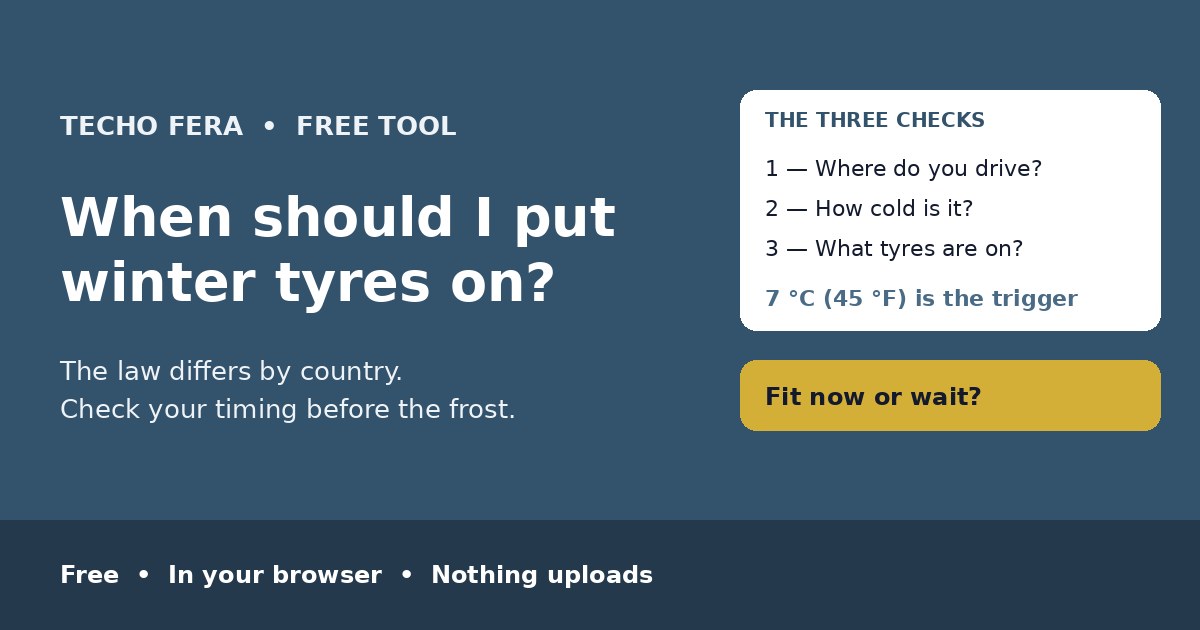
The trigger is temperature, not snow: fit winter tyres when daytime highs consistently stay below 7 °C (45 °F), because summer tyre rubber hardens below that point and loses grip even on a dry road. The law can force the timing too, and it differs by country: Germany has no dates — winter tyres are required whenever the road is wintry — Austria runs 1 November to 15 April in wintry conditions, France runs 1 November to 31 March in its mountain areas, Italy runs 15 November to 15 April on signed roads, Sweden runs 1 December to 31 March in winter conditions, and Quebec runs 1 December to 15 March. This checker asks seven questions — where you drive, the daytime high, the overnight low, the tyres fitted now, how you drive, whether your winter set is ready, and optionally the first frost or snow forecast — and gives one verdict: fit them now, book the swap within two weeks, wait, your all-season tyres already count, or they are already on.
To use it:
- Pick where you drive. Choose it from the list — the United Kingdom, Ireland, Germany, Austria, France, Italy, Sweden, Switzerland, Canada, Quebec, or the northern or southern USA. The list covers 12 regions, grouped by area: UK and Ireland, Europe, and North America.
- Say what the daytime high is doing. Consistently below 7 °C (45 °F), hovering around 7–10 °C (45–50 °F), still above 10 °C (50 °F), or not sure. Check the forecast for the next week, not just today — one cold day does not count.
- Say what the overnight low is doing. Below freezing, 0–5 °C, above 5 °C, or not sure. Frost forms overnight, and early-morning driving is when the roads are coldest.
- Say what tyres are fitted now. Summer tyres, all-season tyres with M+S only, all-season tyres with the Alpine symbol, winter tyres already fitted, or not sure. Look at the sidewall: winter tyres carry the Alpine symbol (a mountain with a snowflake).
- Say how you drive. Every day, most days, rarely, or a mountain trip planned in the next two weeks. A daily commute in the cold matters more than a rare short trip.
- Say whether your winter set is ready. A set is ready when the tread is 4 mm or more, the Alpine symbol is on the sidewall, and the tyres are under ten years old. A worn set grips little better than a summer tyre.
- Optionally, enter the first frost or snow forecast date. The checker works out how many days you have left. Leave it blank if you do not know it.
The law at a glance
| Region | When | What counts | Why it matters |
|---|---|---|---|
| Germany | Whenever the road is wintry | Alpine symbol only | No dates — the law switches on with the weather; M+S-only stopped counting on 1 Oct 2024; fine 60 euros + 1 point |
| Austria | 1 Nov – 15 Apr, wintry roads | M+S or Alpine, 4 mm | All four wheels, in snow, slush or ice; fine 35 euros, up to 5,000 euros if you endanger others |
| France (mountains) | 1 Nov – 31 Mar | 4 Alpine tyres, or chains | 34 mountain departments, whatever the weather; M+S-only stopped counting on 1 Nov 2024 |
| Italy (Alpine roads) | 15 Nov – 15 Apr | Winter tyres, or chains | Only on signed roads; Aosta Valley from 15 Oct; fines 41–85 euros |
| Sweden | 1 Dec – 31 Mar, winter conditions | Winter tyres, 3 mm | When snow, ice, slush or frost is present; 3 mm minimum tread |
| Quebec | 1 Dec – 15 Mar | Alpine symbol required | Every vehicle, no exceptions for the season |
| UK & Ireland | No law | Your call | The 7 °C rule is the trigger — no legal deadline |
| Switzerland | No law | Your call | No legal deadline, but your insurer can hold unsuitable tyres against you |
What makes this checker different
The pages that rank for this search are dealer blogs and tyre-maker guides — and every one of them gives you the same static answer: "below 7 °C". None of them asks where you drive, what the overnight low is doing, what tyres are fitted now, how you drive, or whether your winter set is ready — and none of them applies the law for your country. The one dedicated timing tool that does exist gives you a calendar date for a city, from the forecast alone: it does not know whether you already have all-season tyres with the Alpine symbol, whether a mountain trip is coming, or whether your winter set is worn. There is no free, standalone checker that takes a region, temperatures, tyres, driving and readiness and gives you one verdict — fit now, book the swap, wait, or your all-season tyres already count — with the law, the 7 °C trigger and the next steps. This page is that answer: seven questions, an instant verdict for your exact situation, the blockers named, and the next steps. It is general information, so it says plainly what it cannot know: it cannot see your tyres, your thermometer or your forecast, and where the guidance is thinner — how long the cold will last, how your tyres are really wearing — it tells you to check instead of guessing.
When is this the right check?
When the mornings have turned cold and you are not sure whether this weekend is the weekend to book the swap — because the trigger is a daytime high that stays below 7 °C, not the first snow, and fitting a week early costs little while fitting a week late costs grip. When you are driving to Germany, Austria or France this winter and you do not know whether your tyres count — because M+S-only tyres stopped counting in Germany on 1 October 2024 and in France on 1 November 2024, and the fine in Germany is 60 euros plus a point. When you already run all-season tyres and wonder whether you need a second set at all — because an all-season tyre with the Alpine symbol already counts as a winter tyre, and this checker says so instead of selling you a swap. And when the legal window where you drive is about to start — because Austria opens on 1 November, France on 1 November, and Quebec on 1 December, and the checker counts the days for you.
Honest limitations
General information, not legal advice
This checker cannot see your tyres, your thermometer or your forecast. It cannot tell you how cold it really is where you drive, how much tread your tyres really have, or whether the law has changed since November 2026. Check the official sources of the country you are driving in before you travel.
The cold-weather score is an estimate
The checker adds up how cold it is, how demanding the driving is, and how soon frost is coming into a score out of 35. That score is the checker's own estimate, not a published figure — it exists so the verdict is not one number from one rule. The 7 °C trigger and the legal dates are the facts; the score is the judgement.
Not sure means the cautious answer
If you are not sure what tyres are fitted, or you have not checked the forecast, the checker does not guess — it tells you to look at the sidewall and check the forecast before you decide. That is deliberate: the wrong mistake is to drive into a frost on summer tyres you thought were winter tyres.
The 7 °C rule is a rule of thumb
Tyre makers agree on about 7 °C (45 °F), but it is a guide, not a cliff edge: summer tyres do not suddenly fail at 6.9 °C, and winter tyres do not suddenly wear out at 7.1 °C. What matters is the pattern — highs that stay below 7 °C for a week — not a single cold morning.
All four tyres, every time
Winter tyres must be fitted as a matching set of four. Mixing winter tyres with all-season or summer tyres gives uneven grip front to back, which makes the car harder to control when you need it most. This checker assumes a full set — if you only have two, buy the other two before you fit them.
Rules from Nokian, Michelin, DEKRA, TUV Nord, EVZ, ADAC and the Austrian transport ministry, dated November 2026
The rules here are the winter-tyre timing rules and laws as they read in November 2026: the 7 °C (45 °F) switch point; Germany's situational requirement with the Alpine symbol since 1 October 2024; Austria 1 November to 15 April at 4 mm; France 1 November to 31 March in its mountain areas; Italy 15 November to 15 April on signed roads; Sweden 1 December to 31 March; Quebec 1 December to 15 March; and the 1.6 mm legal tread minimum with 4 mm recommended. Laws change: recheck with the official sources before you travel.