How the summer tyres in winter check works
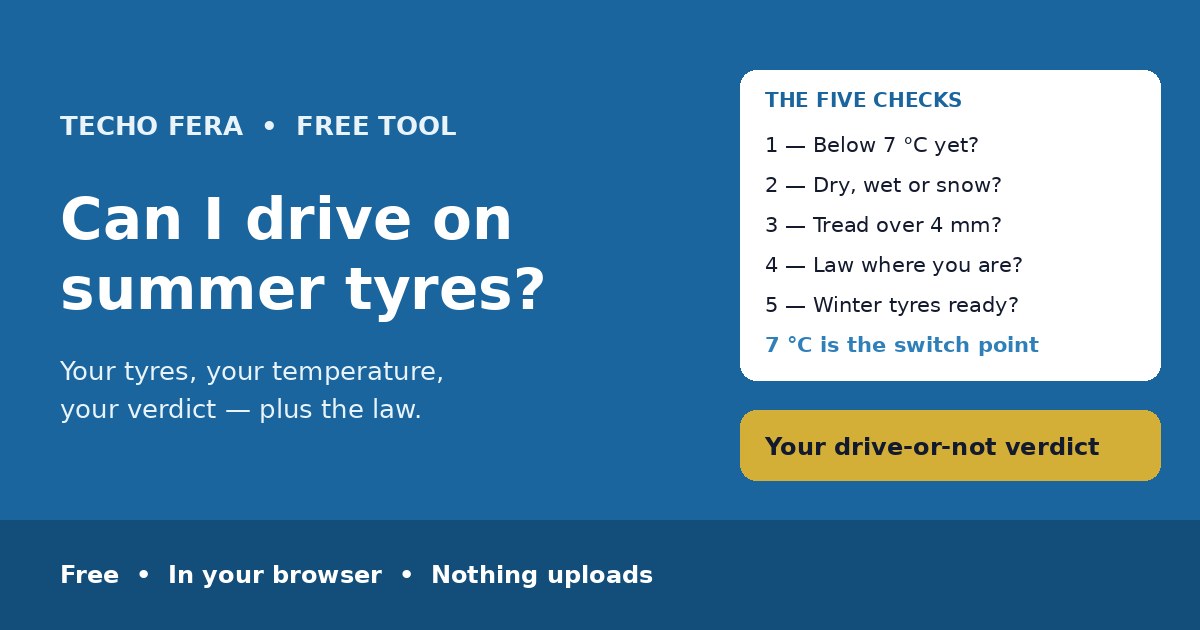
Summer tyres are made for warm weather. Their rubber is designed to stay flexible on hot tarmac, with shallow grooves and almost no siping for dry and wet grip at speed. That same rubber hardens as the temperature falls — and at 7 °C (45 °F) it has hardened enough that winter tyres start to outperform it. That is the switch point every tyre maker quotes, and it is the number this checker is built on. But the right answer is not the same for every driver. A mild dry day at 10 °C is fine on summer tyres. A wet road at 2 °C in a rear-wheel-drive car is not. A tread depth below 1.6 mm is illegal in the UK and most of Europe whatever the season. And in Germany, Austria, France, Italy, Sweden and Quebec, the law can forbid summer tyres outright in winter conditions. This checker asks twelve questions — where you are driving, the temperature, the road surface, the journey, the tread depth, the age of the tyres, the drivetrain, the forecast, whether winter tyres are available, your experience, how urgent the trip is, and the overnight low — and turns the answers into a risk score out of 35, a drive-or-not verdict, a stopping-distance estimate and a step-by-step plan.
To use it:
- Say where you are driving. Germany, Austria, France, Italy, Sweden and Quebec require winter tyres in winter conditions — the law changes the answer, and the checker names the rule for your country.
- Say what the temperature is. 7 °C (45 °F) is the switch point: below it, summer-tyre rubber hardens and winter tyres start to outperform it, on dry roads as well as wet ones.
- Say what the roads are like. Dry tarmac, wet roads, slush, snow or ice — summer tyres lose the most grip on snow and ice, but a cold wet road is already worse than a warm dry one.
- Say what the journey is. A short local trip at low speed is forgiving; a motorway trip at 70 mph leaves no margin; a mountain pass is where grip runs out first.
- Measure the tread. The legal minimum is 1.6 mm, and at least 4 mm is recommended for winter driving. A tread-depth gauge or a 20p coin tells you in a minute.
- Say how old the tyres are, what the drivetrain is, what the forecast says, whether you have winter tyres, how much experience you have, how urgent the trip is, and what the overnight low was. Old rubber hardens further; rear-wheel drive loses traction first; heavy snow or freezing rain changes the answer; a set on spare wheels is the quickest fix; and a night below freezing can leave black ice in the morning even on a dry road.
- Read the verdict — and the plan. The verdict tells you whether to drive, drive only if you must, fit your winter tyres first, or not drive at all. The plan lists the steps in order, so you can act on them one by one.
What makes this checker different
The pages that rank for this search are guides — a tyre maker's blog, a dealer blog, a car magazine. Every one of them gives you the same flat answer — no, don't do it — and leaves you to judge your own tyres, your own temperature and your own road. None of them asks how much tread you have left, whether you have winter tyres on spare wheels, or which country you are driving in — and none of them tells you what to do when the answer is "I don't know". This page is that answer: twelve questions, a risk score that changes with the temperature, the road, the tread, the age, the drivetrain and the forecast, the law for your country, and a plan that stops at the step you cannot do and tells you what to do instead. It is a planning aid, so it says plainly what it cannot know: it cannot see your tyres, and where your answers are uncertain it says so instead of guessing.
When is this the right check?
When the first cold snap arrives and you are not sure whether the summer tyres still on the car are safe — because the answer depends on the temperature, not the calendar. When you are driving to another country for the winter — because the law changes at the border, and Germany, Austria, France, Italy, Sweden and Quebec all have winter-tyre rules. When you have winter tyres sitting in the garage — because the checker tells you to fit them instead of telling you not to drive. And when the trip is optional — because an optional trip on a risky day is a trip to postpone.
Honest limitations
A planning aid, not tyre advice
This checker cannot see your tyres, your tread or your forecast. It cannot tell you whether a specific tyre is cracked, perished or damaged, or whether your tyre pressures are right. If a tyre is cracked, bulging or losing pressure, do not drive on it — get it inspected by a tyre fitter.
The stopping distance is an estimate
The stopping-distance figure on this page is the checker's own rough estimate, not a measured figure. It is there to show how fast the margin shrinks as the temperature falls and the road worsens — not to tell you exactly how many metres you need. The real number depends on your car, your tyres, your brakes and the road.
All-wheel drive helps you go, not stop
All-wheel drive helps you pull away on a slippery road, but it does nothing for braking: every car stops on the same four tyres. A four-wheel-drive car on summer tyres in snow stops no sooner than a front-wheel-drive car on the same tyres — and its driver is more likely to be going faster when it matters.
The law has dates and details
The winter-tyre rules named here have dates, exceptions and local details — France's rule covers 48 mountain départements, Italy's applies on signed roads, Germany's follows the weather rather than the calendar. The checker names the rule as it reads in November 2026; check the current rule for your exact route before a long journey.
Old rubber hardens too
Cold is not the only thing that hardens a tyre: rubber hardens with age as well. A ten-year-old summer tyre is worse in the cold than a new one, even with tread to spare. Tyre makers say to have tyres inspected annually once they are five or six years old, and to replace them at ten years at the latest.
Rules from the tyre makers and the law, dated November 2026
The rules here are the published guidance as they read in November 2026: Michelin, Continental, GT Radial and Nokian on the 7 °C switch point, the winter-tyre laws of Germany, Austria, France, Italy, Sweden and Quebec, and the 1.6 mm legal minimum and 4 mm winter recommendation for tread. Guidance and laws change: recheck with those sources if anything about your plans changes.