How the antifreeze check works
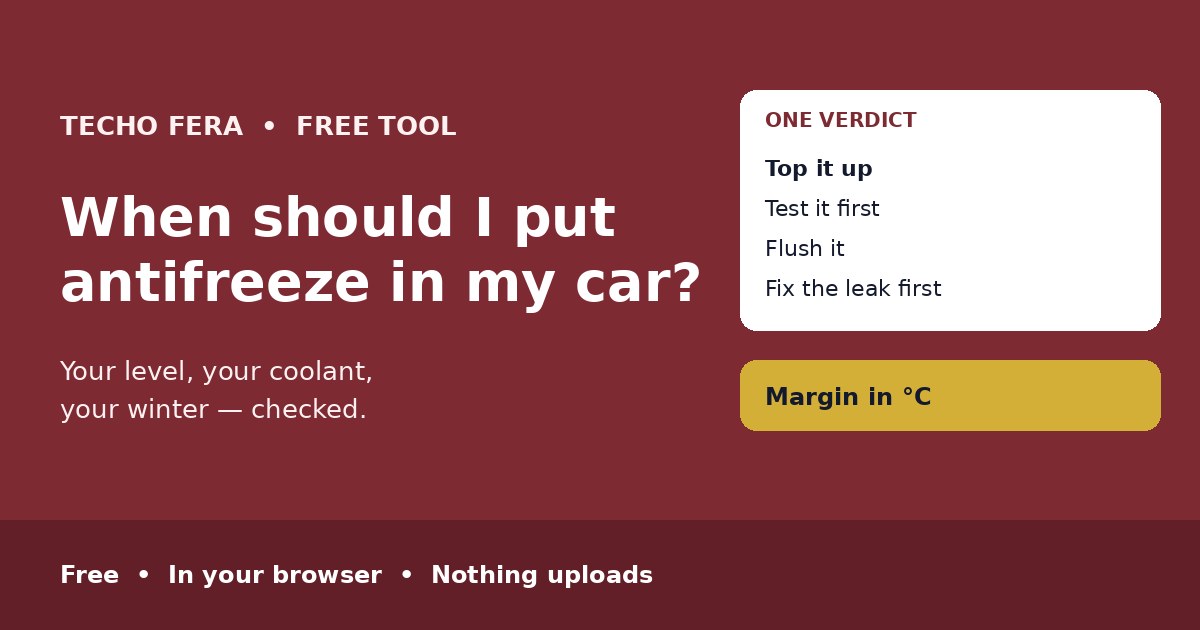
The rule is the cold engine, not the calendar. A web page cannot see inside your cooling system — it has no dipstick, no hydrometer and no nose for a sweet coolant smell — so it works from the state you report. Antifreeze does two jobs besides carrying heat: it must not freeze in winter, which could crack the block, and it must not boil in summer. A 50% antifreeze and 50% distilled-water mix protects to about -34°C (-30°F) for most climates, and up to 60% antifreeze protects to about -45°C (-50°F) in very cold regions — but only in the right proportion, and only if the coolant's protective additives are still good. This checker turns your answers — the reservoir level, the coolant's colour and age, whether its freeze protection has been tested, any leak signs, the coldest temperature your winter reaches, whether you know the exact coolant type, and whether the engine is cold — into one verdict: top it up, leave it alone, test it first, flush it, or fix the leak first, with the protection margin in degrees.
To use it:
- Check the level with the engine cold. Park on level ground and wait at least an hour after driving. The reservoir is the translucent plastic tank near the radiator, with MIN and MAX marks on its side. The level should sit between them — below MIN means fluid must go in, above MAX means take a little out, and an empty reservoir means the coolant went somewhere.
- Look at the coolant. Its usual colour is green, orange, pink or blue, and it should look clear. Rusty-brown, murky or oily coolant means its protective additives are spent; milky coolant, like a milkshake, can mean oil is getting into the system — a serious engine problem, not a top-up job.
- Say how old it is. A full flush is due every 30,000–60,000 miles or every 2–5 years, depending on the vehicle and the coolant type. The last service invoice usually says when it was changed — coolant older than 5 years is due a flush even when it still looks fine.
- Say whether its protection has been tested. A hydrometer or refractometer tells you what temperature the mix protects to. A 50/50 mix should protect to about -30°C; if yours protects only to -10°C, it can freeze on a cold night. Never tested means nobody knows — and that is the checker's most common verdict.
- Report any leak signs. A cooling system is a closed loop: the level should not keep dropping. A coloured puddle under the car, a sweet smell, a warning light, a gauge in the red, or topping up more than once a month all mean coolant is escaping — and the leak has to be fixed first, because topping up a leaking system just buys a few days.
- Say whether you know the exact type, whether the engine is cold, and the cold you expect. Colour does not equal type — the exact specification (IAT, OAT or HOAT) is in the owner's manual, and the wrong chemistry can damage the system. Never open the cap while the engine is hot. And the freeze protection has to beat the coldest night your winter reaches — use the forecast low for your area, for example -10°C (14°F).
The scenarios at a glance
| Scenario | Verdict | Why |
|---|---|---|
| Level below MIN, everything else fine | Top it up | Correct premix to MAX, engine cold |
| Level fine, tested to -30°C, coldest night -10°C | Good for winter | 20°C of protection to spare |
| Protection never tested | Test it first | A weak mix freezes at -10°C; a 50/50 mix holds to -30°C |
| Rusty, murky or over 5 years old | Flush it | Additives spent — topping up will not fix it |
| Topping up more than once a month | Fix the leak first | A closed system should not keep losing coolant |
| Engine hot | Wait until it is cold | Opening a hot cap can spray boiling coolant |
| Level below MIN but type unknown | Find the type first | Colour does not equal type |
| Tested to -10°C, winter reaches -20°C | Drain and refill | 10°C short — 50/50 protects to about -34°C |
What makes this checker different
The pages that rank for this search are guides — The Daily Automotive, and two long guides from a parts marketplace — and they all give the same static answer: add antifreeze when the engine is cold and the level is below MIN. None of them works out what that means for your car, your coolant's condition, or the cold your winter will reach. The one interactive tool on the first page, a coolant mix calculator, answers a different question: how much antifreeze and water to mix for a target freeze point, and how much to drain and replace to correct a weak mix. It does not check your level, your coolant's colour or age, leaks or type, and it gives no verdict. The general winter-readiness checklist on this site asks one coolant question among fourteen — it cannot tell you whether to top up, test, flush or fix a leak first. There is no free, standalone checker that takes your level, colour, age, tested protection, leak signs, expected cold, type knowledge and engine temperature and returns one verdict with a protection margin in degrees and a step-by-step plan. This page is that answer: eight questions, an instant verdict for your exact car, the blockers named, and the next steps.
When is this the right check?
When autumn arrives and the first freeze is coming — September to November is the check window, and coolant should be inspected at least twice a year. When the reservoir looks low and you are not sure whether to top it up or leave it — because the checker tells you which, and with what type. When the coolant looks wrong — rusty, murky or milky — and you need to know whether a top-up will do or a flush is due. When you have been topping up again and again — because the checker names the leak rule plainly. When the heater stops working properly or a warning light comes on — because those are the signs that mean act now. And when you have never tested the protection — because the checker tells you the one test that matters before the cold arrives.
Honest limitations
The protection margin is an estimate, not a measurement
The margin is the checker's own estimate, built from the tested protection figure you enter and the cold you expect. It is only as good as your test: a hydrometer reading taken from a cold reservoir is the real number, and this checker cannot take it for you. If the protection was never tested, the checker says so instead of guessing a mix.
The checker cannot see your car
A web page cannot see inside your cooling system — it has no dipstick, no hydrometer and no nose for a sweet coolant smell. Everything here rests on what you report: the level you read, the colour you see, the age you remember. If the level cannot be seen, the checker says it cannot tell, rather than guessing.
Coolant types vary by car
IAT, OAT and HOAT are families, not single products — and some makers specify their own exact formula. The checker tells you to match the specification in your owner's manual, because the manual has the final word for your car. Never mix types unless the manufacturer states they are compatible.
The 50/50 figure is typical, not universal
A 50/50 mix protecting to about -34°C (-30°F) is the usual figure for ethylene-glycol antifreeze, and 60/40 to about -45°C (-50°F) in very cold regions — but propylene-glycol coolants behave differently, and the inhibitor package matters too. Always check the label of the product you buy.
A leak verdict is a pointer, not a diagnosis
The checker can say coolant is escaping — a puddle, a smell, frequent top-ups — but it cannot say where from: a split hose, the radiator, the water pump or a gasket all look the same from the driver's seat. A mechanic has to find it, and the checker says so.
Rules from the guides, dated November 2026
The rules here are the coolant guidance as it reads in November 2026: the cold-engine rule, the 50/50 mix, the 30,000–60,000 mile and 2–5 year flush interval, and the leak-first rule. Specifications change by model year: recheck your manual when anything is unclear.