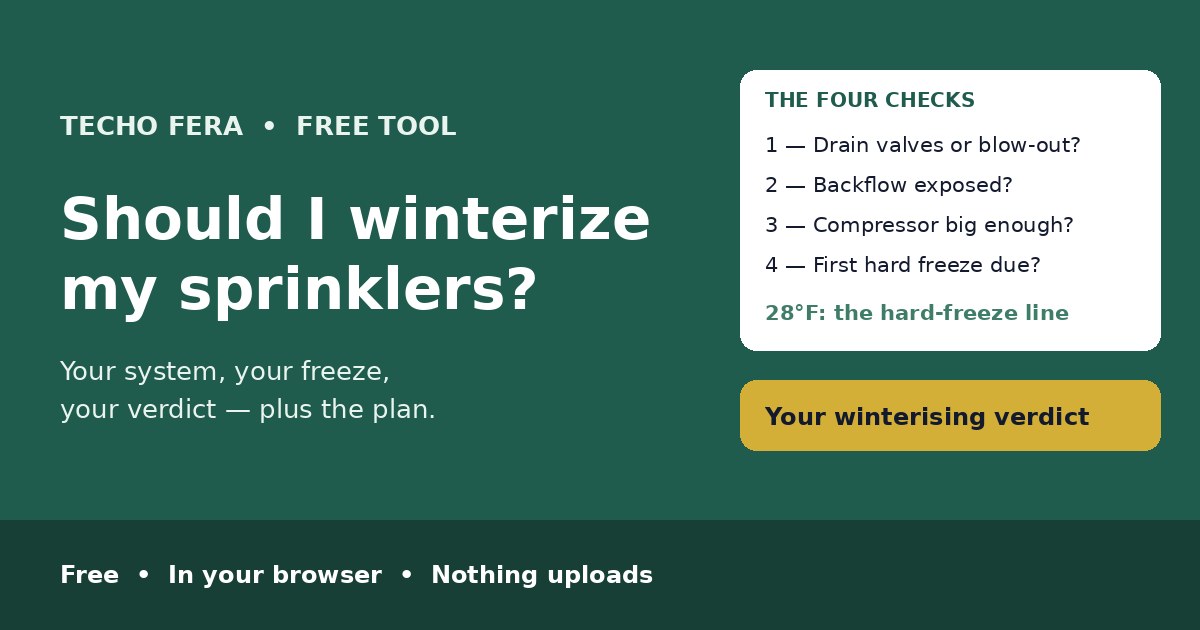
How the sprinkler winterising check works
Water expands about 9% when it freezes, and inside a sealed irrigation line there is nowhere for that expansion to go — so it goes into the pipe wall, the fittings and the brass backflow preventer, and the damage only shows when you turn the water back on in spring. But the right answer is not the same for every system. A system with manual or automatic drain valves can be drained without a compressor. A system with no drain valves needs a blow-out with compressed air, capped at 50 psi for PVC pipe and 80 psi for polyethylene pipe, connected downstream of the backflow preventer — never through it. And a warm-climate system needs no blow-out at all, only its exposed backflow wrapped on a rare cold night. This checker asks twelve questions — where you are, when the first hard freeze is due, what kind of system it is, how it drains, where the backflow preventer sits, what compressor you have, what the pipes are made of, what the controller is doing, whether the supply is shut off, whether you have already winterised it, and whether anything already looks damaged — and turns the answers into a verdict and a step-by-step plan, in the order you should do the job.
To use it:
- Say where you are and when the first hard freeze is due. A hard freeze is the first forecast night of 28°F (−2°C) or colder. Do the job before it arrives. If the first freeze has already passed and the system was not winterised, the checker flags it: a split may already be there, hidden underground.
- Say what kind of system it is. An in-ground system has buried pipes and zones on a controller; a drip system has no pop-up heads; hose-end sprinklers have no buried pipes at all, so there is nothing to blow out.
- Say how the system drains. Manual drain valves sit at the low points and you open them by hand. Automatic drain valves open when the pressure drops. If there are none, the lines can only be blown out — and a small home compressor cannot move enough air to do it.
- Say where the backflow preventer sits. It is the brass or plastic assembly above ground near where the system ties into the water supply. It holds water, sits exposed, and is the first thing to crack — and the most expensive part to replace.
- Say what compressor you have. Air flow is what pushes the water out, not pressure. A large compressor, or a rented one, can do the job; a small home compressor cannot, however high its gauge reads.
- Answer the rest — pipe material, controller, supply, already winterised, damage signs, how many zones. The pipe material sets the pressure cap; the controller and the supply decide the shutdown; damage signs decide whether to check first; the zone count works out the time — about 10 minutes per zone.
- Read the verdict — and the plan. The verdict tells you whether to drain it, blow it out, book a professional, or just wrap the backflow. The plan lists the steps in order, so you can walk outside and do them one by one.
What makes this checker different
The pages that rank for this search are how-to guides — a water district, two landscaping companies, a sprinkler installer, a home-inspection firm. Every one of them gives you the same four steps and leaves you to judge your own system. None of them asks how your system drains, what compressor you have, or what your pipes are made of — and none of them tells you what to do when the answer is "I don't know". This page is that answer: twelve questions, a verdict that changes with the drain method and the compressor, and a plan that stops at the step you cannot do and tells you what to do instead. It is a planning aid, so it says plainly what it cannot know: it cannot see your pipes, and where your answers are uncertain it says so instead of guessing.
When is this the right check?
When autumn arrives and you are not sure whether to bother — because the answer depends on the system, not the season. When a hard freeze is forecast this week — because a do-it-yourself blow-out takes about 10 minutes per zone and the window is short. When you have just moved into a house and do not know how the system drains — because a system with drain valves needs no compressor at all, and a system without them needs a blow-out or a professional. And when the first freeze has already passed — because the checker tells you the damage may already be there, hidden underground, and the spring check is the moment it shows.
Honest limitations
A planning aid, not irrigation advice
This checker cannot see your pipes, your backflow preventer or your forecast. It cannot tell you whether a specific line is already frozen, or whether your backflow preventer is cracked. If you can see water where it should not be, shut off the irrigation supply and call a sprinkler professional.
The split you cannot see
The damage from a frozen irrigation system almost never happens where you can see it. It happens underground, in a fitting or a valve, where the split pipe sits quietly all winter and then sprays water on the first warm day in spring. That is why the spring check — run each zone by hand and look for geysers, soggy patches and heads that do not pop up — matters as much as the winterising.
Pressure is not the whole story
A small home compressor can show 100 psi on its gauge and still leave the lines full of water. Air flow is what pushes the water out, and a small compressor cannot move enough air. Too much pressure is worse than too little: it cracks heads and valves. Stay at 50 psi for PVC pipe and 80 psi for polyethylene pipe, and never run the compressor with all zones closed.
Never blow air through the backflow preventer
The backflow preventer is the most expensive single component above ground, and the first to crack. Connect the compressor downstream of it, using the blow-out fitting if your system has one. Drain the backflow and leave its test cocks and ball valves half open, so any residual water has somewhere to expand.
Compressed air can hurt you
Compressed air can cause serious injury, including serious eye injury from flying debris. Wear eye protection, keep your face away from the heads while a zone is being blown out, and never let a zone run dry on air for long.
Rules from the extension services and the sprinkler makers, dated November 2026
The rules here are the published guidance as they read in November 2026: the Colorado State University Extension fact sheet on winterizing irrigation, the 28°F hard-freeze definition used by water departments and the Farmers' Almanac, the sprinkler makers' manuals (Rain Bird, Hunter) on blow-out pressure limits, and the backflow guidance from irrigation professionals. Guidance changes: recheck with those sources if anything about your plans changes.