How the outdoor tap check works
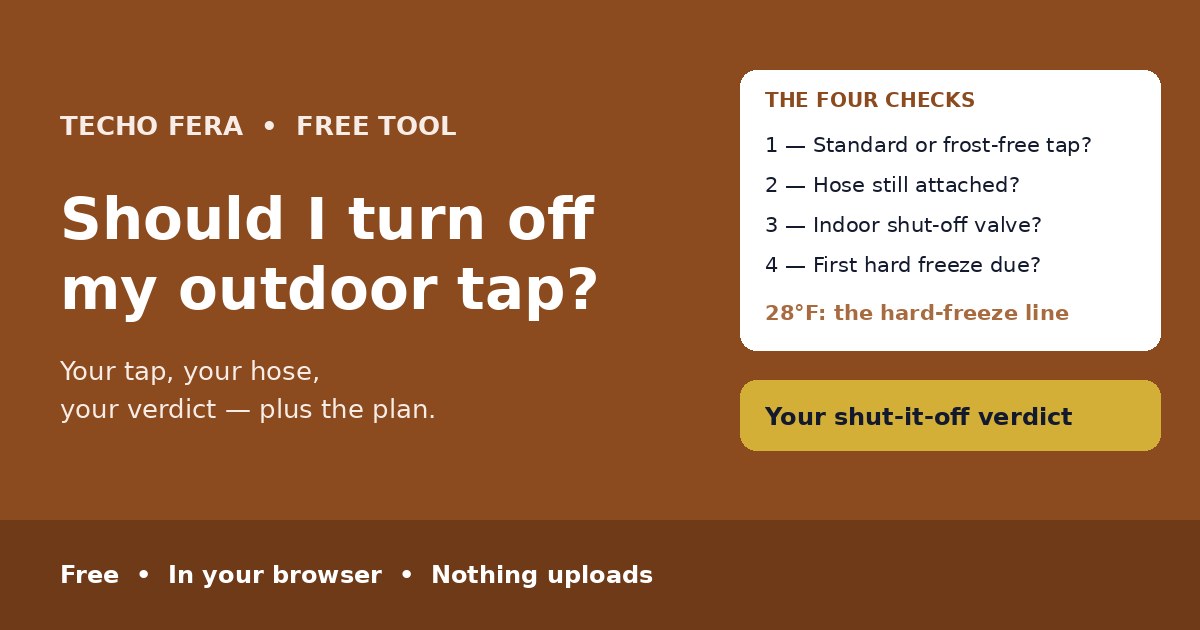
Outdoor taps are the first thing to freeze when the temperature drops — the American Red Cross lists hose bibs first among the pipes that freeze most often. But the right answer is not the same for every tap. A standard tap shuts the water off right at the wall, leaving water in the tap and in the pipe behind it. A frost-free tap shuts the water off 150 to 350 millimetres inside the heated house, and the barrel drains itself when you close it — but only if the hose is off and it was installed with a slight downward pitch to the outside. And a tap with no indoor shut-off valve cannot be drained at all, whatever type it is. This checker asks ten questions — the tap type, whether a hose is still attached, whether there is an indoor valve, when the first hard freeze is due, whether the tap has a cover, where the supply pipe runs, and whether you have already winterised it — and turns the answers into a verdict and a step-by-step plan, in the order you should do the job.
To use it:
- Say what kind of tap it is. A frost-free tap has a long barrel running back through the wall and the handle usually sits on a slight angle. A standard tap is short, with the valve right at the wall. If you are not sure, say so — the checker treats an unknown tap as a standard tap, which is the safe default, and tells you how to tell.
- Say whether a hose is still attached. A hose, splitter or timer left on is the most common reason outdoor taps split. It stops a frost-free tap draining and turns any tap into a closed pipe full of water.
- Say whether there is an indoor shut-off valve. Look on the pipe just inside the wall from the tap, often in the basement, crawl space or utility room ceiling. Without a valve, a standard tap cannot be drained — the checker says so plainly instead of giving you a draining plan you cannot follow.
- Say when the first hard freeze is due. A hard freeze is about 28°F (−2°C) held for four hours or more. Do the job before it arrives. If the first freeze has already passed and the tap was not winterised, the checker flags it: a split may already be there, hidden inside the wall.
- Answer the rest — cover, pipe run, already winterised, split before, how many taps, where you are. The cover and the pipe run decide the extra steps; a previous split raises the stakes on the spring check; the tap count works out the time — about 10 minutes per tap.
- Read the verdict — and the plan. The verdict tells you whether to shut it off, just take the hose off, fit a cover, or get a valve fitted first. The plan lists the steps in order, so you can walk outside and do them one by one.
What makes this checker different
The pages that rank for this search are how-to guides — a garden-supply store, two local plumbers, a product-review site. Every one of them gives you the same four steps and leaves you to judge your own tap. None of them asks what kind of tap you have, whether a hose is still attached, or whether there is an indoor valve — and none of them tells you what to do when the answer is no. This page is that answer: ten questions, a verdict that changes with the tap type, and a plan that stops at the step you cannot do and tells you what to do instead. It is a planning aid, so it says plainly what it cannot know: it cannot see your tap, and where your answers are uncertain it says so instead of guessing.
When is this the right check?
When autumn arrives and you are not sure whether to bother — because the answer depends on the tap, not the season. When a hard freeze is forecast this week — because the job takes about 10 minutes per tap and the window is short. When you have just moved into a house and do not know what kind of tap it is — because a frost-free tap with the hose off needs almost nothing, and a standard tap with no valve needs a plumber. And when the first freeze has already passed — because the checker tells you the damage may already be there, hidden inside the wall, and the spring check is the moment it shows.
Honest limitations
A planning aid, not plumbing advice
This checker cannot see your tap, your pipes or your forecast. It cannot tell you whether a specific pipe is already frozen, or whether your tap was installed with the right pitch. If you can see frost on a pipe, or water where it should not be, call a plumber.
The split you cannot see
The damage from a frozen hose bib almost never happens at the spout. It happens half a metre back, inside the wall, where the split pipe sits quietly all winter and then delivers mains pressure into the wall cavity on the first warm day in spring. That is why the spring check — turn it on while someone watches the wall inside — matters as much as the winterising.
Frost-free does not mean freeze-proof
A frost-free tap only drains itself if it was installed with a slight downward pitch to the outside. A unit fitted dead level, or pitched slightly inward, holds water in the barrel no matter how carefully you shut it off. If yours does not dribble briefly after closing, treat it as a standard tap and shut off the supply indoors.
A cover does not replace draining
An insulated foam cover helps, and insulating a supply run through an unheated space buys hours in a freeze. But neither empties the line. For a standard tap, the draining is the job — the cover is the finishing touch, not the fix.
Never thaw with a flame
If a pipe is already frozen, close the indoor valve if you can reach it safely, so a split pipe cannot flood the wall as it thaws. Never use a torch or an open flame against the house. Leave the thawing to a plumber if you cannot find or safely warm the frozen section.
Rules from the Red Cross and the tap makers, dated November 2026
The rules here are the published guidance as they read in November 2026: the American Red Cross on which pipes freeze and how to drain an outdoor faucet, the tap makers on how a frost-free sillcock drains and why a hose left attached defeats it, and the 28°F hard-freeze definition used by city water departments. Guidance changes: recheck with those sources if anything about your plans changes.