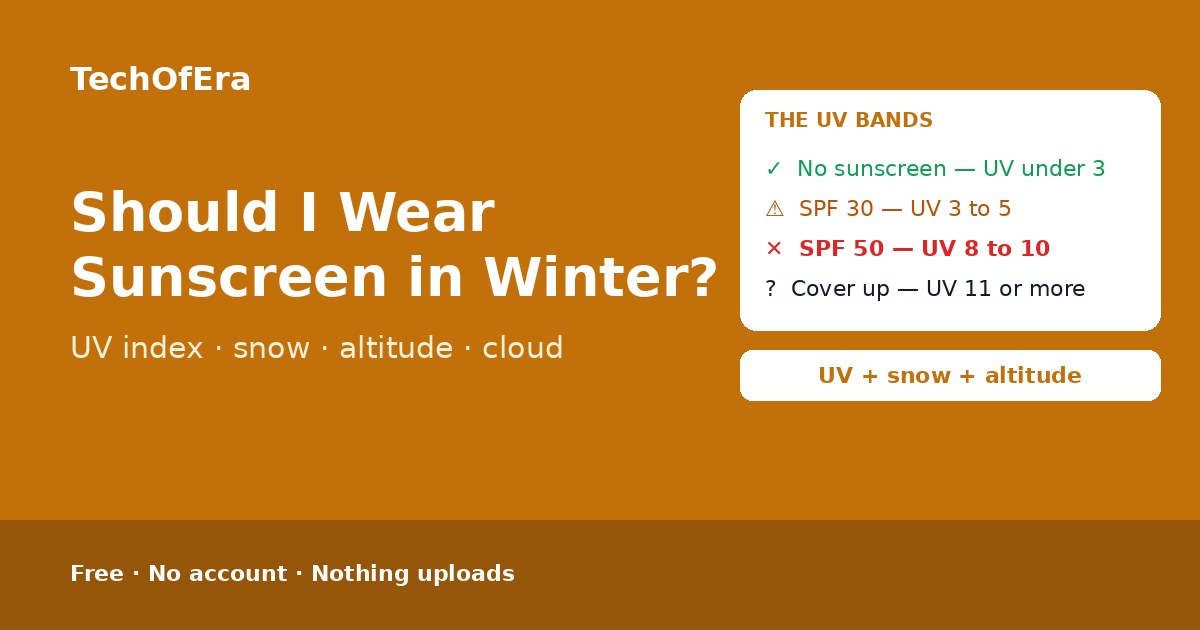
How to decide whether you need sunscreen in winter
The temperature is not the number that decides it — the UV index is. The World Health Organization and the US Environmental Protection Agency use the same bands: 0 to 2 is Low, 3 to 5 is Moderate, 6 to 7 is High, 8 to 10 is Very High, and 11 or more is Extreme — and the WHO says sun protection is needed from UV 3 upwards, whatever the season. Winter UV is weaker than summer UV, because the sun sits lower in the sky, but it is not zero: Mayo Clinic says UV rays are present year-round, and snow, water and ice reflect them back at you. The EPA says reflection off snow can nearly double UV strength, and the WHO says fresh snow reflects up to 80% of UV radiation — so a UV 4 day on snow is roughly a UV 7 day for your skin. Altitude adds more: the WHO says UV rises 10 to 12% with every 1,000 metres. This checker asks exactly what decides it.
To use it:
- Enter today’s UV index. Use the UV index for the time you will actually be out, where you will actually be — most weather apps show it next to the temperature. If it is missing, the checker says it cannot tell yet, rather than guessing.
- Read the effective UV. The verdict shows the UV index you entered and the effective UV after snow, altitude and cloud are worked in. A low number on snow or in the mountains can be a moderate one in practice — that is the adjustment doing its job.
- Match the SPF to the effective UV, not the season. No sunscreen under 3, SPF 30 at 3 to 5, SPF 30 plus a hat and glasses at 6 to 7, SPF 50 at 8 to 10, and SPF 50 plus covering up at 11 or more. Skin that burns easily, a long time outside, or a ski day each push the verdict one band stricter.
- Apply it properly. Broad-spectrum sunscreen, at least 15 minutes before going out, on all exposed skin — face, neck, ears and the backs of your hands, which winter clothing leaves bare. Most people use too little: about a teaspoon for the face and neck alone.
- Reapply every two hours. Sunscreen wears off, and a morning application does not cover an afternoon. Reapply sooner if you sweat or wipe your face — set a reminder before you leave.
- Know the warning signs. Skin that goes red has already had too much sun. Sunburn that blisters, skin that stays red for days, or a new or changing mole are medical matters, not sunscreen questions — see a clinician.
Conditions and what to do at a glance
The table below is built from the same rules as the checker, so it can never disagree with your verdict. The effective UV decides, together with skin type, activity, duration, snow, altitude and cloud.
| Condition | Verdict | What to know |
|---|
What makes this checker different
The pages that rank for this search are guides — thorough explanations of why winter sun still burns, the UV index bands, and the snow-reflection effect — but they leave you to do the maths yourself: to look up the UV index, multiply it for snow and altitude, discount it for cloud, and then judge whether your skin, your activity and your time outside change the answer. The UV forecast pages that do exist report a number for one city — they do not answer whether you, on snow, at altitude, with skin that burns easily, need sunscreen today. This page is the winter sunscreen answer: the UV index in, the snow, altitude and cloud adjustments worked out, and a verdict for the exact outing you plan — which SPF, whether to add a hat and glasses, and when to reapply, with skin type, activity and duration scored alongside the weather. It is a self-assessment, so it says plainly what it cannot know: a web page cannot measure the UV where you are or see your skin, so anything you mark “Not sure” stays on the list until you confirm it.
When is this the right check?
Whenever you are about to go out in winter and the sun makes you hesitate: the bright January morning with snow on the ground, the ski trip when the forecast says UV 4 and the resort is above 2,000 metres, the long walk on a clear cold day when the UV index has crept up to 3, the drive across a snowy landscape with the sun low and glaring. Also whenever the conditions are borderline and the decision turns on something specific — whether light cloud means you can skip it, whether skin that burns easily changes a moderate day, whether two hours outside needs a second application, or whether driving needs sunscreen on your face at all. And whenever you have burned in winter before and want a straight answer instead of a table to interpret.
Honest limitations
A self-assessment, not medical advice
This checker works only from the UV index and answers you enter. It cannot diagnose you — no web page can measure the UV where you are, see your skin, or know your medical history. If an answer is wrong, the verdict is wrong. When in doubt, wear sunscreen — or ask a clinician.
The snow and cloud numbers are estimates
The EPA says snow reflection can “nearly double” UV and that up to 80% of UV penetrates light cloud — it does not give exact multipliers. This checker uses 1.8 for snow, 0.8 for light cloud and 0.5 for heavy overcast, and labels all three as its own estimates. The real numbers vary with how fresh the snow is and how thick the cloud is.
The UV index is a forecast, not a measurement
The UV index your weather app shows is a forecast for solar noon, usually for the nearest city — not a live reading where you are standing. Cloud, altitude and the time of day all move the real number. If the sky looks stronger than the forecast, trust your skin and put sunscreen on.
SPF is not a clock
SPF 30 does not mean thirty times longer in the sun without burning — it means about 97% of UVB is filtered, if you apply enough and reapply. Most people apply too little, and sweat, wiping and snow all wear it off. The two-hour reapply rule is the part that matters most.
Warning signs override the verdict
Skin that goes red has already had too much sun, whatever the checker said. Sunburn that blisters, swelling, fever, or skin that stays red for days means see a clinician. A new or changing mole, or a spot that bleeds, itches or does not heal, needs a clinician promptly.
Rules from public-health sources
The rules here follow the World Health Organization and EPA UV index bands, the EPA snow-reflection and cloud guidance, the WHO altitude rule, and Mayo Clinic and Skin Cancer Foundation SPF guidance, as they read in November 2026. Guidance can be revised, so re-check if a new edition appears.