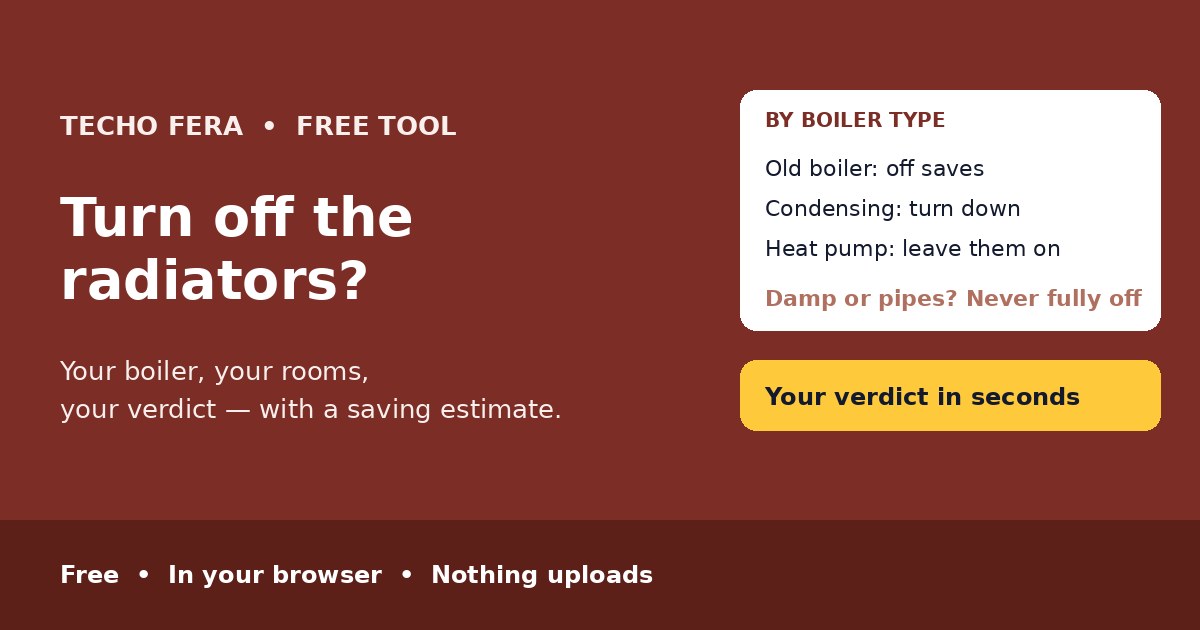
How to tell whether to turn off radiators in unused rooms
First, the boundary of this checker: it answers only the radiator question — whether to turn off, turn down or leave on the radiators in rooms you do not use, within your existing central heating system. It does not answer whether heating one room with a separate heater beats heating the whole house — that is the Is It Cheaper to Heat One Room or the Whole House? Checker. It does not answer whether to switch the heating off overnight — that is the Should I Turn My Heating Off at Night? Checker — and it does not diagnose why a radiator is cold at the top or noisy, which is the Should I Bleed My Radiators? Checker.
Turning off a radiator feels like the obvious saving: why pay to heat a room nobody sits in? The catch is what “off” does to the rest of the system and to the room itself. A modern condensing boiler is at its most efficient with cool return water, and it gets that by running at a low flow temperature across as much radiator surface as possible — close radiators and the flow temperature has to rise, so the boiler condenses less and the saving shrinks or disappears. A heat pump is the same story, only sharper: it runs at low water temperatures and needs every radiator it has. And the room itself, left cold, attracts condensation on its coldest wall, where mould grows — and pipes in the room can freeze in a cold snap. This checker turns your boiler type, TRVs, damp, pipes, doors and insulation into a verdict — turn them off, turn them down, or leave them on — with the TRV setting to use and a saving estimate in pounds a year, so you know what “enough” looks like for your home, not just for a home in general.
To use it:
- Answer the eight questions honestly. How many rooms are unused, what heats your home, whether the radiators have TRVs, how long the rooms stay unused, whether there is damp or mould, whether pipes run through the rooms, whether the doors stay shut, and how well insulated the home is. If you are not sure about the boiler, the damp or the duration, say so — the checker scores the unknown as a risk and lists it as something to confirm, rather than guessing.
- Read the verdict and the TRV setting. The verdict is turn them off, turn them down, or leave them on. Under it is the TRV setting to use — fully off, the frost symbol at about 12–15°C, or the usual setting — plus a saving estimate in pounds a year. The estimate is built from the Energy Saving Trust’s £75-a-year typical figure, and it is labelled as the checker’s own estimate, not a measurement.
- Turn them down, not off, on a modern system. If you have a condensing boiler or a heat pump, the answer is almost never “off”. Set each TRV to the frost symbol or its lowest notch — about 12–15°C — and shut the door. The room holds at its frost-and-damp guard, the boiler keeps condensing, and you keep most of the saving.
- Work down the cautions. Every caution is a fix: fit TRVs so a room can hold a low setback, shut the doors, heat a damp room for 30–60 minutes a day. Each fix moves the score up — re-run the checker after the fixes to see the new verdict.
- Check the rooms again after a week. Look behind the furniture and the radiator for black spots or damp patches, and check the room with a thermometer in the first cold snap: it should stay above 13°C for the pipes. If any damp appears, turn the radiator back on low straight away.
- Know when the saving is not worth it. A room left cold for just a few hours barely cools down, so there is almost nothing to save. A room with visible damp needs heat, not less of it. And a heat pump loses more than it saves when radiators are closed — keep every radiator on at a low, steady temperature instead.
Radiator situations and what to do at a glance
The table below is built from the same rules as the checker, so it can never disagree with your verdict. The boiler type matters more than anything else — an old boiler and a heat pump give opposite answers.
| Situation | Verdict | What to know |
|---|
What makes this checker different
The pages that rank for this search are guides — thorough explanations from heating specialists, radiator makers and content sites of why the boiler type matters, why cold rooms grow mould, and why a TRV beats a manual valve — but they leave you to judge your own home: to weigh a condensing boiler against a damp spare room against pipes in the wall against doors left open, and to decide which of those matters most. The nearest interactive rival does not exist: the top results are all guides, with no free checker that turns your answers into a verdict. This page is the answer for your home: eight questions in, a verdict that says turn them off, turn them down, or leave them on — with the exact TRV setting, a saving estimate in pounds a year, and the fixes in the order that matters, with the damp and freeze cases handled as blockers, not low scores. It is a self-assessment, so it says plainly what it cannot know: a web page cannot see your radiators or feel your rooms, so anything you mark “Not sure” stays on the list until you confirm it. And the score and the pound figures are this checker’s own estimates, built from the guidance above — they are not measurements, and the page says so.
When is this the right check?
Whenever a room stops being used — the spare bedroom after a guest leaves, the box room after the kids move out, the dining room you only sit in twice a year — and especially at the start of winter, when the heating goes back on and the question matters for months. Also whenever something has already happened: a cold snap is forecast, a damp patch appears behind the wardrobe, or a new boiler or heat pump goes in and the old rules no longer apply. And whenever the home changes — TRVs fitted, insulation added, or the damp fixed — run it again with the new answers.
Honest limitations
A self-assessment, not a measurement
This checker works only from the answers you enter. It cannot see your radiators or feel your rooms — no web page can measure your boiler type, check for damp, or feel how cold a room is. If an answer is wrong, the verdict is wrong. When in doubt, look at the boiler plate, look behind the furniture, and check the room with a thermometer.
The score is a guide, not a guarantee
A high score means the risks you described are handled — not that nothing can happen. A room that was dry yesterday can grow condensation in a cold snap, and a boiler that condenses well today can short-cycle tomorrow. Re-check whenever the weather, the rooms or the system change.
The pounds are estimates, not measurements
The saving figures are this checker’s own estimates, built from the Energy Saving Trust’s £75-a-year typical figure and the £80–£200 range from CBS Southampton, applied per room by boiler type. Your home’s real saving depends on your tariff, your boiler’s age and how many rooms you actually close — measure it against your own bills.
A turned-down room is not a heated room
A TRV on the frost symbol holds a room at 12–15°C — warm enough to guard against frost and damp, but not warm enough to sit in. If you start using the room again, turn the TRV back up an hour before you go in, and give the room time to warm through.
Damp overrides the verdict
A room that smells musty or shows black spots needs the damp fixed first — find its source, ventilate the room, and keep it heated while you do. No heating saving is worth a mould problem, and switching the radiator off will only make the mould worse.
Frozen pipes override the saving
A pipe that freezes and splits can cost hundreds of pounds in one afternoon — years of small heating savings, gone. Never switch a radiator fully off in a room with pipes in it, and never let an unused room fall below 13°C (55°F) in winter.