How the one-room-or-whole-house check works
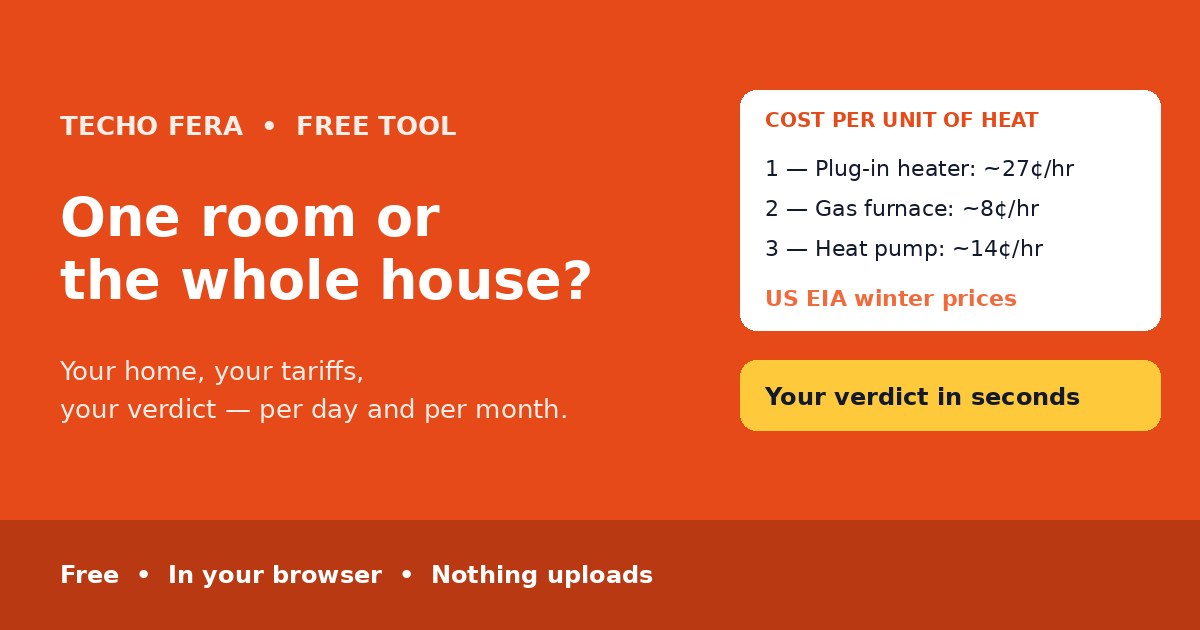
Heating one room feels cheaper because the heater is small — but the size of the heater is not what decides the bill. What decides it is the cost of one unit of heat. A plug-in heater makes heat with electricity, and electricity is expensive heat: at US average rates a 1,500-watt heater costs about 27 cents an hour. The same heat from a gas furnace costs about 7 to 8 cents, and from a heat pump about 14 cents or less. So a heater only wins when the rest of the house is turned down far enough to pay for it — the saving comes from the rooms you switch off, not from the heater. This checker takes your country, your central heating type, your electricity and fuel prices, how many rooms the house has, how many rooms you would heat with a plug-in heater, how many hours a day you spend in that one room, which heater you would use, how cold it is, and how far down you would turn the main thermostat — and gives you a verdict: heat one room, heat the whole house, or about even, with the saving or extra cost per day and per month.
To use it:
- Pick your country and your central heating. Your country sets the currency and the default tariffs; your heating type sets the cost per unit of heat. Gas and oil boilers divide the fuel price by about 85% efficiency; a heat pump divides the electricity price by its COP; electric radiators pay the full electricity price.
- Check the prices — or leave them blank. A blank price box uses the default for your country: the Ofgem price cap for the UK, EIA averages for the USA, Eurostat and Destatis for Germany, and labelled estimates for Canada and Australia. If your bill says something else, type your own price and the verdict updates.
- Count the rooms and the hours. How many rooms the central heating warms, how many you would heat with plug-in heaters, and how many hours a day you actually sit in that one room. An evening is usually 3 to 5 hours; a working day 6 to 8.
- Pick the heater and the setback. A plug-in heater and an oil-filled radiator cost the same to run; a heated blanket costs almost nothing but warms you, not the room; a mini-split is cheap to run but costs money to install. The setback is the whole trick — without turning the rest of the house down, the heater is just extra cost. Never go below 13°C (55°F).
- Read the verdict. Heat one room means the zone plan saves you money; heat the whole house means the heater costs more than the setback saves; about even means the two plans cost nearly the same, so pick comfort. If your setback is below 13°C, the checker tells you to raise it first — whatever the money says.
What makes this checker different
The pages that rank for this search are guides — a space-heater comparison, a one-room guide, a retailer guide, a money site's fuel-by-fuel breakdown — and they all give the same general answer: it depends. None of them asks about your home. They cannot tell you whether one room wins for your heating type, your tariffs, your room count and your hours, because they never ask. One site has a heating-cost calculator that includes a one-room figure as a side number, but it works out total heating cost, not a verdict for this question. There is no free, standalone checker that takes your home's details and gives you a verdict — heat one room or heat the whole house — with the saving or extra cost per day and per month, and a hard stop at the 13°C pipe-freeze floor. This page is that answer: ten questions, an instant verdict for your exact home, the blockers named, and the next steps. It is a cost guide, so it says plainly what it cannot know: it cannot see your meter, your tariff or your house, and where a figure is an estimate — the heat each room needs, the heater's average draw — it says so instead of inventing a rule.
When is this the right check?
When you spend most of the day in one room and wonder whether a plug-in heater would cut the bill — because the answer turns on your heating type, and this checker works it out for your home. When the house is on gas and a heater looks tempting — because the honest answer is usually no, and the checker shows you the money instead of letting you find out on the bill. When the house is on electric radiators — because the answer is usually yes, and the checker shows how much you save. When you work from home in one room all day — because long hours change the answer, and the checker counts them. And when you are choosing between a blanket, a plug-in heater and a mini-split — because the checker prices all three against the whole house.
Honest limitations
A cost guide, not advice for your home
This checker cannot see your meter, your tariff or your house. It cannot tell you how draughty your rooms are, how well your home is insulated, or what your next bill will actually say. If a number looks wrong, the tariff boxes are the first thing to check — and your real bill is the final word.
The heat each room needs is an estimate
The checker counts about 1 kW of heat per average room on a cold day — 0.6 kW when it is mild, 1.4 kW when it is very cold. That is the checker's own estimate, not a heat-loss survey: a draughty room with big windows needs more, a small well-insulated room needs less. The verdict is about the comparison, not a promise of an exact bill.
The heater's average draw is an estimate
A thermostat-controlled heater does not run flat out all the time: once the room is warm it cycles on and off. The guides put it at about half power on average, and this checker counts half of 1,500 watts. A heater left on full blast in a cold, draughty room costs more than the checker says; one in a small, warm room costs less.
Standing charges are not counted
The comparison covers the cost of the heat itself — fuel and electricity per unit. It does not count standing charges, delivery fees, servicing or hot water, which you pay either way. That is why the figures are a guide to the choice, not a forecast of your bill.
The 13°C floor is the hard stop
Never let the house fall below 13°C (55°F): the Red Cross names 55°F as the temperature that keeps pipes from freezing, and below about 12°C damp and mould risk rises. This checker refuses to recommend a setback below 13°C. Pipes in outside walls, lofts and garages need extra care — keep those rooms warmer than the floor.
This is the cost question, not the comfort or safety question
This checker answers whether heating one room saves money. It does not answer whether the house is warm enough to live in — that is the Is My House Too Cold? Checker — or whether to leave the heating on while you are away, or what heating costs in total. Those are different questions, with their own checkers, linked below.