How the water turn-off checker works
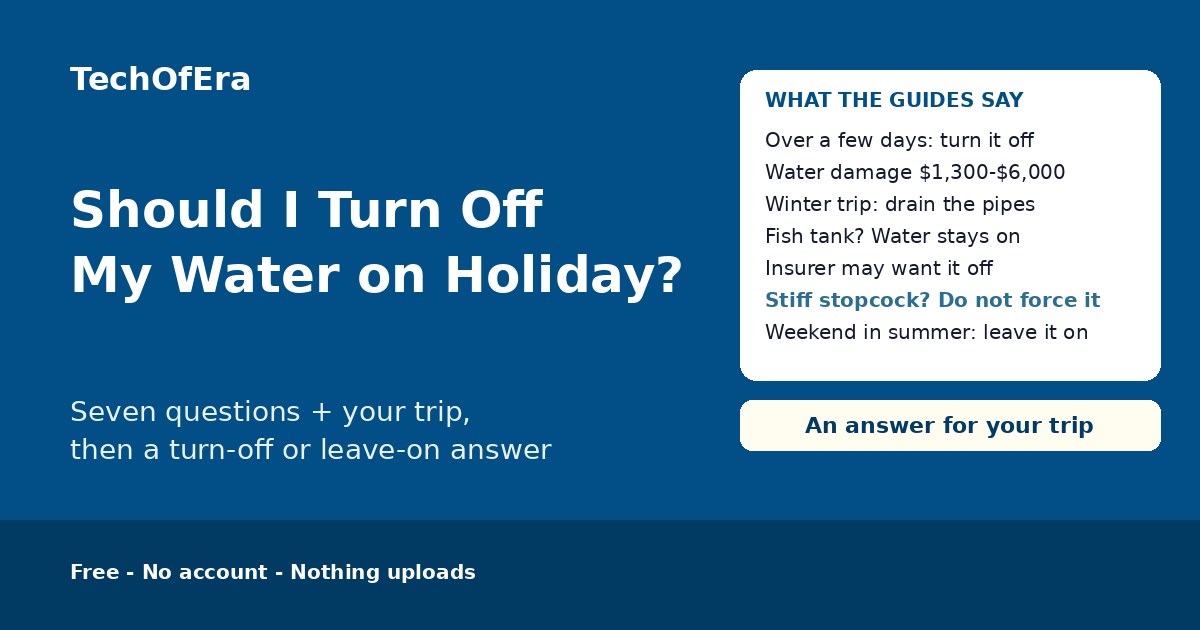
There is no single right answer to whether you should turn your water off when you go on holiday — and the pages that rank for this search do not help you find yours. They are guides and plumber blogs — Angi, a local plumber, a water-automation site — and they all give the same blanket answer: yes, turn it off. That answer is right for a fortnight away, but it is the wrong question for a weekend in summer, and it is impossible for a house with a fish tank. This checker starts from the facts the guides agree on and turns them into an answer for your trip: for a trip of more than a few days, turn off the main water supply, because a leak nobody catches can run for the whole trip — a crack as small as 1/8 inch in a pipe can spray more than 250 gallons of water a day, and water damage repairs cost $1,300 to $6,000. In winter, a long trip means draining the pipes too, with the heating left on low. If something in the house still needs water, the water has to stay on, with precautions instead. This is a self-assessment, so it says plainly what it cannot know: it cannot know your pipes, your stopcock or your policy.
To use it:
- Say how long you are away. Trip length drives the answer. A weekend is the short case: the risk is small, and so is the inconvenience of turning the water off. A week is long enough for a leak to do real damage. Two weeks is a long stretch, and insurers often expect the water off by now. A month or more is the longest case: the water should be off, and in winter the pipes should be drained too.
- Say what season it is. Winter changes the answer on its own. Pipes in walls and crawl spaces freeze first, and water left standing in cold pipes freezes, expands and bursts them. A long winter trip means turning the water off and draining the pipes down, with the heating left on low. In summer, the question is the leak risk, not frozen pipes.
- Say what your stopcock is like. The whole job is one turn of the stopcock — but only if you know where it is and it turns. Find it before you leave: near the water meter, under the kitchen sink, or where the main enters the house. If it is stiff or old, do not force it: forcing it can snap the valve and leave you with no way to shut the water off at all.
- Say what your home insurance requires. Some policies want the water off after 7 or 30 days away, and cover can be voided if you leave it on. The clause usually sits in the unoccupancy section. If your trip is longer than your policy's limit, turning the water off is a policy condition as well as a leak precaution.
- Say what needs water while you are away. A fish tank needs the water on for top-ups and filtration. Fire sprinklers are usually supplied by the water main, so turning the water off turns them off. Plants and ice makers can be handled separately: water the plants before you leave, and turn the ice-maker supply valve off before you close the main.
- Say whether someone can check the house, and what the heating will do. Someone checking regularly catches a leak early: the damage is limited to hours, not days. Nobody checking makes turning the water off more important. In winter, heating on low is the other half of the defence, alongside turning the water off — turning the heating off to save money is what lets pipes freeze.
What makes this checker different
The pages that rank for this search are guides — Angi, a Georgia plumber, a Sarasota plumber, a water-automation site — listing the same blanket "yes, turn it off" with a few paragraphs of advice. None of them asks how long you are away, whether it is winter, whether your stopcock works, what your insurer requires, or whether anything in the house still needs water. None of them gives you a drain-down answer for a long winter trip, none of them tells you what to do when a fish tank or fire sprinklers keep the water on, and none of them gives you a return-home checklist. This page is that answer: seven questions, one verdict for your trip — turn it off, leave it on with precautions, or turn it off and drain the pipes — the steps that go with it, and the return-home checklist. It is a self-assessment, so it says plainly what it cannot know: it cannot know your pipes, your stopcock or your policy, and the verdict is not plumbing or insurance advice.
How this is different from our other water tools
This checker answers the main-supply question: the whole house supply, at the stopcock, in every season. Our Should I Leave My Water Heater On While on Holiday? Checker answers a different question — whether the water heater stays on, a heater question, not a supply question. And our Should I Turn Off My Outdoor Tap in Winter? Checker covers the outdoor tap only, in winter. If you are turning the main supply off for a long trip, check the water-heater tool too: a heater that loses supply pressure while still receiving power or gas can be damaged.
When is this the right calculation?
When you are packing and wondering whether to turn the water off before you lock the door. When you are away for two weeks in winter and you are not sure whether draining the pipes is overkill. When your insurer wants the water off after seven days and your trip is ten. When you have a fish tank and the blanket advice to "just turn it off" does not work. When your stopcock is stiff and you are not sure whether to force it — do not. And when you get home and want to turn the water back on without flooding the kitchen: turn it back on slowly, open the taps one at a time to let the air out, and check under every sink for drips before you unpack.
Honest limitations
A self-assessment, not plumbing or insurance advice
This checker cannot know your pipes, your stopcock or your policy. It gives a verdict from the published plumbing guidance — it cannot tell you what your insurer requires, and it is not plumbing or insurance advice.
The facts are the guides, dated November 2026
The facts here are Angi, the plumber guides and the insurer advice, as they read in November 2026. Guides change and policies are reworded: recheck the numbers and your policy wording if anything about your trip changes.
Your stopcock may not turn
A stiff or seized stopcock is common in older houses, and this checker cannot turn it for you. If it will not turn, do not force it — call a plumber before the trip, and use the leave-on precautions until it is fixed.
Well water is different
If your house is on a well, turning the water off also means turning off the pump breaker, so the pump does not run dry. This checker assumes mains water: if you are on a well, ask your plumber about the pump as well as the stopcock.
Fire sprinklers need a professional answer
Fire sprinklers are usually supplied by the water main, and this checker cannot know how yours are plumbed. Ask your sprinkler contractor what to do before you close anything — do not turn the water off until you have their answer.
The verdict is for your trip, not every trip
Change the trip length or the season and the answer changes: a weekend in summer is a different answer from two weeks in winter. Run the checker again for each trip, with that trip's answers.