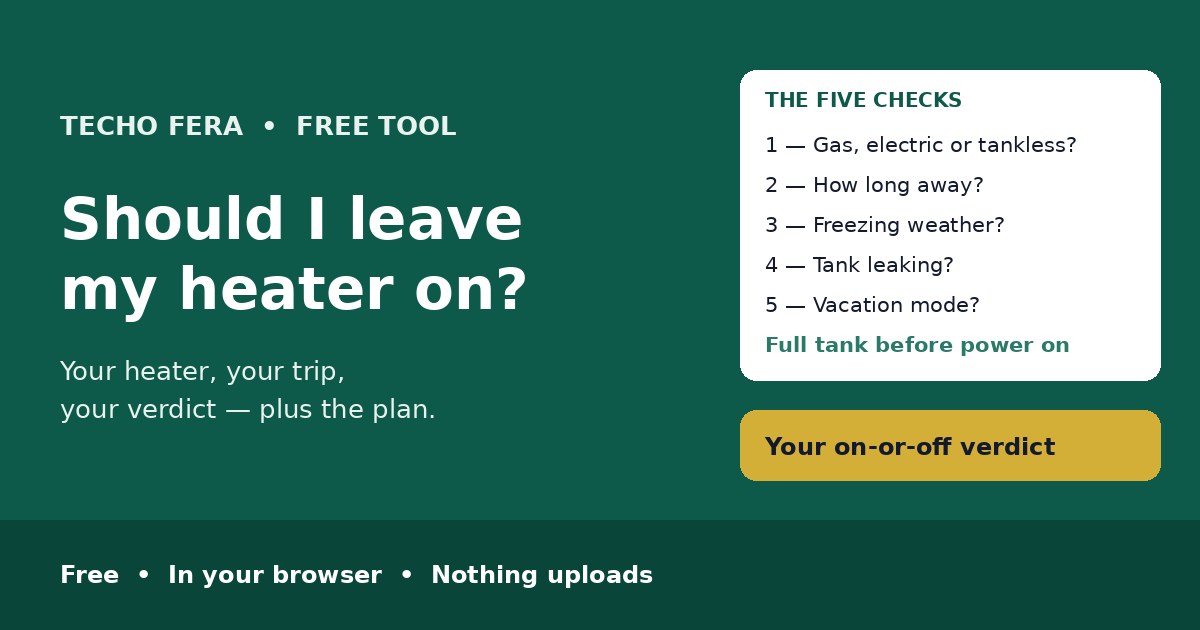
How the water heater holiday check works
A tank water heater keeps 40–50 gallons of water hot all day, every day — even when nobody is home to use it. Switching it off for a holiday saves the standby heat it would have lost, but the saving is small: for a typical 50-gallon tank, about 7 cents over a weekend, 66 cents over a week and $1.96 over two weeks at the US average 18.2 cents per kWh. And switching it off has costs of its own: in freezing weather a tank kept warm cannot freeze, an old heater may not fire up again, and an electric tank switched on while empty burns out its elements in seconds. The right answer is not the same for every trip. A weekend away means leave it on. A week away means vacation mode for gas and the breaker off for electric. A dripping tank must not be left running at all. A tankless heater has nothing to switch off. Hot water from the boiler must stay on, because the boiler also heats the house. And a seasonal absence in freezing weather with the heating off needs a full winterisation, not just a closed valve. This checker asks twelve questions — where you are, what kind of heater it is, how long you will be away, what the weather will be, whether the heating stays on, whether the main water will be shut off, how old the heater is, whether it has a vacation mode, whether it shows signs of a leak, whether anyone will check the house, how big the tank is, and what matters most to you — and turns the answers into a verdict and a step-by-step plan, in the order you should do the job.
To use it:
- Say what kind of water heater it is. Gas tank, electric tank, tankless, heat pump, or hot water from the boiler. A tankless heater has nothing to switch off; a boiler must stay on because it also heats the house; a gas tank has a vacation mode and an electric tank goes off at its breaker.
- Say how long you will be away. A weekend, a week, three weeks, or three months. The trip length is what turns "leave it on" into "switch it off" — and it sets the checker-estimate saving.
- Say what the weather will be. Freezing weather changes the answer completely — a tank kept warm cannot freeze, and a tank switched off in a cold house can.
- Say whether the heating stays on, and whether the main water will be shut off. The heating is what keeps the pipes from freezing. The main water is what limits a leak to a few gallons instead of thousands.
- Say how old the heater is, and whether it has a vacation mode. An old heater may not fire up again after a full shutdown, and vacation mode — VAC on the thermostat, about 50°F instead of 120–130°F — is the safer choice for it.
- Say whether the tank shows signs of a leak, whether anyone will check the house, how big the tank is, and what matters most. A drip means do not leave it running at all. Nobody checking means less risk is worth taking. The tank size only changes the saving estimate, never the verdict.
- Read the verdict — and the plan. The verdict tells you whether to leave it on, use vacation mode, switch it off, winterise the house, or call a plumber first. The plan lists the steps in order, so you can walk to the heater and do them one by one.
What makes this checker different
The pages that rank for this search are how-to guides — a tech site, a plumbing company, an energy blog. Every one of them gives you the same answer — it depends — and leaves you to judge your own heater. The timer calculators that do exist price a daily on-off schedule, not a holiday: they cannot tell you whether to leave the heater on for two weeks in January with the heating off and nobody checking. None of them asks whether the tank is dripping, whether the heating stays on, or whether the main water will be shut off — and none of them tells you what to do when the answer is "I don't know". This page is that answer: twelve questions, a verdict that changes with the heater type, the trip length, the weather, the heating and the leak signs, a checker-estimate saving in kWh and dollars, and a plan that stops at the step you cannot do and tells you what to do instead. It is a planning aid, so it says plainly what it cannot know: it cannot see your heater, and where your answers are uncertain it says so instead of guessing.
When is this the right check?
When the bags are half packed and you are standing in front of the heater wondering whether to touch it — because the answer depends on the heater, the trip and the weather, not on a rule of thumb. When the trip is a week or more and nobody will check the house — because a leak found after two weeks is a renovation. When the tank is old and you are not sure it will fire up again — because vacation mode is the safer choice for an old heater. And when the absence is seasonal — because a closed valve is not enough for a month or more in freezing weather, and the house needs a full winterisation.
Honest limitations
A planning aid, not plumbing advice
This checker cannot see your heater, your pipes or your weather. It cannot tell you whether a specific tank is about to fail, or whether your pilot will relight. If the tank is dripping, do not leave it running — shut the water and the heater off and call a plumber before you go.
The saving is small — say so plainly
For a typical 50-gallon tank, switching off saves about 7 cents over a weekend, 66 cents over a week and $1.96 over two weeks at the US average 18.2 cents per kWh. Older tanks save two to three times more; a tankless heater saves nothing. The real reason to switch off on a long trip is not the money — it is that a leaking tank is not being refilled and reheated while nobody is home.
An electric tank must be full before it goes back on
An electric tank switched on while empty burns out its elements in seconds. That is the one mistake this checker will not let you make: every plan that switches an electric tank off says, in the same breath, to check the tank is full before the breaker goes back on.
Warm water grows bacteria — reheat before you shower
Bacteria such as Legionella can grow when the water is warm but not hot (77°F–113°F), and they cannot grow at or above 120°F. After any trip where the heater was off or on vacation mode, let the water reach 120°F or higher before you use hot water, especially for a shower.
Freezing weather is about the pipes, not just the tank
A tank kept warm cannot freeze — but the pipes in the walls can, and the heater cannot protect them. Keep the heating on at 55°F (13°C) or higher in freezing weather, or drain the whole house if the absence is seasonal. A tankless heater's freeze protection only works while it has power.
Rules from the plumbers and the energy guides, dated November 2026
The rules here are the published guidance as they read in November 2026: How-To Geek on vacation mode and the Legionella return, IS Plumbing's holiday checklist, The Village Plumber on the main water and the house check, GetEco on short versus long trips, PlugPenny's standby-loss figures at the US average 18.2 cents per kWh, and George Brazil Plumbing on the VAC setting. Guidance changes: recheck with those sources if anything about your plans changes.