How the emergency-heat check works
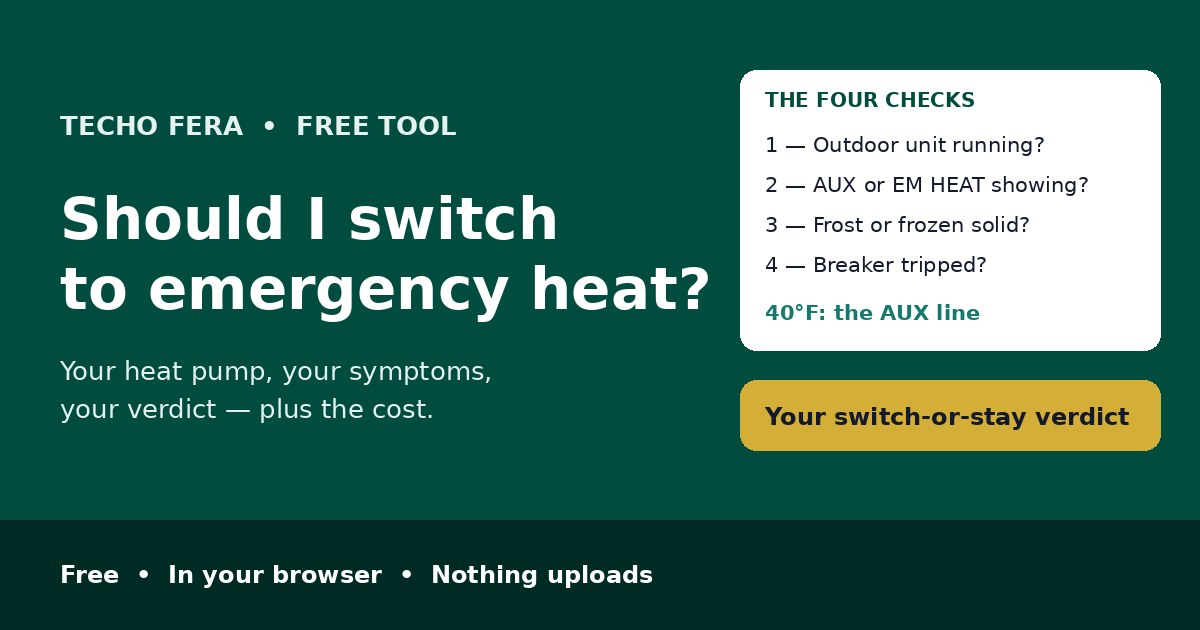
Emergency heat is a thermostat setting you switch on by hand. It locks out the heat pump's compressor and heats the house with the backup heat alone — usually electric heat strips in the indoor air handler, or a gas furnace in a dual-fuel system. Trane puts it plainly: it is a setting you should only use in a true emergency — as in, your heat pump has failed and it is really cold outside — and once you switch, call for HVAC service right away. But the right answer is not the same for every house on a cold night. AUX showing on the thermostat is the system doing its job, not a failure. Light frost on the outdoor coil is normal, and the unit defrosts it on its own. A dead outdoor unit with a tripped breaker may only need a reset. This checker asks thirteen questions — is the outdoor unit running, is the house getting cold, what does the thermostat show, is the outdoor unit iced over, any strange noises, is the breaker tripping, has a technician told you to use emergency heat, how cold is it outside, what kind of backup heat you have, how big the strips are, your electricity rate, and how many hours a day the strips would run — and turns the answers into a verdict, a step-by-step plan, and what a day on emergency heat costs at your rate.
To use it:
- Look at the outdoor unit while the thermostat is calling for heat. Is the fan spinning, or can you hear it hum? That one fact decides most of this answer. If it is running, stay on Heat. If it is not, the next questions decide whether it is a breaker, a fault, or ice.
- Look at the thermostat. AUX means the thermostat is adding backup heat by itself — normal below 40°F, during defrost, and after a setpoint jump of more than 3 to 4 degrees. EM HEAT means someone already switched emergency heat on, and it stays on until it is switched back.
- Look at the outdoor coil. A light, even layer of frost is normal in cold, damp weather. Thick ice that defrost will not clear, or snow covering the unit, is a fault — and a reason to switch to emergency heat until it is inspected.
- Listen, and check the breaker. Grinding, banging or screeching is a fault even if the unit is still running. A tripped breaker is the most common fixable cause of a dead unit: reset it once, and if the unit starts, stay on Heat.
- Say what the backup heat is, and what it costs. Electric strips are priced from your strip size and your electricity rate — a 10 kW strip costs about $1.82 an hour at the US average rate of 18.16 cents per kWh. A gas furnace in a dual-fuel system is a different cost question, and the checker says so.
- Read the verdict — and the plan. The verdict tells you whether to stay on Heat, switch to emergency heat now, check the breaker first, or set a reminder because emergency heat is already on. The plan lists the steps in order, so you can do them one by one.
What makes this checker different
The pages that rank for this search are how-to guides — a heat-pump specialist, a local HVAC company, a homeowner advice site, and one page with a backup-heat cost calculator. Every one of them gives you the same rule — switch only when the heat pump has failed — and leaves you to judge whether yours has. None of them asks whether your outdoor unit is running, what your thermostat shows, or whether the ice is frost or a frozen-solid coil — and none of them prices a day on emergency heat at your own rate and strip size. This page is that answer: thirteen questions, a verdict that changes with the symptoms, and a plan that stops at the step you cannot do and tells you what to do instead. It is a planning aid, so it says plainly what it cannot know: it cannot see your outdoor unit, and where your answers are uncertain it says so instead of guessing.
When is this the right check?
When the house is getting cold and you are staring at the thermostat wondering whether to flip it to EM HEAT — because the answer depends on what the outdoor unit is doing, not on how cold you feel. When AUX has been showing for hours and you are not sure whether that is normal — because AUX on a cold morning is the system doing its job, and switching to emergency heat on top of it only turns the compressor off. When the outdoor unit is iced over and you cannot tell frost from a fault — because light frost clears itself in defrost, and thick ice that will not clear is a reason to switch and call. And when emergency heat is already on — because it stays on until you switch it back, and the reminder is the job.
Honest limitations
A planning aid, not HVAC advice
This checker cannot see your outdoor unit, your thermostat, or your electricity meter. It cannot tell you whether a specific compressor has failed, or whether your strips are actually 10 kW. If you can smell burning, see smoke, or the breaker keeps tripping, switch the system off and call a technician.
The bill you cannot see coming
Emergency heat stays on until you switch it back by hand. A setting left on after a repair is an easy way to get a very large bill — at $1.82 an hour for 10 kW strips, a forgotten week costs about $150 at 12 hours a day, and twice that if the strips run around the clock. Set a phone reminder for the day of the repair.
Your rate is not the average
Every dollar figure here is arithmetic from the rate and strip size you enter, not a measured bill. The US average of 18.16 cents per kWh is the default — your rate may be half that or twice it. Enter your own rate from your electricity bill for a figure that means something.
Never chip the ice off
Do not chip ice off the outdoor unit, pour hot water on it, or open it up. The coil fins bend easily, hot water can crack a cold coil, and opening the unit exposes live parts. Clear snow away from around the unit if you can do so safely, and leave the ice to the technician.
A grinding unit is a fault, even if it runs
Grinding, banging or screeching from the outdoor unit is a fault even while the unit is still running. Switch to emergency heat to keep the house warm, switch the outdoor unit off, and call for repair — running a grinding compressor can turn a repair into a replacement.
Rules from the makers and the energy agencies, dated November 2026
The rules here are the published guidance as they read in November 2026: Trane, Honeywell, Carrier, Lennox and Rheem on when emergency heat is for and what AUX means, Google's Nest help pages on emergency heat staying on until it is switched back, the US Department of Energy on heat-pump efficiency, and the EIA Electric Power Monthly Table 5.6.A for the August 2026 US average residential electricity rate of 18.16 cents per kWh. Guidance changes: recheck with those sources if anything about your plans changes.