How the winter dog coat check works
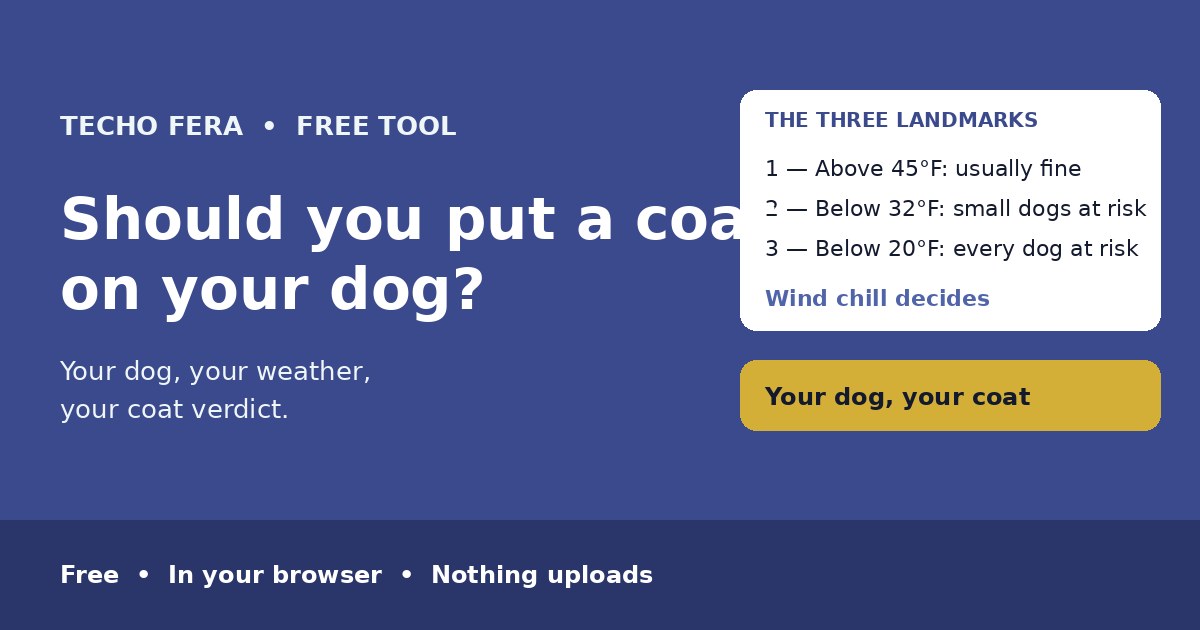
A dog's need for a coat depends on the dog and the weather, not on the season. Most dogs are fine above 45°F (7°C); below 32°F (0°C) small and thin-coated dogs are at risk; below 20°F (−7°C) every dog is at risk of hypothermia and frostbite on long walks. But those are landmarks, not a verdict for your dog: a toy dog in the wet at 25°F needs a coat, a husky running on a mild day does not, and the same dog needs a coat for an hour standing in the snow and not for a ten-minute walk on a calm morning. This checker takes your dog's size, coat type, age and health, the temperature, the wind, the wet, what the dog will be doing outside, how long it will be out, and whether it is used to the cold — and gives you a personal verdict: coat needed, coat recommended, optional, no coat needed, or too cold — stay in, with a coat-fit guide.
To use it:
- Say how big your dog is, and how cold it is. Those are the two answers the verdict needs. Size changes the answer a lot: a toy dog loses heat fast, a giant dog holds it well.
- Add the wind and the wet. The checker runs the US National Weather Service wind-chill formula on the temperature and wind you enter, so the verdict uses what the cold feels like, not just what the thermometer says. Rain or snow is the single biggest risk factor on the Tufts Weather Safety Scale — wet is worse than cold.
- Say what the dog will be doing, and for how long. A dog that is running makes its own heat and often needs no coat; a dog standing still makes none. And how long the dog is out matters as much as how cold it is.
- Add the dog itself. A puppy chills fast, a senior dog feels the cold more, a short or hairless coat gives almost no insulation, and a dog that is not used to the cold feels it sooner. With a vet-managed condition, the vet should set the dog's own cold limit.
- Read the verdict — and check the fit. If a coat is needed, the checker tells you what kind: warm and waterproof, covering from mid-chest to the base of the tail, with full shoulder movement and two fingers under the straps. If it is too cold to go out at all, it says so plainly.
What makes this checker different
The pages that rank for this search are guides — Vetstreet's winter coat and boots guide, Pets Best's vet tips, Petco's coat guide, Penn Vet's winter advice, and FOUR PAWS' extreme-cold guide — and they all give the same three landmarks: 45°F, 32°F, 20°F. Every one of them leaves you to guess where your dog falls between those lines. None of them asks about the wind, the wet, what the dog will be doing, or how long it will be out — and none of them gives you a verdict for your exact dog, with a fit guide. There are coat calculators elsewhere — one that picks a coat from breed, size and coat, and one walk planner that scores cold safety — but neither takes the outing itself into account: the activity, the duration, whether the dog is used to the cold, or whether the coat must be waterproof. This page is the answer to the question as asked: should you put a coat on your dog, for this outing, in this weather? Ten questions, an instant verdict for your exact dog, the blockers named, and the next steps. It is a coat aid, so it says plainly what it cannot know: it cannot see your dog, feel whether it is shivering, or know its medical history, and where the cold is extreme it says to stay in.
When is this the right check?
When the first cold snap arrives and you wonder whether the coat should come out with the lead — because the answer depends on your dog, not the season. When the wind picks up and the temperature on the app does not match how cold it feels — because the checker runs the wind chill. When it is raining or snowing and you wonder whether a coat will help or make it worse — because a soaked coat makes a dog colder, and the checker says so. And when it is bitterly cold and you wonder whether to go out at all — because the checker says plainly when to stay in.
Honest limitations
A coat aid, not veterinary advice
This checker cannot see your dog, feel whether it is shivering, or know its medical history. It cannot tell you whether your dog's weight is healthy, whether its joints are sore, or whether a health condition changes everything. If you are unsure, ask your vet — especially for a puppy, a senior dog, or a dog with a condition.
The feels-like temperature is an estimate
The checker runs the National Weather Service wind-chill formula on the middle of the temperature band you pick, and the middle of the wind band. Your weather app gives the exact temperature for your street — use that to pick the band. The score bands and the stay-in lines are the checker's own estimates, built from the PetMD landmarks and the Tufts scale, and the page says so.
Wet is worse than cold
A wet coat traps much less warm air than a dry one, and wind increases heat loss — an animal can become dangerously cold in wet and windy conditions even near freezing. This checker treats rain and snow as the biggest risk factor, but it cannot check whether your dog's coat is actually wet. If the coat soaks through, take it off and dry it.
Watch the dog, not just the verdict
Whatever the verdict says, watch the dog itself: shivering, curling up, slowing down, lifting its paws or seeking warmth all mean it is cold. If you see any of those signs, put a coat on — or cut the outing short and go home. If the shivering does not stop once the dog is warm, call your vet.
Coats are for outside only
A dog wearing a coat indoors can overheat easily, and the coat can chafe the skin. Take the coat off as soon as the dog is back inside, and never leave a dog wearing a coat unsupervised. If the house is cold, warm the room instead of dressing the dog.
This is the coat question, not the cold question
This checker answers whether your dog needs a coat for a specific outing. It does not answer whether your dog is safe outside in winter at all — that is the Is My Dog Too Cold Outside? Checker — or whether your dog's food should change for winter — that is the Should I Change My Dog's Food in Winter? Checker. Those are different questions, with their own checkers, linked below.