How the winter dog food check works
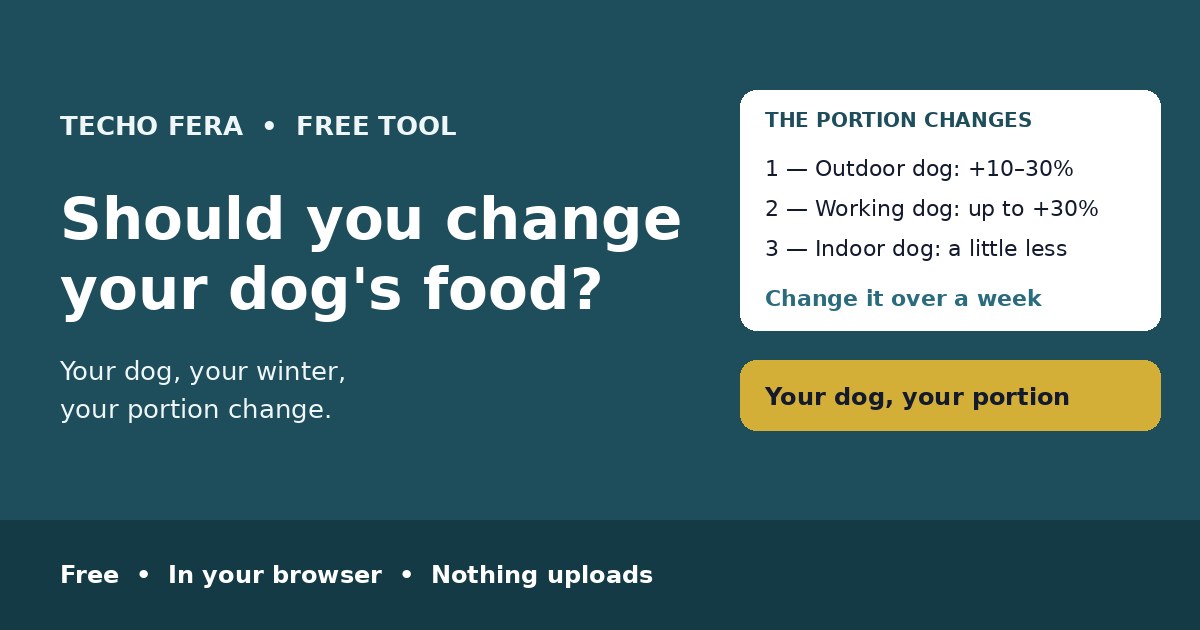
A dog's food needs change in winter — but in opposite directions for different dogs. An outdoor dog burns calories just staying warm: vets quote 10–15% more food for a moderately active outdoor dog and 20–30% more for a highly active working dog. An indoor dog that walks less in winter burns fewer calories, and the same bowl that was right in summer can slowly add weight. This checker takes where your dog spends the day, how its exercise has changed since summer, its age, its weight trend, its coat, how cold it is where you live, what it eats now, whether its water freezes, and any health condition — and gives you a personal verdict: feed more, feed the same, feed less, or ask the vet first, with a suggested portion change in percent and a plan for making the change gradually over about a week.
To use it:
- Say where your dog spends the day. This is the biggest factor: a dog outside most of the day burns calories staying warm, a dog on the sofa does not. A working dog outdoors all day is the extreme end.
- Compare its exercise with summer. Shorter days and cold weather cut most dogs' walks. Much less exercise means fewer calories burned — and often less food needed.
- Add the dog itself. A puppy is still growing and should never have its food cut. A senior dog often moves less. A thick double coat is insulation; a short or clipped coat leaves the dog burning more energy to stay warm — but only if it is actually outside.
- Say what the weight is doing. The weight trend is the check on everything else: gaining weight plus less exercise means cut back; losing weight plus an outdoor life means feed more. If you have not been weighing your dog, weigh it this week.
- Read the verdict — and change it slowly. Feed more means add about the suggested percent to each meal; feed less means take about that percent out of each meal. Either way, change it gradually over about a week — sudden changes upset a dog's stomach — and weigh the dog every week.
What makes this checker different
The pages that rank for this search are guides — Maplewood Veterinary Center's winter nutrition tips, Diamond Pet's winter nutrition guide, EveryPaw's winter feeding guide, and a seasonal feeding guide on Medium — and they all give the same blanket numbers: 10–15% more for an outdoor dog, 20–30% for a working dog, a little less for an indoor dog. Every one of them leaves you to guess where your dog falls in those ranges. None of them asks where your dog spends the day, how its exercise has changed, what its weight is doing, or whether it has a health condition that makes the whole question a vet's call. There is no free, standalone checker that takes your dog's own winter routine and gives you a personal portion change, a vet-first flag, and a gradual-change plan. This page is that answer: nine questions, an instant verdict for your exact dog, the blockers named, and the next steps. It is a feeding aid, so it says plainly what it cannot know: it cannot see your dog, weigh it, or know its medical history, and where a health condition is involved it says to ask the vet instead of giving a portion change.
When is this the right check?
When the first cold snap arrives and you wonder whether the bowl should change with the weather — because the answer depends on your dog, not the season. When your dog has been gaining weight since the walks got shorter — because the checker tells you how much to cut and how to do it slowly. When your outdoor dog is losing weight in the cold — because the checker tells you how much more to feed and when to see the vet. And when your dog has diabetes or a thyroid problem — because the checker tells you plainly that this is the vet's call, not yours.
Honest limitations
A feeding aid, not veterinary advice
This checker cannot see your dog, weigh it, feel its ribs, or know its medical history. It cannot tell you whether your dog's weight is healthy, whether its joints are sore, or whether a health condition changes everything. If you are unsure, ask your vet — especially for a puppy, a senior dog, or a dog with a condition.
The percentage is an estimate, not a prescription
The suggested portion change is the checker's own estimate, built from the ranges vets quote — 10–15% for a moderately active outdoor dog, 20–30% for a highly active working dog — and rounded to the nearest 5%. Dogs vary: two dogs with the same answers can need different amounts. Weigh your dog every week and adjust again if the weight keeps moving.
Extra weight does not keep a dog warm
Some owners think a few extra pounds help a dog stay warm. The AVMA says the health risks of carrying extra weight outweigh any benefit. A dog stays warm with a thick coat, a dry shelter out of the wind, and enough food to fuel shivering — not with fat. Aim for a steady weight all winter.
Change the amount, not the food
A complete food change is not normally needed in winter — adjust the portion size instead, and keep the same food the dog's stomach is used to. A working dog in deep cold may suit a high-energy food, and a dog gaining weight may suit a weight-control food, but ask your vet before switching foods.
Water matters as much as food
A bowl that freezes over leaves the dog without water, and a dehydrated dog eats less and feels the cold more. This checker flags frozen water as a blocker, but it cannot check your bowl for you. Check it at least twice a day in freezing weather, or use a pet-safe heated bowl.
This is the feeding question, not the food question
This checker answers whether the amount — or the food — should change for winter. It does not answer whether a particular food is safe for your dog — that is the Can My Dog Eat This Thanksgiving Food? Checker — or whether your dog is safe outside in winter, or how long it can be left alone. Those are different questions, with their own checkers, linked below.