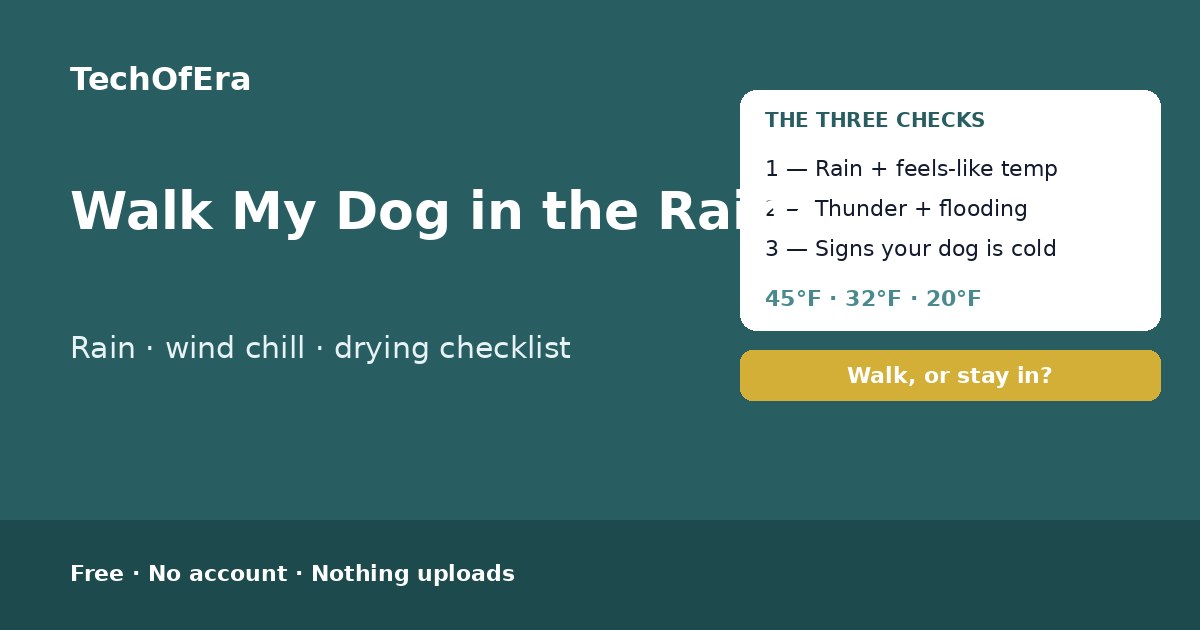
How the rain-walk check works
It is generally safe to walk a healthy dog in light rain, as long as the dog is healthy, does not mind the cold and you are mindful of the intensity — but always avoid lightning. A wet dog feels cold far faster than a dry one, because wet fur loses its insulation: when a dog’s fur gets wet, the skin gets wet too, and the dog feels cold a lot faster, especially with cold feet and a cold wind. Most dogs are fine down to about 45°F (7°C). Below 32°F (0°C), small, thin-coated, young, old or unwell dogs are at real risk. Below 20°F (-7°C), almost any dog can develop hypothermia or frostbite. This checker works out the feels-like temperature — the wind chill — from the temperature and the wind, then moves the band for the rain, your dog’s size, coat, age and health, how your dog feels about rain, and whether you have a raincoat — and gives you a verdict for your dog right now: walk as normal, a short walk only, skip the walk, or do not go out — with the safe-time limit and the rain-walk checklist.
To use it:
- Say how hard it is raining. Look out of the window — drizzle, light rain, moderate rain, heavy rain or a downpour. The rain is the whole question: drizzle is barely wet pavement, a downpour soaks you in a minute.
- Enter the temperature outside. A wet dog feels cold far faster than a dry one, so the temperature matters as much as the rain. Enter it in °C or °F.
- Enter the wind speed. Wind chill moves the cold line further than the thermometer reading alone — and a wet coat in wind chills a dog fast. Leave it blank if you do not know it, and the checker uses the air temperature.
- Say whether there is thunder, and whether the route is flooded. Audible thunder means lightning can strike nearby, and floodwater can conceal damaged surfaces and other hazards — either one means staying in, whatever the rain says.
- Say how big your dog is, and what kind of coat they have. Small dogs chill far faster than big ones in the rain, and a thick double coat sheds rain while a thin single coat soaks through.
- Say how old your dog is, how their health is, and how they feel about rain. Very young puppies, very old dogs and unwell dogs need extra care in the rain — and a dog that hates the rain should not be forced through a long walk in it.
- Say how long you plan to walk, and whether you have a raincoat and a towel ready. A raincoat keeps the worst of the wet off, but it cannot make dangerous weather safe — and drying your dog off the moment you get home is half the rain walk.
- Tick any signs your dog is showing. Shivering, lifting a paw, refusing to walk, lethargy, coughing or vomiting after a wet walk all mean cut the walk short and bring them in — the dog is the thermometer that matters most, whatever the numbers say.
What makes this checker different
The pages that rank for this search are guides — a dog walking app’s article on walking a dog in rain, a trainer’s piece on why it is okay to walk your dog in the rain, a tips page on walking a dog in the rain the proper way, and a vet site’s article on whether it is okay to walk dogs in the rain. They give you the rules and leave you to judge them against the sky on a wet afternoon. There is no free, standalone checker that takes the rain, the temperature and the wind, works out the feels-like temperature, checks thunder and flooding, adjusts for your dog’s size, coat, age, health and attitude, asks how long you plan to walk and whether you have a raincoat and a towel ready, listens to the signs your dog is showing — and gives you a verdict: walk as normal, a short walk only, skip the walk, or do not go out — with the safe-time limit and the rain-walk checklist. This page is that answer: fifteen questions, an instant verdict for your exact dog and your exact weather, the blockers named, and the next steps. It is a self-assessment, so it says plainly what it cannot know: it cannot feel your dog or read the sky, and where your dog’s signs disagree with the numbers it says so instead of guessing.
When is this the right check?
On a wet morning when the rain is falling and the lead is hanging by the door — because the drizzle that was fine last week can be a downpour today, and the thunder on the horizon changes everything. Before the evening walk in a cold snap, when the rain is light but the wind is up and your dog will come home soaked and shivering. When a new puppy, a senior dog or a small thin-coated dog joins the house, and the rain limits you knew for your old dog no longer apply. When someone else walks your dog — a dog walker, a family member, a neighbour — because a long walk in rain your dog cannot handle is the most common way a routine outing turns into a cold, wet dog. And whenever your dog starts shivering, lifting a paw or pulling back towards home in the rain — because that is when a guide leaves you guessing and a checker earns its keep.
Honest limitations
A self-assessment, not veterinary advice
This checker cannot feel your dog or read the sky. It cannot check how hard it is raining, how cold the wind is, or whether your dog is shivering. If you are worried about your dog, talk to your vet.
The dog’s signs beat the numbers
A dog showing cold stress in rain the numbers call fine is a dog that needs bringing in. The bands are guidance for an average dog of that size and coat — your dog’s own signs are the verdict that counts.
The wind chill is an estimate
The National Weather Service wind chill is for a person standing in the open, and it is the best public estimate there is for what a wet dog feels. Sheltered streets, gusts and how hard your dog is running all move it — which is why the signs matter as much as the sum.
Breed ranges are approximate
The size and coat bands use the usual breed examples — a Chihuahua is toy, a Labrador is large — but mixed breeds and dogs between bands sit between the lines. Where your dog falls between two sizes, use the smaller one for rain: it is the safer reading.
The 45–32–20 bands are guidance, not a guarantee
No dog reads the thermometer. A hardy dog can be fine below the line and a vulnerable dog can be cold above it. The bands are where vets say to start paying attention — not a promise that above them is safe and below them is not.
Rules from official sources, dated November 2026
The rules here are the US National Weather Service lightning and flood guidance, the veterinary rain and cold guidance, and the CDC leptospirosis guidance, as they read in November 2026. Guidance changes: recheck with your vet if anything about your dog changes.