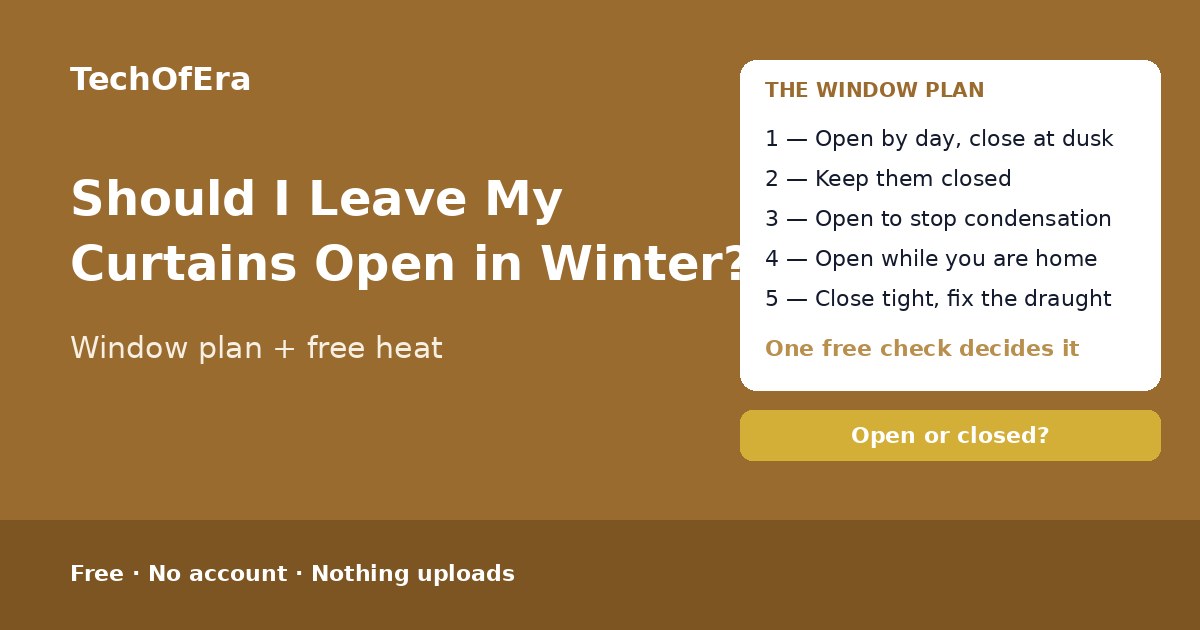
How the winter curtains check works
Leaving your curtains open in winter is not one decision — it is a routine, and it is different for every window. The US Department of Energy says to open curtains on south-facing windows on sunny winter days so sunlight can warm the home, and to close them at night to help insulate against cold drafts. About 30% of a home's heating energy escapes through its windows, and 75% of households leave their window coverings in the same spot all day, usually closed in winter because closed feels warmer. That habit wastes the free heat: on a clear winter day the low sun drives straight through south-facing glass, and in one tracked passive-solar home about 275 sq ft of south-facing glass brought in roughly 16,000 watts on a clear day near the solstice — and about 3,200 watts even on a fully cloudy day. This checker weighs all of it — which way the window faces, how much direct sun reaches it, what winter days are usually like where you live, what hangs at the window, what kind of glazing it is, whether condensation forms on it, whether you can feel a draught, and whether people outside can see in — and gives you the plan for that one window.
To use it:
- Say which way the window faces. In winter the sun sits low in the southern sky (northern hemisphere) and shines straight through south-facing glass for most of the day. East- and west-facing windows get a slice in the morning or the afternoon. North-facing windows get almost no direct winter sun at all. In the southern hemisphere the directions swap: north-facing windows get the winter sun there.
- Say how much direct sun reaches it on a clear winter day. Watch the window on a clear day: does the sun fall on the glass for most of the day, a few hours, or never? Shade from a porch, a tree or a neighbouring building counts — a south-facing window in permanent shade behaves like a north-facing one.
- Say what winter days are usually like where you live. Mostly sunny days make the open-by-day plan pay; mostly grey days mean the curtain is worth more closed. On a fully cloudy day the same windows deliver only about a fifth of the clear-day heat, so a grey-winter window is a keep-closed window even if it faces south.
- Say what hangs at the window. Heavy, lined or thermal curtains insulate best; ordinary curtains help a little; sheer or unlined curtains give minimal protection. Dark curtains absorb heat from sunlight in winter, while light-coloured ones reflect it back out — but weight and timing matter more than colour.
- Say what kind of window it is. Single glazing loses heat fast, so closed heavy curtains at night matter more; double or triple glazing loses far less. Old double glazing can be draughty if its seals have gone — then the draught, not the glass, is the problem.
- Say whether condensation forms on it. Look at the glass on a cold morning. Condensation is the one exception to closing at night: keeping the curtains open lets warm room air reach the glass and evens out the temperature around it. A closed curtain traps warm, humid air against the cold pane and makes the streaming worse.
- Say whether you can feel a draught. Hold a hand near the frame on a cold, windy day. A curtain cannot fix a draught: if cold air is physically coming through or around the frame, the gap needs weather stripping or caulk. Until then, closing the curtains snugly at dusk slows the heat loss.
- Say whether people outside can see in. A ground-floor window facing the street is usually kept closed for privacy — that changes the plan to open only while you are home. A sheer or voile layer lets light in while softening the view from outside.
The five verdicts, and what each one means
Open on sunny days, close at dusk
The window gains real free heat from the sun during the day. Open the curtains in the morning and let the light in; at dusk, close them snugly, down to the sill and tucked behind any radiator. On grey days there is little to gain, so leave them closed and let the curtain insulate instead.
Keep them closed
The window gets no useful winter sun, so opening the curtains would only let heat out faster. Keep them closed around the clock and let the curtain do its job as insulation. Open them only when you want the light or the view — not for warmth, because there is no warmth to gain here.
Keep them open — stop the condensation first
The glass streams most winter mornings, and a closed curtain traps warm, humid air against the cold pane. Keep the curtains open — or parted — so warm room air can reach the glass, wipe the pane dry in the morning, and keep indoor humidity near 40% in winter.
Open while you are home
The sun gain is real, but so is the privacy problem: the window can be seen into from outside. Open the curtains during the sunny hours while you are home, and close them when you go out or at dusk — whichever comes first. A sheer layer lets light in while softening the view.
Open on bright days only — close tight, fix the draught
A draughty, single-glazed window loses heat fast, so the draught matters more than the sun most days. Open the curtains only on bright days when the sun is actually on the glass, close them snugly at dusk, and fix the draught itself with weather stripping or caulk — a curtain cannot seal a gap.
What makes this checker different
The pages that rank for this search are guides — an article on why one woman opens her curtains on cold winter days, a designer-led guide to keeping curtains open or closed in winter, a window-company guide to whether curtains keep a house warmer, and a condensation tip about keeping curtains open. Every one of them says the same thing: both, at different times. None of them asks which way your window faces, how much sun actually reaches it, what hangs there, whether the glass streams in the morning, whether you can feel a draught, or whether people outside can see in — and none of them gives you a verdict for your window. There is no free, standalone checker that takes your window, sun, weather, curtain, glazing, condensation, draught and privacy and turns them into a plan for that window, with the condensation exception and the privacy trade-off named. This page is that answer: eight questions, an instant verdict, the blockers named, and the next steps. It is a self-assessment, so it says plainly what it cannot know: it cannot feel the sun on the glass, test how draughty the frame is, or see whether the glass is wet.
When is this the right check?
When you leave every curtain in the house in the same position all day and wonder whether you are wasting free heat — because the Department of Energy says 75% of households do exactly that, and the sunny windows are the ones losing out. When the heating bill climbs and the sunny rooms still feel cold — because a closed curtain on a sunny winter window at noon is blocking a space heater the sun is trying to hand you. When the windows stream every morning and you are not sure whether the curtains are helping or hurting — because a closed curtain traps humid air against the cold pane, and keeping them open is the fix. And when the window faces the street and you want the sun without the fishbowl — because the plan for that window is open while you are home, not open all day.
Honest limitations
A self-assessment, not an energy survey
This checker cannot feel the sun on the glass, test how draughty the frame is, or see whether the glass is wet. It cannot tell you how many watts your window gains, or how much money the routine saves. If the glass streams every morning or the room feels cold beside the window, check the window itself.
One window at a time
A sunny south-facing window and a shaded north-facing one in the same house need opposite answers. The checker scores one window: run it again for each window that matters, instead of applying one verdict to the whole house.
Northern hemisphere directions
The direction rules assume the northern hemisphere, where the winter sun sits in the south. In the southern hemisphere the directions swap: north-facing windows get the winter sun there. The checker says so on the page, but it cannot detect where you live.
The sun figure is one home's measurement
The 16,000-watt figure for 275 sq ft of south-facing glass comes from one energy consultant's tracked passive-solar home, not a laboratory test. Your window is a different size, in a different place, with different glass — treat it as a sense of scale, not a promise.
Curtains cannot fix a draught
If cold air is physically coming through or around the frame, the gap needs sealing with weather stripping or caulk. A curtain only slows the heat leaving through the glass — it cannot seal a hole in the building.
Rules from official sources, dated November 2026
The rules here are the US Department of Energy guidance (open south-facing coverings on sunny winter days, close them at night; about 30% of heating energy escapes through windows), the ENERGY STAR guidance (thermal curtains as one option for north-facing windows), and the condensation guidance (keep curtains open so warm air reaches the glass; indoor humidity near 40% in winter), as they read in November 2026. Guidance changes: recheck if anything about the window changes.