How the garage door check works
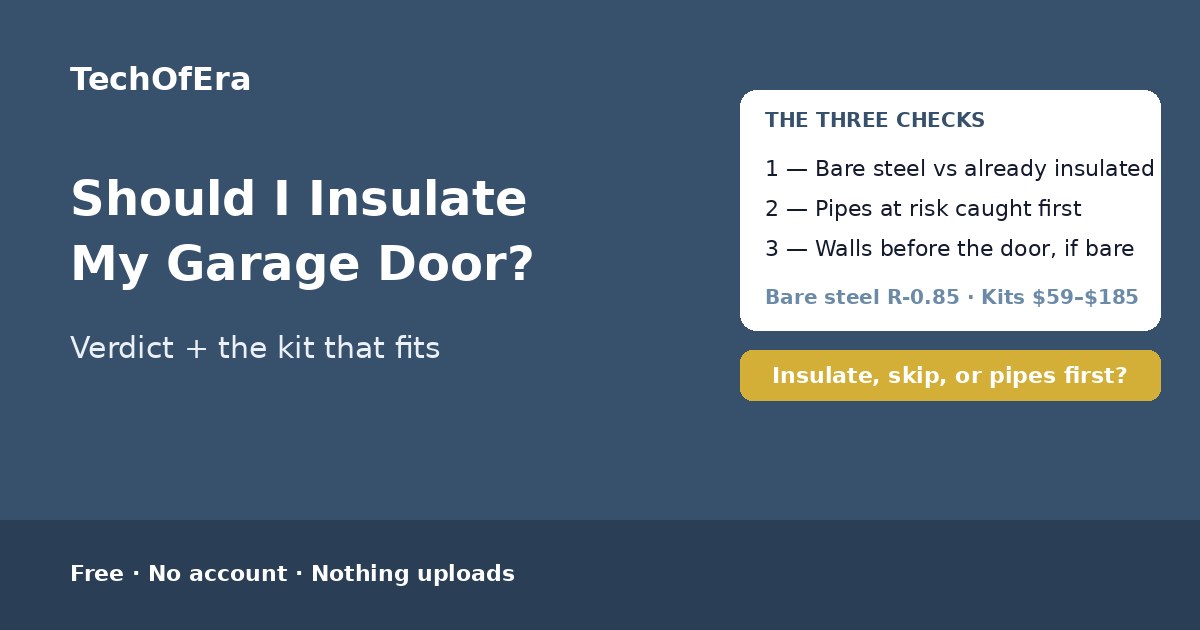
A bare single-layer steel door is about R-0.85 — a thin sheet of steel with nothing inside it — and on an attached garage it is often the coldest wall in the house. But a kit is only worth it on the right garage. A detached garage you only park in, in a mild climate, has little to gain; a garage with a room above it, or one you work in through a cold winter, has a lot. The guides agree on the shape of the answer, and this checker turns it into a verdict for your exact garage: how cold your winters are, how you use the garage, whether it is attached, what the door is made of, whether pipes or a water heater sit in it, whether it is heated, whether the walls are insulated, what state the seals and the door are in, and what you can spend — into one of six verdicts, the kit that fits, its R-value, and the payback as the checker's own estimate.
To use it:
- Pick how cold your winters get. Very cold means regularly below -10°C (14°F); cold means regularly below freezing; mild means rarely below freezing. The colder the winter, the more a bare steel door costs you.
- Say how you use the garage. Parking only, a workshop or gym, laundry or cold-sensitive storage, or a living space above or beside it. The use decides how much the kit is worth: a room above the garage is the strongest case, parking only is the weakest.
- Say what the door is made of. Look at the inside face and tap the panels: bare, ribbed steel that sounds thin and tinny has no insulation. If your door already has a polystyrene or polyurethane core, a kit is not worth the effort — the checker says so.
- Say whether pipes or a water heater sit in the garage, whether it is heated, and whether the walls are insulated. Pipes in an unheated garage in a cold winter are the urgent job, before any kit. And in an attached garage, DOE puts the shared wall and the floor over the garage before the garage door.
- Say what state the seals and the door are in, and what you can spend. Gaps around the door often let in more cold than the panels themselves, a rusted door or worn springs means plan a replacement instead of a kit, and the budget picks the kit: reflective foil about $59–$90, an EPS kit about $80–$100, a fibreglass batt kit about $120–$185.
What makes this checker different
The pages that rank for this search are guides — they tell you how to insulate a garage door, which kit to buy, and how to fit it, step by step. None of them asks about your garage and gives you a verdict. One guide embeds a garage insulation planner, but it plans the whole garage, not the door question. There is no free, standalone checker that takes your climate, use, door, pipes, heating, walls, seals, condition and budget and gives you a score, a verdict (insulate now, worth it, skip it, walls first, or pipes at risk), the kit that fits, its R-value, and the payback. This page is that answer: ten questions, an instant verdict for your exact garage, the blockers named, and the next steps. It is a self-assessment, so it says plainly what it cannot know: it cannot inspect your door or test your springs, and where a rusted door, worn springs or pipes at risk are involved it says get a professional in instead of fitting a kit.
When is this the right check?
When the room above the garage is the coldest in the house — because the garage below it is why, and the floor over the garage matters as much as the door. When the garage feels freezing on cold mornings and you work in it — because a bare steel door is usually the coldest wall in the garage. When pipes in the garage froze last winter — because that is the urgent job, and a kit will not fix it on its own. When you are about to buy a kit and want to know which one — because the checker names it, with its R-value and price, for your door and budget. And when the heating bill arrives and the garage is attached — because the door is the biggest hole in the garage, and the cheapest upgrade you can make yourself.
Honest limitations
A self-assessment, not a survey
This checker cannot inspect your door, test your springs, or know whether the walls are insulated behind the plasterboard. It cannot check whether the door will hold its balance, or whether the pipes in the garage are at risk. If the door is rusted, dented, or will not stay balanced, get a garage door technician in before touching anything.
The R-value is an estimate, not a measurement
A bare single-layer steel door is about R-0.85 by the DASMA method, and a factory-insulated steel door is typically R-6 to R-10. The kit R-values are the ones the guides list — EPS R-4.8, fibreglass R-8, reflective R-3 to R-6, XPS about R-5 per inch, polyiso about R-6 per inch — and the exact figure is on the kit box.
The payback is the checker's own estimate, not a promise
No guide publishes a dollar saving for a garage door kit, because it varies too much from home to home. Trade sources cite 10–20% less energy loss for attached garages with a well-insulated door — their figure, not a promise. The payback band here is the checker's own estimate from your score, and it says so.
Seal the gaps first
Insulated panels will not help much if cold air pours in around the door. Gaps at the bottom and sides often let in more cold than the panels themselves. Close the door on a sunny day and turn off the garage lights: any daylight showing around the edges is a gap worth sealing, before any kit goes on.
Pipes come before the kit
Insulation slows heat loss, it does not create heat. A kit on the door will not keep pipes in an unheated garage from freezing: the American Red Cross says never let the temperature where pipes run drop below 55°F (13°C), and pipes in unheated spaces can freeze at 20°F (-7°C). Protect the pipes first.
Rules from the guides and DOE, dated November 2026
The rules here are the garage-door guides' kit comparisons (R-values and prices as listed in November 2026), DOE's Energy Saver guidance on attached garages (the house side first), and the American Red Cross 55°F floor for pipes. Guidance changes: recheck with a professional if anything about your home changes.