How the loft insulation check works
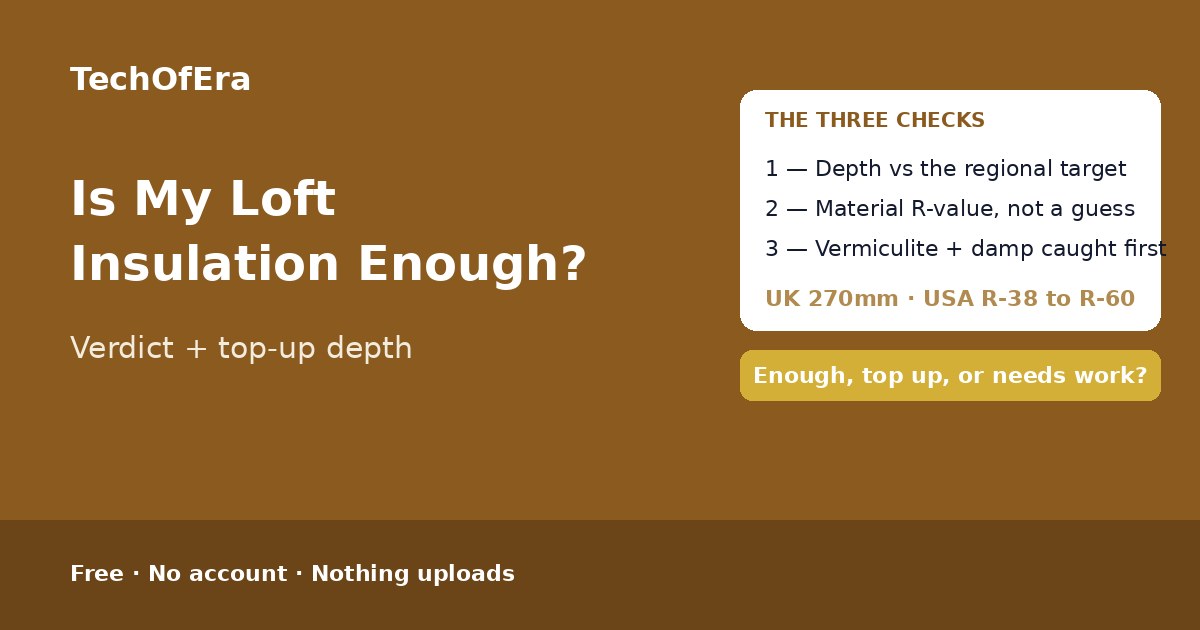
The Energy Saving Trust puts the roof's share at up to a quarter of a home's heat loss when the loft is uninsulated, and ENERGY STAR says a home with low insulation levels could easily have utility bills 10% higher than a well-sealed, insulated home. But whether your loft is enough depends on two numbers: how deep the insulation is, and what the target is where you live. A loft in Scotland needs 350mm of mineral wool, one in the warm south of the USA needs R-38, and one in the cold north needs R-60 — the same depth can be plenty in one place and far too little in another. This checker turns your measured depth and material into an R-value, compares it with the target for your region, and names the verdict, the top-up depth, and how much the top-up cuts the heat flowing through the roof.
To use it:
- Pick your region. The target depends on the climate: 270mm of mineral wool in most of the UK, 350mm in Scotland, R-38 to R-60 across the USA by climate zone, R-60 in Canada and northern Europe, R-30 in Australia, New Zealand and southern Europe.
- Measure the depth. Open the hatch with a torch and a tape measure, push the tape straight down to the ceiling in three or four spots, away from the hatch, and take the average. Do not walk on the insulation — the ceiling below will not hold you. If you have not measured, answer whether you can see the tops of the joists instead: if you can, the insulation is at most about 100mm (4 in) deep.
- Say what it is made of. Grey or white fluff is mineral wool, grey-brown shredded paper is cellulose, pink or yellow blankets are batts — and grey-brown pebbles are vermiculite, which you should not disturb until it has been tested. An inch of one material is not an inch of another: mineral wool is about R-3 per inch, cellulose about R-3.5, closed-cell spray foam about R-5.7.
- Say how evenly it covers the loft, how old the home is, and how the loft is used. Even coverage matters as much as depth, homes built before the 1980s usually have far less than the current target, and boards laid over the insulation squash it and cut its rating.
- Tick what you notice. Cold upstairs rooms, high bills, ice dams and a draughty hatch are all clues that the loft is thin. Damp in the loft is different: it is a blocker, and adding insulation over damp insulation traps the moisture.
What makes this checker different
The pages that rank for this search are guides — ENERGY STAR's own self-check, which tells you to measure the depth and multiply by 3, and local installer guides that tell you the target for one state or one city. None of them asks how deep your insulation is, what it is made of, how evenly it covers the loft, or where you live — and none of them gives you a verdict. The insulation calculators that rank for the quantity question — how many bags or rolls to buy — answer a different question: they need the area, the climate zone and the material, and they price the job, but they never say whether what is already up there is enough. There is no free, standalone checker that takes your measured depth, material, coverage and region and gives you a score, a verdict (enough, top up, or needs work), the top-up depth, and the heat the top-up saves. This page is that answer: seven questions, an instant verdict for your exact loft, the blockers named, and the next steps. It is a self-assessment, so it says plainly what it cannot know: it cannot measure your loft, and where vermiculite, damp or a converted room is involved it says get a professional in instead of adding more depth.
When is this the right check?
When the heating bill arrives and the upstairs rooms never quite warm up — because the heat rises, escapes through a thin loft, and the top floor never catches up. When you can see the tops of the joists from the hatch and wonder whether that means anything — because it does: it means the insulation is at most about 100mm deep, well short of the 270mm target. When ice dams or icicles form along the roof edge — because heat escaping through a thin loft melts snow on the upper roof, which refreezes at the cold eaves. And when you are about to pay for a top-up and want to know how much you actually need — because the checker names the depth in millimetres and inches, for your material, before anyone quotes you a price.
Honest limitations
A self-assessment, not a survey
This checker cannot measure your loft, test your insulation, or know whether the layer is damp or compressed. It cannot check whether the insulation is vermiculite, whether the soffit vents are blocked, or whether the loft is damp. If the insulation looks grey-brown and pebbly, or the loft smells damp, get a professional in before touching anything.
The R-value is an estimate, not a measurement
The R-value per inch is the middle of the published range for each material — about R-3 for mineral wool, R-3.5 for cellulose, R-5.7 for closed-cell spray foam — and the exact figure is on the product bag or roll. Settled, compressed or damp insulation rates lower than the label, which is why the checker asks about coverage and loft use as well as depth.
The saving is a heat-flow cut, not a bill promise
Heat flow through the ceiling is proportional to 1/R, so topping up from R-now to R-target cuts the roof heat flow by (1 - R-now / R-target). That is a physics statement about the roof, not a promise about your bill: your saving depends on your heating system, your tariff and how cold the winter is.
Air sealing comes first
Insulation slows heat but does not stop air. Gaps around light fittings, plumbing stacks, wall top plates and the loft hatch have to be closed before the new layer goes on — and insulation pushed into the eaves blocks the soffit vents and traps heat and moisture. A top-up on top of air leaks is money spent twice.
Vermiculite is a stop sign, not a top-up
Older grey-brown pebbly vermiculite fill is a known asbestos concern. Have it tested before you disturb it, walk on it, or add a layer on top of it: the EPA advises leaving undamaged asbestos-containing material alone, and removal is a job for a licensed contractor.
Rules from official sources, dated November 2026
The rules here are ENERGY STAR's attic insulation guidance (the joist test, the depth-times-3 rule, R-38 to R-60 by climate zone, and the 10% higher bills figure), the UK 270mm mineral wool recommendation (350mm in Scotland), and the Energy Saving Trust's quarter-of-heat-loss figure, as they read in November 2026. Guidance changes: recheck with a professional if anything about your home changes.