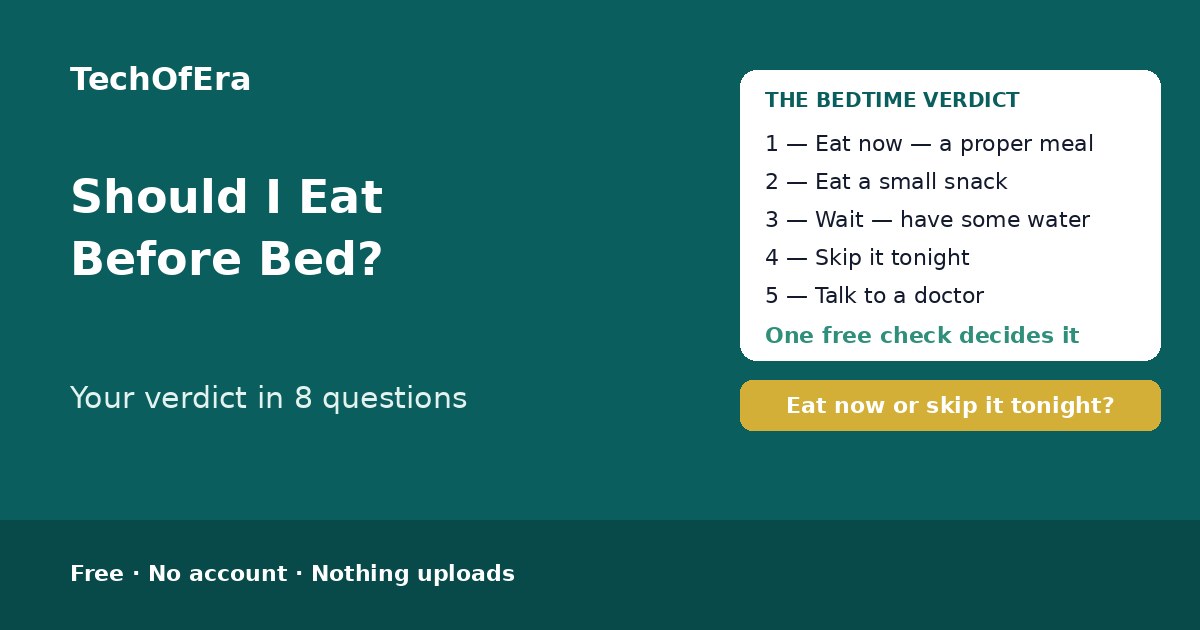
How the eat-before-bed check works
Eating before bed is a genuine argument, not a settled rule — and the experts disagree about the details. The Cleveland Clinic says to stop eating about three hours before going to bed, because eating late works against your circadian rhythm and your insulin sensitivity drops at night. The Sleep Foundation says the same: eating within three hours of bedtime increases the likelihood of sleep disruptions, and the risk may be even greater if you overeat at dinner. But both sources add the other half of the story: going to bed hungry can also disrupt your sleep. A small snack 30 to 40 minutes before bed is fine if you feel a little hungry, says the Sleep Foundation's medical reviewer. So the right answer depends on your evening: how soon bedtime is, how hungry you are, what you would eat, whether you get heartburn, how you usually sleep, diabetes or night-time lows, weight goals, and how often you eat late. This checker weighs all eight and gives you a verdict: eat now, eat a small snack, wait, skip it tonight, or talk to a doctor.
To use it:
- Say how soon bedtime is. More than 3 hours away, 2–3 hours, 1–2 hours, or under an hour. Three hours is the gap the Cleveland Clinic and the Sleep Foundation point to — and it is the single biggest driver of the verdict.
- Say how hungry you are. Not hungry at all, a little hungry, very hungry, or ravenous. Real hunger changes the answer: going to bed starving disrupts your sleep more than a tiny snack does.
- Say what you would eat. A light snack, a balanced small meal, a heavy meal, spicy or acidic food, something sugary, or caffeine or alcohol. What you eat matters as much as when: a banana with peanut butter and a pizza are not the same decision.
- Say whether you get heartburn or acid reflux. Never, sometimes, or often. Heartburn is the first thing late eating makes worse, because lying down lets stomach acid move upward.
- Say how you usually sleep. Fall asleep easily, sometimes struggle, or often struggle. If you already struggle, eating close to bed is one of the things making it worse — Sleepopolis reports that eating within three hours of bedtime could increase your chances of waking up during the night by up to 40 percent.
- Say whether you have diabetes, or feel low overnight. No diabetes, type 2, type 1, or that you often feel shaky or low overnight. For people with diabetes, a bedtime snack can prevent blood glucose from dropping very low during the night — but it is a blood-sugar decision, not a snack decision.
- Say whether you are trying to change your weight. No, trying to lose weight, or trying to gain weight. Eating before bed does not automatically cause weight gain — what matters most is your overall eating pattern — but late snacking often adds calories you would not otherwise eat.
- Say how often you eat late at night. Rarely, a few nights a week, or every night. A nightly habit matters more than a one-off snack: the Sleep Foundation survey found every-night snackers go to bed about an hour later than people who never snack.
The five verdicts, and what each one means
Eat now — a proper meal is fine
Bedtime is more than three hours away, so your body has time to digest before you lie down. The Cleveland Clinic and the Sleep Foundation both point to three hours as the gap to aim for, and you have it. Eat a proper meal now, and finish at least three hours before bed.
Eat a small snack, not a meal
You are hungry and bedtime is one to three hours away — or you are ravenous with under an hour to go, and going to bed starving would disrupt your sleep more than a tiny snack. Keep it light and small: Greek yogurt, a banana with a tablespoon of peanut butter, a handful of nuts, or vegetables with hummus — the snacks the Cleveland Clinic and Hartford Healthcare both recommend.
Wait — have some water and see how you feel
You are not hungry, or only a little hungry with under an hour to bed. A glass of water and twenty minutes will tell you whether the hunger is real. The Sleep Foundation says a small snack 30 to 40 minutes before bed is fine if you feel a little hungry — so if the hunger grows, a tiny light snack is still on the table. Right now, waiting is the better call.
Skip it tonight
Bedtime is under an hour away, and what you would eat is heavy, spicy, sugary or caffeinated — or you often get heartburn. Your stomach will still be working when you lie down, and the acid will move upward. Skip it tonight, have some water, and eat a proper meal earlier tomorrow so the hunger does not strike again at midnight.
Talk to a doctor — your pattern needs a professional look
You often feel shaky or low overnight, which can be low blood sugar — or you often get heartburn and you eat late every night, a combination that keeps disrupting your sleep and can damage the oesophagus over time. Either way, the answer is not a better snack: it is a professional look at the pattern. Book an appointment, and keep a note of what you eat, when, and how you sleep.
Which answer for which evening
The reference table the checker works from — your evening on the left, the verdict it points to on the right:
| Your evening | Verdict | Why |
|---|---|---|
| Bedtime more than 3 hours away | Eat now — a proper meal is fine | Digestion has time before you lie down |
| Bedtime 2–3 hours away, very hungry | Eat a small snack, not a meal | Inside the three-hour gap, but real hunger needs settling |
| Bedtime 1–2 hours away, a little hungry | Eat a small snack, not a meal | A tiny light snack 30 minutes before bed is fine |
| Bedtime under an hour away, not hungry | Wait — have some water and see how you feel | No reason to eat for the sake of it |
| Bedtime under an hour away, ravenous | Eat a small snack, not a meal | Going to bed starving disrupts sleep more than a tiny snack |
| Bedtime under an hour away, heavy meal | Skip it tonight | Heavy food takes hours to digest; acid moves up when you lie down |
| Bedtime under an hour away, spicy or sugary food | Skip it tonight | Spicy food and sugar are heartburn and wake-up triggers |
| Bedtime under an hour away, caffeine or alcohol | Skip it tonight | Caffeine keeps you awake; alcohol fragments sleep |
| Heartburn often, bedtime under an hour away | Skip it tonight | Lying down this soon lets stomach acid move upward |
| Often feel shaky or low overnight | Talk to a doctor | That can be low blood sugar — a blood-sugar decision, not a snack decision |
| Heartburn often and eat late every night | Talk to a doctor | The combination keeps disrupting sleep and can damage the oesophagus |
| Trying to lose weight, late snacking | Eat a small snack, not a meal | Late eating does not automatically cause weight gain — but keep it small and count it |
Your step-by-step evening plan
Whatever the verdict, this is the evening the checker is aiming for — the plan it builds from your answers:
- Finish your last meal at least three hours before bed. That is the gap the Cleveland Clinic and the Sleep Foundation point to. If your bedtime is 11 p.m., finish eating by 8 p.m. — and make dinner a proper meal, so the late-night hunger does not strike in the first place.
- Eat enough during the day. The Hartford Healthcare dietitian says getting enough calories and protein during the day is what stops the night-time hunger. If you are ravenous at 10 p.m., the problem started at lunch, not at bedtime.
- If you are hungry inside the three-hour gap, keep it small and light. Greek yogurt, a banana with a tablespoon of peanut butter, a handful of nuts, or vegetables with hummus. Keep the portion small, and finish at least 30 minutes before bed.
- Swap the heavy, spicy, sugary and caffeinated food. Pizza, curry, chilli, ice cream, cookies, coffee and wine are the foods that disrupt sleep this close to bed. If that is what you were about to eat, the swap is the verdict.
- Stay upright after eating. Lying down removes gravity's help, so stomach acid moves upward. If heartburn still strikes, sleep on your left side with your head slightly raised — the position the Sleep Foundation notes is often recommended for night-time reflux.
- Watch for a pattern, and act on it. One late snack is nothing. Eating late every night, feeling shaky or low overnight, or heartburn that keeps waking you — those are patterns, and they need a doctor, not a better snack.
What makes this checker different
The pages that rank for this search are articles — a Cleveland Clinic dietitian's walkthrough, a Sleepopolis explainer, a UPMC guide, a Hartford Healthcare dietitian's piece, and Sleep Foundation survey coverage. They all answer the same question in words: stop eating three hours before bed, and here are the good and bad snacks. None of them asks how soon your bedtime is, how hungry you are, what you would actually eat, whether you get heartburn, or whether you feel low overnight — and none of them gives you a verdict for tonight. This page is the answer the articles do not give: eight questions, an instant verdict, the blockers named, and an evening plan built from your answers. It is a self-assessment, so it says plainly what it cannot know: it cannot see your stomach, your blood sugar or your sleep.
This checker also answers a different question from the Should I Drink Water Before Bed? Checker — that one is about hydration timing, this one is about food. The two go together: a glass of water is often the right answer to a little hunger, and the water checker covers the night-time bathroom trips this one does not.
When is this the right check?
When it is 10 p.m., you are standing in the kitchen, and you cannot decide whether the snack in your hand is a good idea or a bad night. When you keep waking up at 2 a.m. and you suspect the late dinner is why. When heartburn keeps waking you and you want to know whether the timing or the food is the trigger. When you have diabetes and you are not sure whether a bedtime snack helps or hurts. And when you eat late every night and you want to know whether tonight is the night to break the habit — because the checker will tell you, and give you a plan for tomorrow too.
Honest limitations
A self-assessment, not medical advice
This checker cannot see your stomach, your blood sugar or your sleep. It cannot tell whether your night-time lows are low blood sugar, or whether your heartburn needs treatment. If you often feel shaky or low overnight, or heartburn keeps waking you, talk to a doctor.
The three-hour rule is a guideline, not a law
The Cleveland Clinic says about three hours, the Sleep Foundation says at least three hours, and other sources say two to four. Your digestion is your own: some people empty their stomach in two hours, others take four. The checker uses three hours as its cut-off and says so, rather than pretending the number is exact for everyone.
“A little hungry” is a judgement, not a measurement
Most people judge hunger by feel, and “a little hungry” and “very hungry” can look alike. If you are not sure which one yours is, the checker treats a little as wait and very as a small snack — and says so in the answer, rather than pretending it measured your hunger.
The diabetes answers are general, not personal
A bedtime snack for diabetes depends on your medication, your glucose readings and your care team's plan — the American Diabetes Association recommends a personalised plan, and this checker cannot build one. It flags the pattern and points you to your doctor; it does not tell you what to eat.
One person at a time
This checker looks at one person's evening at a time. It does not check the other people in the household, and it does not ask whether anyone else in the house eats late or gets heartburn — so run it once per person, and talk to a doctor for anyone who often feels shaky or low overnight.
Rules from official sources, dated November 2026
The rules here are the sleep and nutrition guidance from the Cleveland Clinic, the Sleep Foundation, Sleepopolis, UPMC, Hartford Healthcare, the National Institute of Diabetes and Digestive and Kidney Diseases, Medical News Today and the American Diabetes Association, as they read in November 2026. Guidance changes: recheck with a doctor if anything about your health, your medication, or your sleep changes.