How the cover-your-plants check works
Whether to cover your plants tonight is a trade-off, not a yes-or-no question. Frost forms on clear, calm nights when the forecast low is 33–36°F (1–2°C), even though the air stays above freezing — and a light freeze of 29–32°F (−2–0°C) kills tender plants like tomatoes, peppers and basil. But hardy vegetables shrug off a light frost, a cloudy night keeps frost away entirely, and a cover put on wrong protects nothing. This checker weighs all of it — tonight's forecast low, the sky and wind, what you are protecting, where it grows, what cover you have, how established it is, how moist the soil is, and whether frost has already hit — and gives you a verdict: cover them tonight, bring them in or harvest, cover them but do it right, or no need to cover tonight, plus a step-by-step cover routine.
To use it:
- Check tonight's forecast low. Above 40°F (4°C) means no frost risk; 37–40°F (3–4°C); 33–36°F (1–2°C); 29–32°F (−2–0°C); 25–28°F (−4–−2°C); or below 25°F (−4°C). 32°F is the line for tender plants — and on a clear, calm night, frost can form at 33–36°F.
- Say what the sky and wind are doing tonight. Clear sky and calm is frost weather; clear but windy is less risky; cloudy and calm, cloudy and windy, or rain expected all keep frost away. Frost forms on clear, calm nights — cloud and wind are your friends.
- Say what you are protecting. Tender vegetables — tomatoes, peppers, basil, squash, beans, cucumbers; tropicals or houseplants out for the summer; tender flowers — impatiens, petunias, begonias, marigolds; hardy vegetables — kale, spinach, carrots, broccoli, lettuce; shrubs and perennials in the ground; or fruit trees or bushes in bloom. Tender plants need covering; hardy ones usually do not.
- Say where they grow. In the ground, in pots or planters, in raised beds, in hanging baskets, or in a greenhouse or cold frame. Pots lose heat fast and are worth moving; plants in the ground hold the soil's warmth.
- Say what cover you have. Frost cloth (row cover), old sheets or blankets, buckets, pots or boxes to put over them, plastic sheeting, or nothing at all. Frost cloth is best, old sheets work well, and plastic needs cloth underneath it.
- Say how established they are. New seedlings just planted out, recently planted a few weeks in, established this season, or dormant, or finished for the year. New seedlings are the most tender — cover them on any night forecast at 36°F or below.
- Say how moist the soil is. Moist soil, dry soil, or just watered today. Moist soil stores far more heat than dry soil, and hydrated plant tissue tolerates cold better than drought-stressed tissue — water dry soil the day before a frost.
- Say whether frost has already hit this season. No frost yet, a light frost has already hit, or a hard freeze has already hit. If a hard freeze has already hit, covering tender plants now will not bring them back.
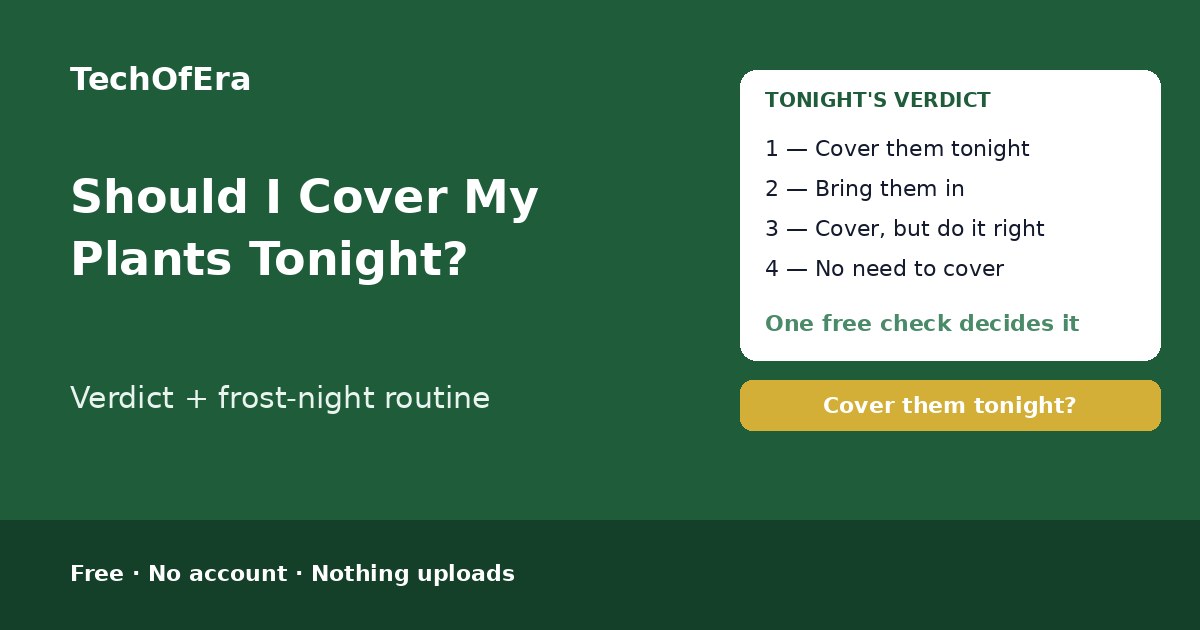
The four verdicts, and what each one means
Yes — cover them tonight
Tender plants and a frost or freeze in the forecast. Cover them before sunset, so the cover traps the heat the soil banked all day. Drape the cover right down to the ground on all sides and anchor it, and uncover in the morning once temperatures climb back above freezing.
Bring them in — or harvest
Covers will not save these plants tonight: pots lose heat fast, tropicals are hurt in the mid-40s, and below about 28°F covers stop working. Move pots and baskets under cover or indoors, and harvest what is ripe — a hard freeze tonight is a harvest night, not a covering night.
Cover them — but do it right
Tonight is borderline, or the method needs fixing: cover before sunset, drape the cover to the ground and anchor it, keep plastic off the leaves, and uncover in the morning. A cover put on wrong — cinched around the stem, or left on all day — protects nothing.
No need to cover tonight
Nothing tonight is cold enough, tender enough or exposed enough to need a cover. Hardy plants shrug off a light frost, and a cloudy or windy night keeps frost from forming. Save the covers for a colder, clearer night — and check the forecast again tomorrow.
Your frost-night routine
Whatever the verdict, this is the evening the checker is aiming for — the routine it builds from your answers:
- Water dry soil a day or two ahead. Moist soil stores far more heat than dry soil, and hydrated plant tissue tolerates cold better than drought-stressed tissue. Water the root zone deeply, 24 to 48 hours before the cold night — this is the single most skipped step, and it costs nothing.
- Top up the mulch. Mulch the root zone 2 to 3 inches over the roots, keeping it off stems. Mulch banks the day's heat in the soil, and the cover traps it there.
- Cover before sunset. Put the cover on in the late afternoon, before the sun goes down, to trap the heat that built up in the soil all day. A cover put on after dark traps cold air, not warm soil.
- Drape it to the ground and anchor it. The cover works by catching the heat rising from the soil, so it has to reach the ground on all sides — a cover cinched around the trunk protects nothing, because the heat source is the ground, not the plant. Anchor the edges with soil staples, bricks or lumber so wind cannot lift the tent.
- Keep plastic off the leaves. Cloth beats plastic every time. If you only have plastic, put frost cloth or a sheet under it, and only add plastic above the cloth if freezing rain is coming.
- Move the pots. Wheel potted tropicals and citrus into the garage, where even an unheated space beats open wind by 10 degrees or more across a cold night. Group pots together, or against a south- or west-facing wall.
- Uncover in the morning. Take the covers off once temperatures climb back above freezing, so the plants get light and air between frost nights. Covers left on all day block both.
What makes this checker different
The pages that rank for this search are guides — a Gardenary walkthrough of when to cover a vegetable garden, a Sow & Sprout frost-advisory explainer, a Green Thumb nursery guide for Southern California, a homestead frost-protection guide, and a freeze-warning alert page. None of them asks what your forecast low is tonight, whether your sky is clear or cloudy, what you are protecting, or whether your plants are in pots or in the ground — and none of them gives you a verdict for tonight. There is no free, standalone checker that takes your forecast, your plants and your cover and turns them into a verdict with a frost-night routine. This page is that answer: eight questions, an instant verdict, the blockers named, and the next steps. It is a self-assessment, so it says plainly what it cannot know: it cannot read tonight's forecast for your street, feel how cold your garden is, or know your plants.
When is this the right check?
When the first frost advisory of the season shows up and you are not sure whether your tomatoes are worth saving — because a few minutes before sunset is all it takes, and the checker tells you whether those minutes are worth spending. When your tropicals are still on the patio and the nights are dipping toward 40°F — because tropicals are hurt in the mid-40s, well above freezing, and the answer for them is bring them in, not cover them. When you have a hard freeze forecast and a garden full of ripe vegetables — because that is a harvest night, not a covering night, and the checker says so instead of letting you waste the evening on covers that will not work. And when you are standing in the garden at dusk with an old sheet in your hand, wondering whether it is worth the effort — because the checker answers that in seconds, from the forecast you already looked up.
Honest limitations
A self-assessment, not a weather forecast
This checker cannot read tonight's forecast for your street, feel how cold your garden is, or know your plants. It cannot tell whether frost will actually form in your yard tonight. Check your weather app for tonight's low before you answer, and where the answer is unclear it says cover them instead of guessing.
Your yard can run colder than the forecast
Forecasts measure the air at a weather station, and low pockets of your yard can run colder than the weather app admits. A cold pocket, a low spot, or a garden far from the nearest station can all turn a forecast of 36°F into frost on your plants. If your garden sits low, cover a degree earlier than the checker says.
The 28°F cover limit is a rule, not a guarantee
Covers help down to about 28°F, and a double layer of heavyweight frost cloth can hold a few degrees more — but a long freeze, a windy night, or a cover that does not reach the ground can all break the rule. A freeze lasting five hours or more can damage tender plants even above 28°F.
“Tender” covers a wide range
Two plants in the same group can handle cold very differently: a tomato and a basil plant are both tender, but basil dies first, and a pepper holds on a little longer. The checker works in groups, not species — if you know your exact plant is hardier or more tender than its group, trust what you know.
Without your forecast low, the routine is a rule, not a plan
The forecast low decides whether tonight is a cover night, a bring-in night, or a skip night, and guessing it wrong by a few degrees changes the answer. The checker still works without it, but it gives the cover-them rule instead of a tailored routine — and the verdict drops to low confidence until the low is known.
Rules from official sources, dated November 2026
The rules here are the frost and freeze guidance from the US National Weather Service, Iowa State Extension, Gardenary, Sow & Sprout, Green Thumb Nursery and Ellis Landscape Services, as they read in November 2026. Guidance changes: recheck with your local extension service if anything about your climate, your plants, or your garden changes.