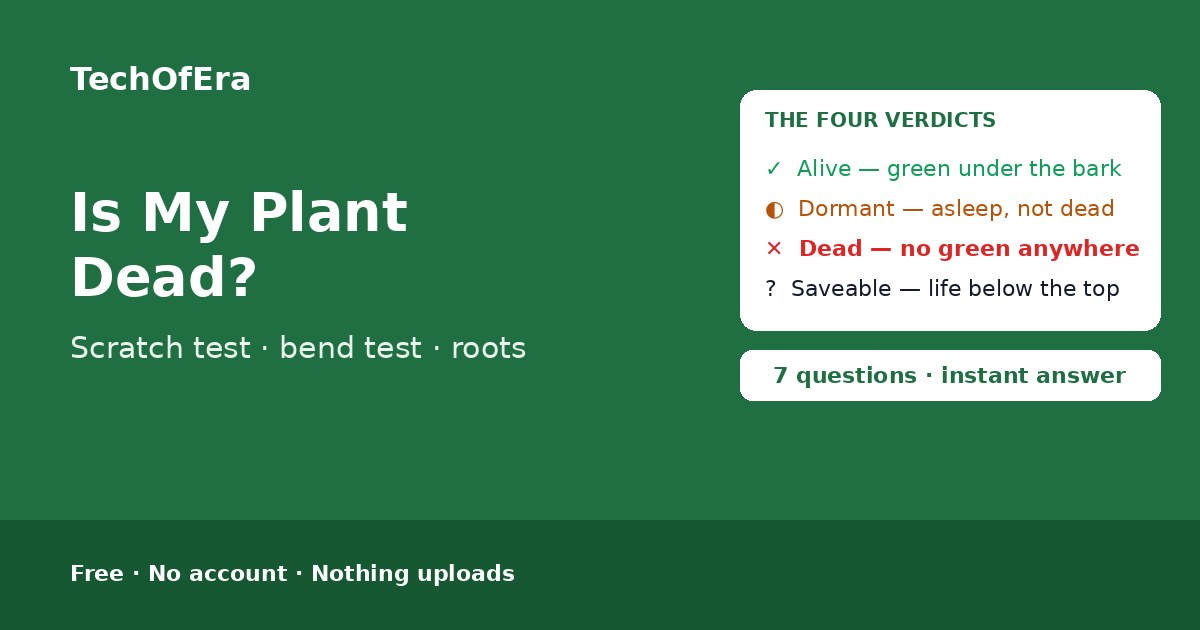
Is my plant dead — or just dormant?

A bare, brown plant in winter may just be asleep — or it may be gone. The scratch test, the bend test, the roots and the crown decide it in a minute. Answer seven questions and get an instant verdict for the exact plant you are looking at. Entirely in your browser.

  • Instant verdict — alive, dormant, saveable, or dead
  • The scratch test and bend test, step by step
  • Dead signs named — brown bark, hollow stems, rotted roots
  • Free, no account, nothing uploads
Is my plant dead — or just dormant?

Check the plant

Try a preset:
0 of 7 answered

Your result

Answer the questions Your verdict appears here as you answer.
What this combination means

Answer the questions above and what this combination means will appear here.

Dead signs

Cautions

Still to confirm

Things to check

What to do next

    Your result summary


    Answer the questions above — the verdict updates live.

    Privacy you can verify, not just trust

    Checking a plant question by uploading photos of your home to a website would be backwards — the check should never be the leak. This one can't: your answers are checked with plain JavaScript on your device, and they never leave the device — the only third-party requests are the site's own analytics, which count page views. Don't take our word for it:

    New cross-origin requests during use: 0
    1. Press F12 to open developer tools, then the Network tab.
    2. Answer a question above. Watch: apart from the site's analytics, nothing new is requested — no uploads, and no data ever leaves your device.
    3. Extra credit: disconnect your internet after this page loads — the checker still works.

    How to tell whether your plant is dead or dormant

    That brown, leafless plant you have been staring at all winter may not be gone; it may just be dormant. Dormancy is a survival strategy: the plant's cells are alive, its energy is stored in the root system underground, and the above-ground parts have simply shut down until conditions improve. It looks lifeless. It isn't. Death is different — when a plant dies, its cells die, and unlike dormancy, that state is permanent. The question gardeners actually ask is not what dormancy is — it is whether this plant, the one in front of them, is still alive. This checker asks exactly what decides it.

    To use it:

    1. Do the scratch test first. Using your thumbnail or the edge of a key, gently scrape a small patch of bark from a stem. Green, moist tissue beneath means that part is alive; brown and dry means it is dead; pale yellow is a middle signal — stressed, but not gone. Work from the top of the plant downward, testing in several spots. Purdue University Extension teaches this as the first test, and Louisiana State University starts near the base, where the plant is most likely to still be alive.
    2. Do the bend test. Gently flex a small stem: if it bends without breaking, the tissue inside is still alive; if it snaps cleanly, especially if it feels hollow, that section is dead. Hollow twigs are a reliable additional signal that a branch has lost viability. One caution: experts disagree on the bend test on its own, so this checker never decides on it alone — it always pairs it with the scratch test, the roots and the crown.
    3. Check the roots. Lift the plant from its pot, or look at the drainage holes. Firm, white or tan roots are alive; black, slimy roots that fall apart when touched, with a sour or rotten smell, are rotted. If more than nine in ten roots look like that, the plant has very little left to recover with.
    4. Check the crown. The crown — the base where the stems meet the soil — is the plant's command centre, and its condition predicts recovery better than the foliage does. Firm, with tiny buds or new shoots, is good. Soft, spongy or sunken, dark brown to black, is a bad sign.
    5. Check the season. A bare plant in winter is exactly what dormancy looks like. A bare plant in June is a different story. Iowa State University Extension says do not decide a tree or shrub is dead before at least 1 June — but no bud swelling after 1 June is the warning sign.
    6. Do not judge by the leaves alone. Brown leaves alone do not mean death — the scratch test decides it, not the leaves. And new growth is the strongest sign of life there is: a plant putting out new shoots is alive, whatever the old leaves look like.

    Plant situations and what to do at a glance

    The table below is built from the same rules as the checker, so it can never disagree with your verdict. Scratch, bend, roots, crown and season decide together.

    Plant situationVerdictWhat to know

    What makes this checker different

    The pages that rank for this search are guides — thorough explanations of dormancy, the scratch test, and the bend test — but they leave you to work out what that means for the plant you are looking at right now: whether brown under the bark on the top stems matters when the base is still green, whether a stem that bends but a crown that is soft counts as alive, and whether a bare plant in winter is dormant or gone. The photo-diagnosis apps that rank alongside them want a photo, an account, and usually a subscription or credits — and their answer is a guess from pixels. This page is the answer without the upload: seven questions, an instant verdict, the reason named, and the dead signs stated plainly instead of buried in the text — with nothing to install, no account, and nothing uploaded. It is a self-assessment, so it says plainly what it cannot know: a web page cannot see your plant, so anything you mark “Not sure” stays on the list until you do the test yourself.

    When is this the right check?

    Whenever you catch yourself staring at a brown, leafless plant and wondering whether to pull it: the houseplant that dropped every leaf after a holiday, the shrub that never leafed out in spring, the tree that looks bare while its neighbours are in full leaf. Also whenever the pattern changes — a plant that was green recently and has suddenly turned brown, or one that survived the winter but shows no buds by June. And whenever you are not sure what counts: green under the bark versus pale yellow, a stem that bends versus one that snaps, firm roots versus rotted ones. If the answer is “dead”, the checker tells you what killed it, so the replacement does not go the same way.

    Honest limitations

    A self-assessment, not a diagnosis

    This checker works only from the answers you enter. It cannot see your plant — no web page can scratch the bark, bend a stem, or smell the roots. If an answer is wrong, the verdict is wrong. When in doubt, do the tests again, or ask a local nursery.

    The bend test is disputed

    Experts disagree on the bend test on its own: Louisiana State University says a twig that flexes is alive and one that snaps cleanly is dead, while a University of Nebraska-Lincoln column describes bare branches that are still flexible and bend easily and are dead anyway. This checker never decides on the bend test alone.

    Perennials play by different rules

    For herbaceous perennials, plants without woody stems, the scratch and bend tests do not apply the same way — survival happens underground, and patience is the only real tool. Many, like hibiscus, buddleia and rudbeckia, are naturally late emergers.

    Wait until 1 June for trees and shrubs

    Iowa State University Extension says do not decide a tree or shrub is dead before at least 1 June, and some experts give later deadlines, up to midsummer. A bare tree in late spring looks like an emergency, and sometimes it is only a schedule.

    Partly dead is not all dead

    Dead upper branches do not rule out living tissue below. Green low on the trunk means part of the plant is still alive even if the top is dead — prune the dead wood back to live, green tissue and watch the base for new shoots.

    Rules from university extension services

    The rules here follow the scratch, bend, root and crown tests taught by Purdue University Extension, Iowa State University Extension, Louisiana State University AgCenter and the University of Nebraska-Lincoln, as they read in November 2026. Guidance can be revised, so re-check if a new edition appears.

    Frequently asked questions

    Is my plant dead or just dormant?

    Do the scratch test first: gently scrape a small patch of bark with your thumbnail. Green, moist tissue underneath means the plant is alive — Country Living puts it plainly: if it is green underneath, the plant is fine, it is just dormant. Brown and dry means that part is dead. Then try the bend test: a stem that bends without breaking is alive, one that snaps cleanly like a dry twig is dead at that point. Dormancy is hibernation, not death — as master gardener Eric Preston Stout told The Spruce, all plants go dormant — so a bare plant in winter with green under the bark is alive, not gone. A plant is almost certainly dead only when there is no green tissue anywhere, even near the base, the stems all snap cleanly, the roots are black and mushy, and the crown is soft and dark.

    How do I do the scratch test?

    Gently scrape a small patch of bark from a stem with your thumbnail or the edge of a key — just enough to see the tissue underneath. Green, moist tissue means that part is alive; brown and dry means it is dead; pale yellow is a middle signal that the plant is stressed but not gone. Work from the top of the plant downward, testing in several spots, because dead upper branches do not rule out living tissue below. Louisiana State University starts the scratch test near the base, where the plant is most likely to still be alive. Purdue University Extension teaches the same test for trees and shrubs, and it works on houseplants with woody stems too.

    How do I do the bend test?

    Gently flex a small stem with your hands: if it bends without breaking, the tissue inside is still moist and alive; if it snaps cleanly, especially if it feels hollow, that section is dead. Test a few stems, not just one, and test lower down if the tips snap — the base is often still alive when the top is not. One caution: experts disagree on the bend test on its own. Louisiana State University says a twig that flexes is alive and one that snaps cleanly is dead, while a University of Nebraska-Lincoln column describes bare branches that are still flexible and bend easily and are dead anyway. That is why this checker never decides on the bend test alone — it always pairs it with the scratch test, the roots and the crown.

    When is a plant definitely dead?

    A plant is almost certainly dead when the hard signs agree: no green tissue under the bark anywhere, even near the soil line; every stem snaps cleanly like a dry twig, or feels hollow; the roots are black, slimy and foul-smelling; and the crown — the base where the stems meet the soil — is soft, mushy and dark. Proven Winners horticulturist Stacey Hirvela lists mushiness in the crown or roots, the centre of a rosette-forming plant pulling free, and a plant lifting cleanly out of the ground when gently tugged as the surest signs of death. For trees and shrubs, add the calendar: Iowa State University Extension says do not decide a tree is dead before at least 1 June, but no bud swelling after 1 June is the warning sign.

    Can a plant with black mushy roots be saved?

    Sometimes — if the rot has not reached the crown and some roots are still firm and white. Cut away every black, mushy root, repot in fresh, free-draining mix, and water sparingly until new growth shows. Do not feed it until it is growing again. But if more than nine in ten roots are black and slimy, the crown is soft and dark, and there is no green under the bark anywhere, the plant has very little left to recover with. The usual cause is overwatering: soggy soil rots roots, and it kills far more houseplants than underwatering does. Water only when the top few centimetres of soil are dry, and make sure the pot drains.

    My plant has no leaves in winter — is it dead?

    Probably not. A bare plant in winter is exactly what dormancy looks like: the plant has shut down above ground, its cells are alive, and its energy is stored in the roots until spring. Do the scratch test to be sure — green, moist tissue under the bark means it is alive. Then leave it alone: water only enough to stop the soil drying out completely, do not feed it, and do not prune until growth restarts. Wait for the growing season, and if nothing has leafed out by 1 June, do the scratch test again — no green by then means it is gone. For herbaceous perennials the same patience applies: survival happens underground, many are naturally late emergers, and the scratch and bend tests do not apply to them in the same way.

    Does this checker diagnose my plant or upload anything?

    No to both. This checker is a self-assessment: it works only from the answers you pick, runs entirely in your browser with plain JavaScript, and nothing you enter leaves your device. It cannot see your plant — a web page has no way to scratch the bark, bend a stem, or smell the roots — so every test you have not done is reported as something to confirm, and the result says so plainly. The only third-party requests are the site's own analytics, which count page views. You can verify it yourself with the network-request counter in the privacy section below the checker.