How the bring-it-in check works
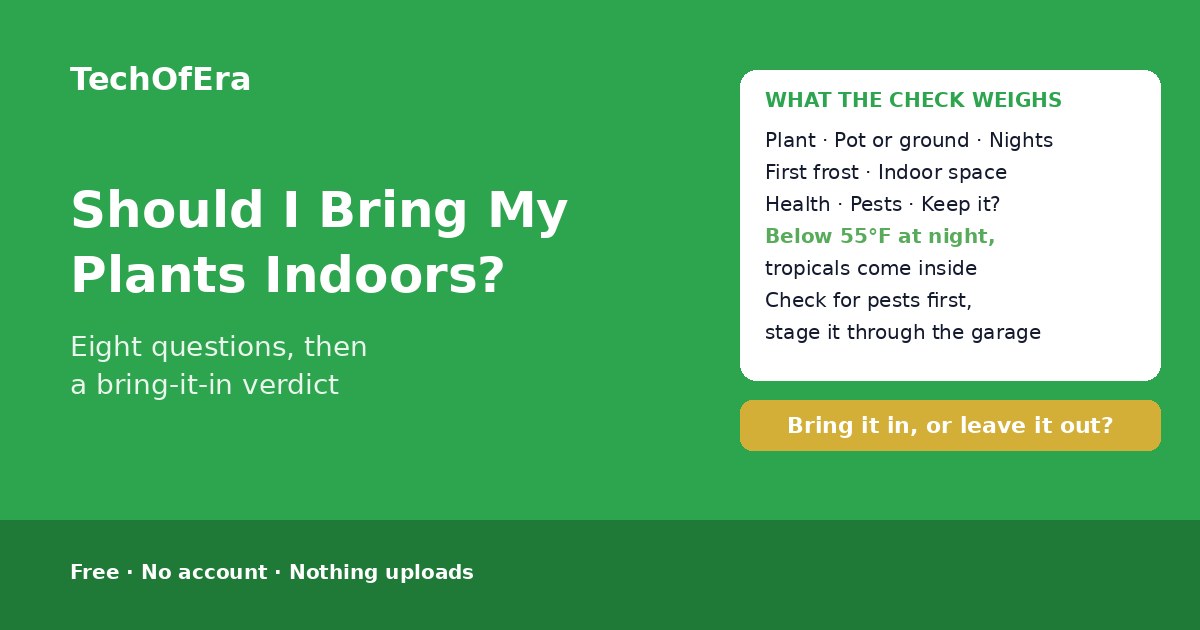
The guides that rank for this question agree on the routine and disagree on the details — one says bring everything in at 55°F, another says wait for 50°F, a third says start at 60°F. None of them scores your situation. What decides it is eight things: what kind of plant it is, whether it is in a pot or in the ground, how cold the nights are now, when the first frost is expected, what indoor space you have, how healthy the plant is, whether it has been checked for pests, and whether you want to keep it. The rule the guides agree on is simple: tropical plants come inside when the nights drop below 55°F, and hardy perennials and shrubs can stay out. Everything else is timing, staging and pest control.
To use it:
- Say what kind of plant it is. Tropical houseplants — pothos, monstera, fiddle-leaf fig — come inside when the nights drop below 55°F. Succulents grow in hot, dry conditions and struggle in the cold. Most herbs do not do well in cold temperatures: basil dies at the first frost. Flowering annuals such as begonias are sensitive to frost and cold, so they come in well before it. Palms should come inside unless you live somewhere with very warm winters. Hardy perennials and shrubs are built for winter and can stay out, in the ground at least. Vegetables and fruiting plants — tomatoes, peppers, chillies — are tender: frost kills them outright.
- Say whether it is in a pot or in the ground. A potted plant moves inside easily. One in the ground has to be dug up carefully, with as much root as you can, and potted in a container at least 2 inches larger than the root ball — or grown from cuttings, which take a fraction of the space. A hanging basket dries out fast and swings in the wind, so it gets colder than a pot on the ground: bring the basket in whole, or take the plant out and pot it.
- Say how cold the nights are now. Above 55°F, most plants are safe out there yet. At 50–55°F, tropical plants come in. At 50°F or less, most container plants start moving indoors. Below 40°F, or once frost has arrived, tender plants must come in now — a plant left out through the first frost rarely recovers. Indoors, most houseplants grow best at 65–75°F by day and 60–65°F at night.
- Say when the first frost is expected. Bring tender plants in about 50 days before the first frost, or when the nights drop below 55°F — whichever comes first. Your average first frost date is the guide; the forecast tells you this year's. If the frost is already here, do it on the next dry day — do not wait for a warmer weekend.
- Say what indoor space you have. A bright windowsill is ideal. A low-light room needs a grow light on a timer — a pothos that was happy across the room in summer may need to move closer to a window in winter. An unheated garage or basement is a halfway step, not a winter home: warmer than outdoors, cooler than the house, and the right place to acclimate the plant for a week or two. With no indoor space at all, take cuttings — they take a fraction of the space.
- Say how healthy the plant is. Bring in only the healthiest plants. A plant that has struggled all summer will only do worse indoors, and its problems will only escalate once placed inside. Prune back no more than one-third of the plant, remove dead growth, and if the plant is nearly dead, take cuttings of the healthy parts instead of the whole plant.
- Say whether it has been checked for pests. Check the leaves, under them and in the soil for aphids, mealybugs and spider mites before the plant comes in. Indoors they have no natural predators, so they multiply fast and spread to your other houseplants. Wash the plant down with water, treat what you find, and check again in a few days — one wash rarely gets them all. Keep the plant away from your other houseplants for the first week.
- Say whether you want to keep it. An annual that has finished flowering has done its job and will not come back, however well you look after it indoors. Take cuttings first if you want the same plant next year, then compost the rest. A keeper is worth the windowsill — and the pest check, and the acclimation.
What makes this checker different
The pages that rank for this search are guides — a real-estate site listing the seven plants to take inside, a botanical garden with five tips, a university extension on bringing potted plants in, a nursery with six overwintering steps, a storage company on winter plant care. None of them scores your situation: none takes your plant, your nights, your frost date, your indoor space, your plant's health, your pest check and whether it is a keeper — and none gives you a verdict — bring it inside, stage it in the garage first, leave it outside for now, treat it first, or let it go — with the plan for the verdict you got. There is no free, standalone checker that takes a plant's kind and your nights and returns a bring-it-in verdict with the 55°F rule, the garage staging and the pest check applied. This page is that answer: eight questions, and an instant verdict for your exact plant. It is a self-assessment, so it says plainly what it cannot know: it cannot see your garden, feel your nights, or know your first frost date, and where a plant would die in the frost or bring pests into the house, it tells you to do something else instead of giving you a maybe.
When is this the right check?
When the nights are dropping toward 55°F and the pots are still out on the patio — because that is the moment the tropicals come in, and by the time the frost arrives it is too late. When the plant is a succulent and the frost is already here — because a frost damages succulents fast, and the move has to happen now. When the plant has pests on it — because one infested pot can spread to the whole houseplant collection, and the treatment has to happen before the move, not after. When the only space is a garage — because the garage is the acclimation step, not the winter home, and the plant still has to come into the house. And when the plant is an annual that has finished flowering — because it will not come back, and the windowsill is better spent on a keeper.
Honest limitations
A self-assessment, not professional advice
This checker cannot see your garden, feel your nights, or know your first frost date. It scores the answers you give against what the overwintering guides say — it cannot tell you what your plant actually needs, and it is not professional advice.
The temperature rules are guides, not guarantees
55°F for tropicals, 50°F for most container plants, 60°F to start overwintering — the guides use different numbers because different plants have different limits. The variety, the pot, the soil and the shelter all change the outcome. A tender plant in a cold snap may still need to come in above 55°F.
Frost dates move year to year
“About 50 days before the first frost” is the rule the guides use, but the average first frost is an average — some years it comes early, some years late. Your local extension office can tell you your average first-frost date, and the forecast tells you this year's.
Pests hide where you do not look
Aphids, mealybugs and spider mites hide under leaves and in the soil, and a plant can look clean and still carry them. This checker asks whether you have checked, but it cannot check the plant for you — look closely, wash it down, and check again in a few days.
Indoor spaces vary too
A bright windowsill is ideal; a low-light room needs a grow light; an unheated garage that drops below freezing will kill a tropical plant. This checker asks what space you have, not how warm or bright it is — check the space itself before you move anything in.
Facts from the overwintering guides, dated November 2026
The facts here are the overwintering guides that rank for this question — Pursuit Real Estate, Green Bay Botanical Garden, University of Georgia Extension, Patuxent Nursery and Public Storage — as they read in November 2026. Guides change and winters move: recheck the numbers if anything about your plant changes.