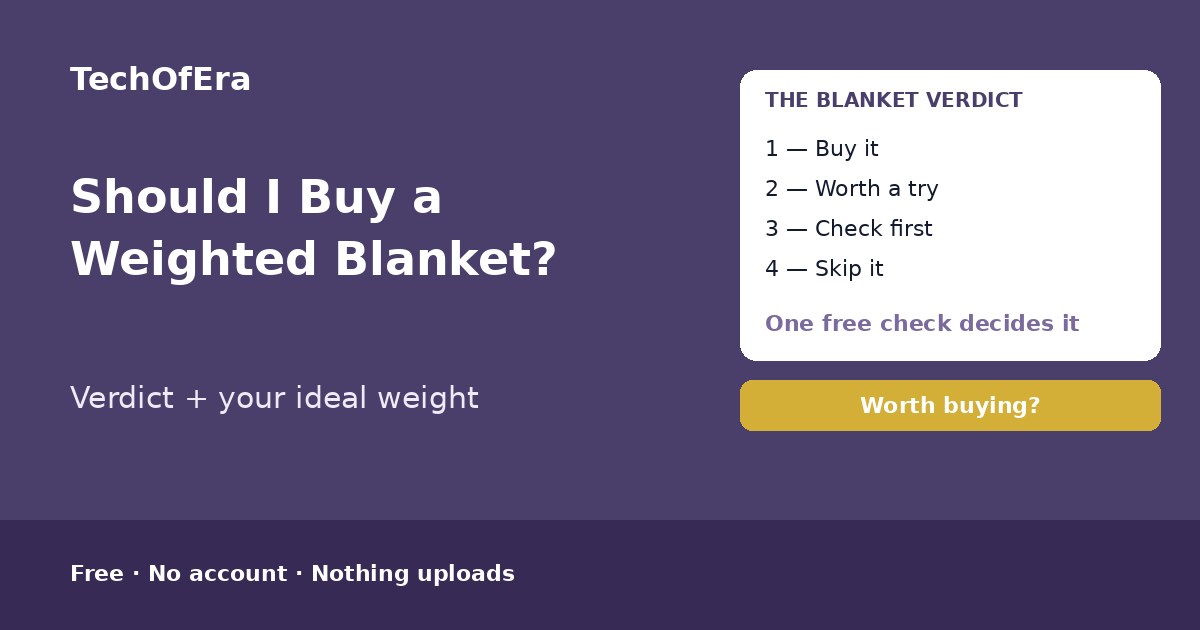
How the weighted blanket check works
A weighted blanket is one of the cheapest sleep interventions there is — a decent adult blanket costs about £50–£200 ($50–$200), and the best trial we have says it can put insomnia into remission for people whose sleep problem is driven by anxiety. It is also one of the few bedroom items that can be unsafe for the wrong person: a baby, someone who cannot breathe well under weight, or someone who cannot pull it off alone. This checker weighs all of it — your body weight, who sleeps under it, what sleep problem you want fixed, whether you run hot, what bed it is for, what you can spend, and any health flags — and gives you a verdict: buy it, worth a try, check first, or skip it — plus the blanket weight to buy and the size to buy.
To use it:
- Enter your body weight. In kilograms or pounds — the blanket weight follows your body weight, about 10% of it, with a comfortable range of 7–12%. A 150 lb person lands on a 15 lb blanket, a 200 lb person on a 20 lb blanket, and a 70 kg person on a 7 kg blanket.
- Say who sleeps under it. A healthy adult, an older adult (65 or over), a child aged 3–12, a baby or toddler under 3, or someone who is pregnant — each one changes the answer. Babies and people who cannot remove a blanket alone face the highest danger.
- Say what sleep problem you want fixed. Anxiety or a racing mind, trouble falling asleep, restless legs or restless sleep, chronic pain, sleep apnoea, or no sleep problem at all. Weighted blankets help anxiety-driven sleeplessness most — not every sleep problem.
- Say whether you run hot or cold. Heat is the biggest practical complaint about weighted blankets — most use glass beads or plastic pellets in a closed cover, and the pressure makes them feel warmer than a normal blanket.
- Say what bed it is for. A single or twin bed, a double or queen bed, a king bed — just you — or shared with a partner. Size follows the bed, weight follows the body, and a couple needs two blankets, not one big one.
- Say what you can spend. Under £50 / $50, £50–£100, £100–£200, or over £200. A decent adult blanket usually costs £50–£200, and the cheapest ones rarely come with a trial — which is what makes a first buy safe.
- Tick any health flags. Breathing problems or sleep apnoea, claustrophobia or feeling trapped under weight, trouble moving or removing a blanket alone, or diabetes, poor circulation or numbness. Each one changes the answer.
The four verdicts, and what each one means
Yes — worth buying
Your sleep problem is the kind weighted blankets help with — anxiety or a racing mind, trouble falling asleep, or restless legs — and nothing about you or your health says stop. Buy the nearest sold size to 10% of your body weight, in the right size for your bed, with glass-bead fill and a breathable cotton cover.
Worth a try — buy one you can return
It may help, but this is a gamble, not a sure thing: you run hot, it is your first blanket, your budget is tight, you are older, or you feel trapped under weight. Buy at the light end of the range, try it awake on the sofa first, and only keep it if you still want it after a week — and only from a shop with a 30-day return.
Check first — talk to a clinician
A health or safety question has to be settled before any money is spent: breathing problems, sleep apnoea, pregnancy, a child under 13, or a condition that affects feeling, movement or circulation. Bring your body weight and the 10% rule, and ask whether a weighted blanket is safe for you.
Skip it — save your money
There is no problem here for a weighted blanket to solve, or the person who would sleep under it should not use one at all. A weighted blanket is a tool for anxiety-driven sleeplessness and restless nights — not a better duvet. If your sleep is fine, a heavier blanket will only make you hotter and poorer.
The 7–12% rule, and what size to buy
A weighted blanket should weigh about 10% of your body weight. The Sleep Foundation cites a 5% to 12% comfort range around that midpoint, and Cleveland Clinic says no more than 10%. This checker uses 7–12% as its working range, with 10% the target, and rounds to the nearest size brands actually sell: 5, 7, 10, 12, 15, 17, 20, 25, 30 and 35 lb. A 100 lb person lands on a 10 lb blanket, a 150 lb person on a 15 lb blanket, a 200 lb person on a 20 lb blanket, and a 70 kg person on a 7 kg blanket. If this is your first weighted blanket, round down — going up a size later is easy, and sleeping under too much weight from night one is the usual reason people give up on them. The 10% figure is a retail convention, not a clinically validated dose: no trial has established an optimal weight, so treat it as a starting point, not a prescription.
Size and weight are independent choices: size follows the bed, weight follows the body. One adult on any bed, from single to king, takes the individual size, about 48 × 72 in (122 × 183 cm). A queen, about 60 × 80 in, suits one tall adult on a double or queen bed. A king, about 90 × 100 in, covers the whole bed but is heavy to move and wash. A weighted blanket should lie on top of your body, not drape over the edge of the mattress like a comforter. Couples more than about 30 lb apart do better with two individual blankets than one shared queen — one shared blanket does not press evenly on two people.
Who should not use one
Never a baby or toddler under 3: the American Academy of Pediatrics says weighted blankets, weighted sleepers and weighted swaddles should not be placed on or near a sleeping infant. Never anyone who cannot remove the blanket alone, move under it, or say they are uncomfortable. Anyone with a condition affecting breathing, temperature regulation, circulation or skin integrity, mobility or alertness should ask a healthcare professional first — that includes sleep apnoea, breathing problems, diabetes with numbness, and pregnancy. For children aged 3 and over, the commonly cited occupational-therapy guideline is about 50 lb minimum body weight, around 10% of the child’s weight plus at most 1–2 lb, and the child must be able to pull the blanket off alone — and a paediatrician should be asked first.
What makes this checker different
The pages that rank for this search are guides and roundups — and they all answer the same two questions: how heavy should it be, and which blanket should I buy. None of them asks who sleeps under it, what sleep problem you want fixed, whether you run hot, what bed it is for, what you can spend, or whether you have breathing problems or claustrophobia, and none of them gives you a verdict for you. There are weight-only calculators — one that takes your body weight and gives you a number, and one that adds a couples mode — but they answer the weight, not the purchase: they never say whether you should buy one at all, and they never warn the person who should not. This page is that answer: seven questions, an instant verdict, the weight and size to buy, the blockers named, and the next steps. It is a self-assessment, so it says plainly what it cannot know: it cannot feel a blanket on you, know how you sleep, or know how well you breathe.
When is this the right check?
When you lie awake with a racing mind and wonder whether a weighted blanket would calm it — because that is the sleep problem the evidence supports best. When you run hot and wonder whether you would just overheat — because heat is the reason most people return one. When someone in the house has sleep apnoea or breathing problems and reaches for a blanket anyway — because the weight may make breathing harder. When you are buying for a child — because children need a paediatrician’s go-ahead and a blanket they can pull off alone. And when you are about to spend £100 on a blanket you have never tried — because a 30-day return is what makes the first buy safe.
Honest limitations
A self-assessment, not medical advice
This checker cannot feel a blanket on you, know how you sleep, or know how well you breathe. It cannot tell whether your sleep problem needs a clinician. If you have sleep apnoea, breathing problems, or any condition that affects breathing, movement or feeling, talk to a clinician before buying one.
The 10% rule is a convention, not a dose
The 10% figure comes from occupational therapy practice and was adopted by retailers. The research on weighted blankets, while generally positive on sleep and anxiety, has not established that any particular weight is optimal. Treat the number as a starting point — comfort varies considerably between people, and if a blanket feels too heavy, it is too heavy, whatever the calculation says.
Without your body weight, there is no size
The blanket weight follows your body weight, and guessing it wrong by 20 lb changes the answer by a whole size. The checker still gives a verdict for the safety questions without it, but it cannot name a weight to buy until you enter one.
The prices are planning estimates
The £50–£200 ($50–$200) typical price range on this page is the checker’s own planning estimate, not a live price check. Prices change by brand, size and sale: check the shop before buying, and check the return policy before you pay.
Restless legs evidence is anecdotal
The reports for restless legs are consistent and positive, but no large trial has tested weighted blankets for restless legs specifically. The checker says so and treats it as a trial with a return policy — and if the restlessness is new, severe, or getting worse, a clinician should be asked first.
Rules from official sources, dated November 2026
The rules here are the weighted blanket guidance from the American Academy of Pediatrics, the Royal College of Occupational Therapists, the Sleep Foundation and Cleveland Clinic, and the 2020 trial in the Journal of Clinical Sleep Medicine and the 2021 review in the American Journal of Occupational Therapy, as they read in November 2026. Guidance changes: recheck with a clinician if anything about the person using the blanket changes.