How the nap-length check works
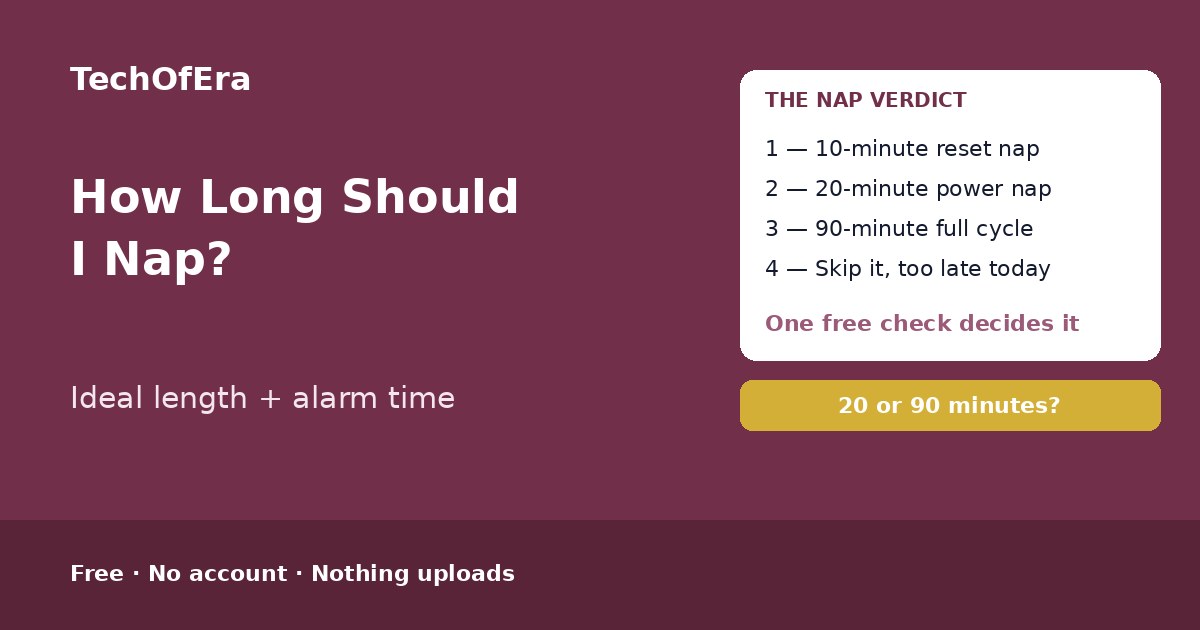
Napping is a trade-off, not a fixed number. A short nap lifts alertness, focus and mood — but a nap that is too long, or too late in the day, wakes you groggy and steals from tonight's sleep. This checker weighs all of it — how much time you have, what time of day it is, how you slept last night, caffeine in the last few hours, shift work, when you must be up, whether you usually wake up groggy, and your age — and gives you a verdict: a 10-minute reset nap, a 20-minute power nap, a 90-minute full-cycle nap, or skip the nap, plus the alarm time to set.
To use it:
- Say how much time you have for a nap. About 15 minutes, 30 minutes, 45 minutes, an hour, or 90 minutes or more. The time you have decides between a 10-minute reset, a 20-minute power nap and a 90-minute full cycle — and the checker never recommends the 30–60 minute band, because that is where deep sleep starts.
- Say what time of day it is. Morning, early afternoon (noon to 2 pm), mid-afternoon (2 to 4 pm), late afternoon (4 to 6 pm), or evening (after 6 pm). The early afternoon is the best time to nap; the evening is too late — unless you work nights.
- Say how you slept last night. Well (7 to 9 hours), a short night (5 to 6 hours), or a very short night (under 5 hours). A very short night is the one case where a full 90-minute cycle beats a power nap.
- Say whether you had caffeine in the last few hours. None, one coffee or tea in the last 2 hours, or several coffees or an energy drink. Caffeine can delay falling asleep, so the checker allows 15 minutes to drift off instead of 10 when you had some recently.
- Say whether you work nights or shifts. Regular daytime hours, on a night shift tonight, or rotating shifts. Night-shift workers are the exception to the short-nap rule: a longer nap before the shift helps alertness through the night.
- Say when you must be up. No deadline, within 30 minutes, within an hour, within 2 hours, or 3 hours or more. Your deadline caps the nap: a 90-minute nap plus the time to fall asleep needs three hours free, and a nap you have to cut short leaves you groggier than no nap at all.
- Say whether you usually wake up groggy after a nap. Never, sometimes, or usually. If you usually wake groggy, your naps are landing in deep sleep — so the checker keeps them to 10–20 minutes, or takes a full 90-minute cycle, and never plans a 30–60 minute nap.
- Say how old you are. Under 18, 18–39, 40–64, or 65 or older. Older adults often wake groggier from long naps, so shorter naps are the safer default — and teenagers need more sleep than adults, so a short afternoon nap is a normal top-up for them.
The four verdicts, and what each one means
Take a 20-minute power nap
The default good answer. Twenty minutes lifts alertness, focus and mood, and you wake before deep sleep starts, so there is little grogginess. Set the alarm for 30 minutes after you lie down — 10 minutes to fall asleep, 20 minutes asleep — and get up as soon as it goes off.
Take a 90-minute full-cycle nap
For a very short night, or before a night shift, when you have 90 minutes free and no tight deadline. Ninety minutes is about one full sleep cycle, so you surface from light sleep instead of deep sleep. Only take it if you can sleep the whole cycle — being woken halfway through is worse than a short nap.
Take a 10-minute reset nap
For very little time, or when you usually wake up groggy. Ten minutes is short, but it is enough for a quick lift in alertness — and with so little time, or a habit of waking groggy, staying in light sleep is the whole point. Set the alarm before you close your eyes.
Skip the nap — it is too late in the day
It is evening, and you work normal daytime hours: sleeping now would steal from tonight's sleep and leave tomorrow worse. Rest without sleeping instead — sit down, close your eyes for a few minutes, get some daylight and fresh air — and go to bed at your normal time tonight.
Your nap plan
Whatever the verdict, this is the nap the checker is aiming for — the plan it builds from your answers:
- Lie down in the early afternoon if you can. Roughly 1 to 3 pm is when the body clock dips — most people feel sleepiest between 2 and 4 pm — so a nap then works with your rhythm instead of against it.
- Set the alarm before you close your eyes. The alarm is the nap: 30 minutes after you lie down for a power nap (10 to fall asleep, 20 asleep), 20 minutes for a reset, 100 minutes for a full cycle. The checker works out the clock time from the time of day you picked.
- Get up as soon as the alarm goes off. Do not snooze into deep sleep — that is exactly how a good nap turns into a groggy one. If you feel groggy, give it 10 to 15 minutes: sleep inertia usually passes on its own.
- Keep it dark and quiet. A short nap works best in a dark, quiet room. Light and noise stretch the time it takes to fall asleep, and the alarm does not wait.
- Skip the next coffee until after the nap. Caffeine in the last 2 hours can delay falling asleep, and more caffeine now will only make tonight harder.
- Finish at least three hours before bedtime. That is the line that protects tonight's sleep. A nap that ends too close to bedtime lowers the sleep pressure your body needs to fall asleep at night.
- Go to bed at your normal time tonight. One nap does not repay a very short night. The nap is a top-up, not a replacement — the fix for a short night is an early night, not a longer nap.
What makes this checker different
The pages that rank for this search are articles — a Kaiser Permanente explainer from a sleep specialist, an Ohio State guide, a Health.com piece, a GoodRx guide, a Calm blog post, an EatingWell expert round-up, a Healthline guide. Most of them agree on the same shape — 10 to 30 minutes, or 90 for a full cycle — and none of them asks how much time you have, what time of day it is, how you slept last night, whether you work nights, when you must be up, or whether you usually wake up groggy — and none of them gives you a verdict for your afternoon, with the alarm time to set. The dedicated nap calculators that exist take clock times and hand back alarm times; they do not turn sleep debt, shift work, grogginess history or age into a personalised verdict, and they do not tell you when to skip the nap. This page is that answer: eight questions, an instant verdict, the blockers named, and the next steps. It is a self-assessment, so it says plainly what it cannot know: it cannot measure how tired you are, how fast you fall asleep, or which sleep stage you wake from.
When is this the right check?
When the afternoon dip hits and you are not sure whether 20 minutes or 90 is the right call — because the answer depends on last night, and guessing wrong means waking groggy. When you slept under 5 hours and you have the whole afternoon free — because that is the one case where a full cycle beats a power nap, and the checker says so. When you only have 15 minutes before a meeting — because a 10-minute reset is a real option, and a 30-minute nap in that slot would leave you worse. When you work nights and the evening rules do not apply to you — because a nap at 7 pm before a shift is the point, not a mistake. And when you usually wake up groggy from naps and you are not sure why — because the 30–60 minute band is almost certainly the cause, and the checker never plans a nap there.
Honest limitations
A self-assessment, not medical advice
This checker cannot measure how tired you are, how fast you fall asleep, or which sleep stage you wake from. It cannot tell whether daytime sleepiness needs a clinician. If you need a long nap every day, or you cannot stay awake in the daytime, talk to a clinician.
Without the time of day, the alarm is a duration, not a time
The alarm clock time depends on when you lie down, and the checker works it out from the time-of-day band you pick. If you do not say what time it is, it gives the alarm as minutes after you lie down instead of a clock time — and the verdict drops to lower confidence until the time is known.
“How long it takes to fall asleep” is an estimate
Most people take about 10 minutes to fall asleep, and caffeine pushes it to about 15 — but some people take 5 and some take 25. If you usually fall asleep fast, set the alarm a little earlier; if you lie there thinking, set it a little later. The checker says which figure it used, rather than pretending it measured it.
The nap lengths are planning estimates
The 10, 20 and 90 minute lengths and the alarm times on this page are the checker's own planning estimates drawn from the nap guidance, not a prescription for any one person. Your body, your medicines and your sleep all change them: if short naps never help, or you wake groggy every time, the answer is a clinician, not a different number.
Sleep quality is not asked
This checker asks how long you slept, not how well — it does not ask about snoring, waking in the night, or how rested you felt. A short night that felt restful is different from a long night broken by waking, and the verdict is about the hours, not the whole night.
Rules from official sources, dated November 2026
The rules here are the nap guidance from Kaiser Permanente, Ohio State Wexner Medical Center, Health.com, GoodRx, Calm and Healthline, as they read in November 2026. Guidance changes: recheck with a clinician if anything about your health, your medicines, or your sleep changes.