How to decide whether to bring an umbrella today
The rain chance on the forecast is only half the story — how long you will be out, how hard it will rain, how much shelter you have and what you are doing are the other half. A 40% chance of rain means rain fell on about 4 out of 10 days with a forecast like this one — that is how the US National Weather Service explains probability of precipitation — but it says nothing about how hard the rain will be or how long it will last. A 40% chance of drizzle and a 40% chance of heavy rain are the same number on the forecast and very different days to be outside in. And the wind decides whether an umbrella is even the right answer: most standard umbrellas start to flip at gusts around 20 to 30 mph, so a windy day calls for a waterproof jacket, not a bigger umbrella. This checker asks exactly what decides it.
To use it:
- Enter the rain chance and wind speed. Use the forecast for the time you will actually be out, where you will actually be — not the daily average, and not the morning chance if you go out in the afternoon. If gusts are much higher than the steady wind, enter the gust speed — gusts are what turn umbrellas inside out. If either is missing, the checker says it cannot tell yet, rather than guessing.
- Say how hard it will rain. Drizzle wets you slowly; steady rain soaks you through in minutes; heavy rain soaks through an umbrella on its own. The same rain chance is a different answer at each of those — which is why the checker asks, and why it says plainly when you have not confirmed it.
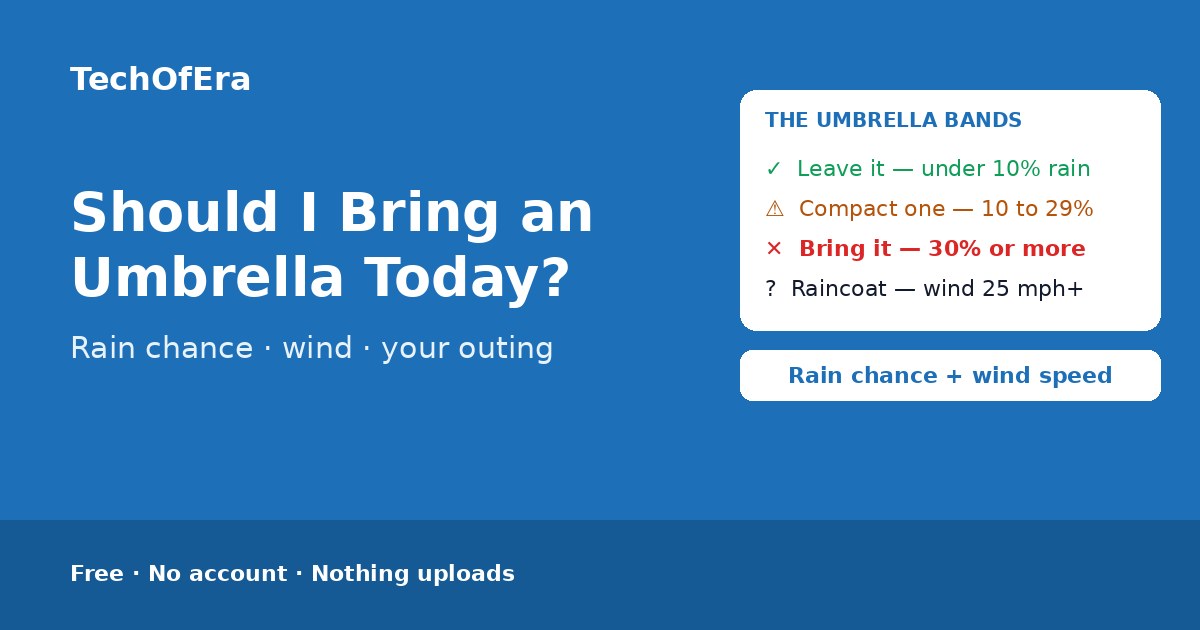
- Match the umbrella to the verdict, not the season. Leave it at home under 10%, pack a compact one at 10 to 29%, bring the full-size umbrella at 30 to 49%, add a raincoat at 50 to 69%, and full waterproofs at 70% or more. A compact umbrella weighs nothing in a bag — the most common mistake is leaving it behind on a borderline day.
- Respect the wind. At 25 mph (40 km/h) or more, an ordinary umbrella is not the answer — wear a waterproof jacket with a hood instead. At 15 to 25 mph it is gusty enough to want a compact windproof umbrella, or a raincoat. Hold the umbrella low, into the wind, and never fight a gust — let it go, or it will break.
- Think about your feet, not just your head. Rain soaks from the feet up as well as from above: waterproof shoes matter as much as the umbrella on a long wet outing, and wet clothes lose their insulation, so a cold rainy day is a colder day than the thermometer says. If you do not have waterproof shoes, take a spare pair of socks in a plastic bag.
- Know when the answer is not an umbrella at all. Cycling and running cannot be done with an umbrella — both hands are on the handlebars, or pumping at your sides. The answer for both is a waterproof jacket. And in a storm, no umbrella makes it safe: stay clear of flooded roads and lightning.
Conditions and what to do at a glance
The table below is built from the same rules as the checker, so it can never disagree with your verdict. The rain chance decides, together with how hard it rains, how long you are out, how much shelter you have and what you are doing.
| Condition | Verdict | What to know |
|---|
What makes this checker different
The pages that rank for this search are weather forecasts and location pages — they tell you the chance of rain where you are, but they leave you to decide what it means: whether 40% is worth carrying for, whether a 30-minute walk is different from an hour outside, whether the wind makes the umbrella useless, and whether a dog walk or an outdoor event changes the answer. The one dedicated tool that does exist answers a different question: it checks live hourly forecasts for a journey you type in, with places and times, and gives a yes or no. This page is the umbrella answer for the forecast you already have: the rain chance and wind speed in, and a verdict for the exact outing you plan — leave it, pack a compact one, bring it, add a raincoat, or skip the umbrella for a waterproof jacket — with duration, shelter, activity and the wind-inversion limit scored alongside the weather. It needs no location, no account and no live forecast, so it works offline the moment the page has loaded. It is a self-assessment, so it says plainly what it cannot know: a web page cannot measure the weather where you are, so anything you mark “Not sure” stays on the list until you confirm it.
When is this the right check?
Whenever you are about to go out and the forecast makes you hesitate over the umbrella: the 30% morning when you do not know whether to carry for it, the day the forecast calls “40% chance of rain” and you cannot tell whether that means drizzle or a downpour, the windy day when you wonder whether the umbrella will survive the walk, the dog walk that cannot be cut short, the outdoor market that keeps you outside for hours. Also whenever the conditions are borderline and the decision turns on something specific — whether a ten-minute dash needs an umbrella at all, whether being mostly indoors changes a day that would be wet walking, whether cycling means a raincoat instead, or whether heavy rain means full waterproofs rather than just the umbrella. And whenever you have been caught out before and want a straight answer instead of a percentage to interpret.
Honest limitations
A self-assessment, not a forecast
This checker works only from the rain chance, wind speed and answers you enter. It cannot measure the weather where you are — no web page can — so if the forecast is wrong, the verdict is wrong. When in doubt, pack the compact umbrella: it weighs nothing and covers the most common surprise.
A rain chance is a probability, not a promise
A 40% chance means rain fell on about 4 out of 10 days with a forecast like this one — it does not mean it will rain 40% of the time, or that 40% of the area gets rain. The same number covers drizzle and downpours, which is why the checker asks how hard it will rain.
Wind limits are for ordinary umbrellas
The 25 mph (40 km/h) line is for a standard umbrella: most start to flip at gusts around 20 to 30 mph. Windproof models rated to about 55 mph exist and hold up longer — but no umbrella is safe in a real storm, and no umbrella keeps you dry in sideways rain.
Wet changes everything
Rain, heavy sweat and wet clothes all strip insulation from what you wear. You can feel cold well above freezing when you are wet — so a mild-looking rainy day can still be an uncomfortable one, and a cold wet day calls for a raincoat, not just an umbrella.
Storms override the verdict
Heavy rain, lightning and flooded roads are not umbrella questions. If the forecast says storms, stay inside if you can — and if you must go out, stay clear of flooded roads and lightning. No umbrella makes that safe.
Rules from public sources
The rules here follow the US National Weather Service explanation of probability of precipitation and the usual wind ratings for standard and windproof umbrellas, as they read in November 2026. Forecasts and guidance can be revised, so re-check if a new edition appears.