How the road salt check works
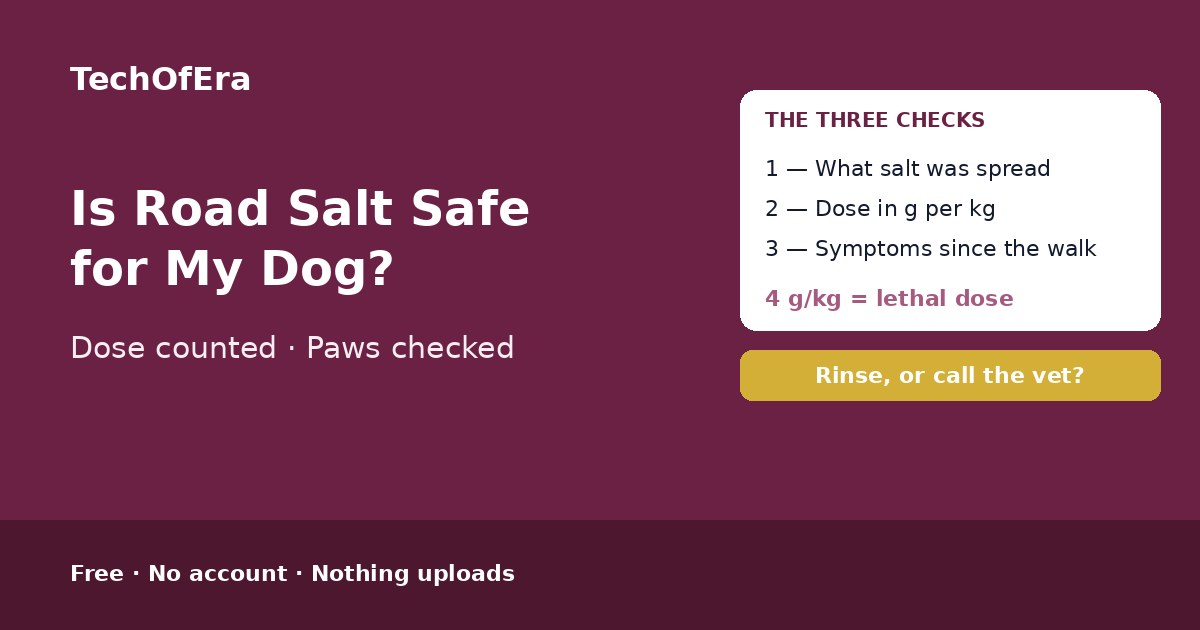
Most commercial de-icers are not safe for pets. They contain sodium chloride, potassium chloride, calcium chloride or magnesium chloride, and they irritate and can chemically burn paw pads — and cause stomach upset, vomiting and diarrhoea if swallowed. Rock salt is sharp: it can cut paw pads, and the cuts can become infected. Salt draws moisture out of the pads, so prolonged contact leaves them dry and cracked. Calcium chloride is the worst of the common salts: it reacts with moisture and gives off heat, so it can burn pads, and if swallowed it can ulcerate the mouth and stomach. The check starts with what was spread and what happened: paws on salted ground is a rinse, a mouthful swallowed is a vet call, and a dog that has eaten a lot from a bag is an emergency. Then it counts the dose: the Merck Veterinary Manual puts the acute lethal dose at roughly 4 grams of salt per kilogram of body weight, with early signs possible from around 2 to 3 grams per kilogram — so a mouthful of about 5 grams is 1.7 grams per kilogram for a 3 kg puppy, but only 0.17 for a 30 kg Labrador. The amounts are estimates — a lick is about half a gram, a mouthful about 5 grams, a handful about 30 grams, a lot from a bag about 100 grams — and the checker says so plainly, never presenting the estimate as a weighed dose. Then it checks the paws: how long they were on salt, what protection was used, and whether the pads were already dry, cracked or cut — and your dog’s size, age and health, and any symptoms since the walk. The verdict is one of four: safe enough, rinse and watch, call your vet today, or call your vet now — with the dose in grams per kilogram and the after-a-salted-walk checklist.
To use it:
- Say what was spread on the ground. Rock salt is white crystals; calcium chloride is usually pellets or flakes. The bag will tell you — or pick “Not sure” and the checker will use the middle of the road.
- Say what happened with the salt. Paws only, licked off the paws, eaten off the ground, eaten from a bag — or no contact at all. That is the question the verdict turns on.
- Say how much salt your dog ate, and how much your dog weighs. A lick is about half a gram, a mouthful about 5 grams, a handful about 30 grams — and the dose is counted per kilogram, in kg or lb.
- Say how long the paws were on salt, what protection was used, and what condition the pads are in. Salt draws moisture out of the pads, so the longer the contact the worse the irritation — and salt in open cuts stings and can infect them.
- Say how big your dog is, how old, and how their health is. A small dog reaches a dangerous dose on far less salt than a big one, and kidney or heart trouble makes salt harder on a dog.
- Tick any symptoms since the walk. Limping, constant licking, red pads, vomiting, diarrhoea, drinking far more than usual, trembling or seizures — any one of these means the salt has already done something, whatever the numbers say.
What makes this checker different
The pages that rank for this search are guides — a pet care brand’s article on the dangers of road salt and dog paws, a vet practice’s guide to keeping dogs and cats safe when de-icing, a vet-school guide to protecting dog paws from road salt, a winter safety site’s piece on road salt and dog paws, and a dog gear site’s round-up of boots for salt, ice and snow. They give you the rules and leave you to judge them against the pavement on a winter evening. One site has an interactive ice-melt selector — but it picks a product for your driveway, not a verdict for your dog — and another has an ice-melt calculator that measures how much to spread, not how much your dog ate. There is no free, standalone checker that takes the salt type, what your dog did, how much was eaten and how much your dog weighs, counts the dose in grams per kilogram against the Merck Veterinary Manual lines, checks the paws, the protection and the symptoms, and gives you a verdict: safe enough, rinse and watch, call your vet today, or call your vet now — with the after-a-salted-walk checklist. This page is that answer: eleven questions, an instant verdict for your exact dog and your exact salt, the blockers named, and the next steps. It is a self-assessment, so it says plainly what it cannot know: it cannot feel your dog’s paws or weigh the salt your dog swallowed — and where your dog’s symptoms disagree with the numbers it says so instead of guessing.
When is this the right check?
On a winter evening when the pavements are white with grit and your dog has just walked across them — because the salt you cannot see is the one that dries the pads out overnight. When your dog comes home licking their paws, or starts limping on the salted pavement halfway round the block. When a puppy or a small dog has eaten salt off the ground, and the same mouthful that would be nothing for a Labrador is a vet call for them. When someone else walks your dog — a dog walker, a family member, a neighbour — because a long walk on salted roads your dog’s pads cannot handle is the most common way a routine outing turns into cracked, bleeding pads. And whenever your dog starts vomiting, drinking far more than usual, or trembling after a winter walk — because that is when a guide leaves you guessing and a checker earns its keep.
Honest limitations
A self-assessment, not veterinary advice
This checker cannot feel your dog’s paws or weigh the salt your dog swallowed. It cannot tell what was spread on the pavement, how much your dog ate, or whether the pads are cracked. If you are worried about your dog, talk to your vet.
The amounts are estimates, not a weighed dose
A lick is about half a gram, a mouthful about 5 grams, a handful about 30 grams, a lot from a bag about 100 grams — those are estimates, and the grams-per-kilogram figure is only as good as them. If your dog ate a lot, call your vet rather than trusting the estimate.
The dog’s symptoms beat the numbers
A dog showing symptoms in a case the numbers call safe is a dog that needs a vet, not a rinse. The bands are guidance for an average dog of that size — your dog’s own symptoms are the verdict that counts.
Antifreeze is a different emergency
Some de-icers contain ethylene glycol (antifreeze), which is poisonous to dogs in tiny amounts — drooling, wobbling or vomiting after contact with a de-icer means call your vet at once, whatever this checker says. The checker flags the risk when the salt type is unknown, but it cannot tell antifreeze from salt.
Breed ranges are approximate
The size bands use the usual breed examples — a Chihuahua is toy, a Labrador is large — but mixed breeds and dogs between bands sit between the lines. Where your dog falls between two sizes, use the smaller one: it is the safer reading for the dose.
Rules from official sources, dated November 2026
The rules here are the ASPCA, Cornell, VCA and Merck Veterinary Manual de-icer guidance as they read in November 2026. Guidance changes: recheck with your vet if anything about your dog changes.