How the thunderstorm check works
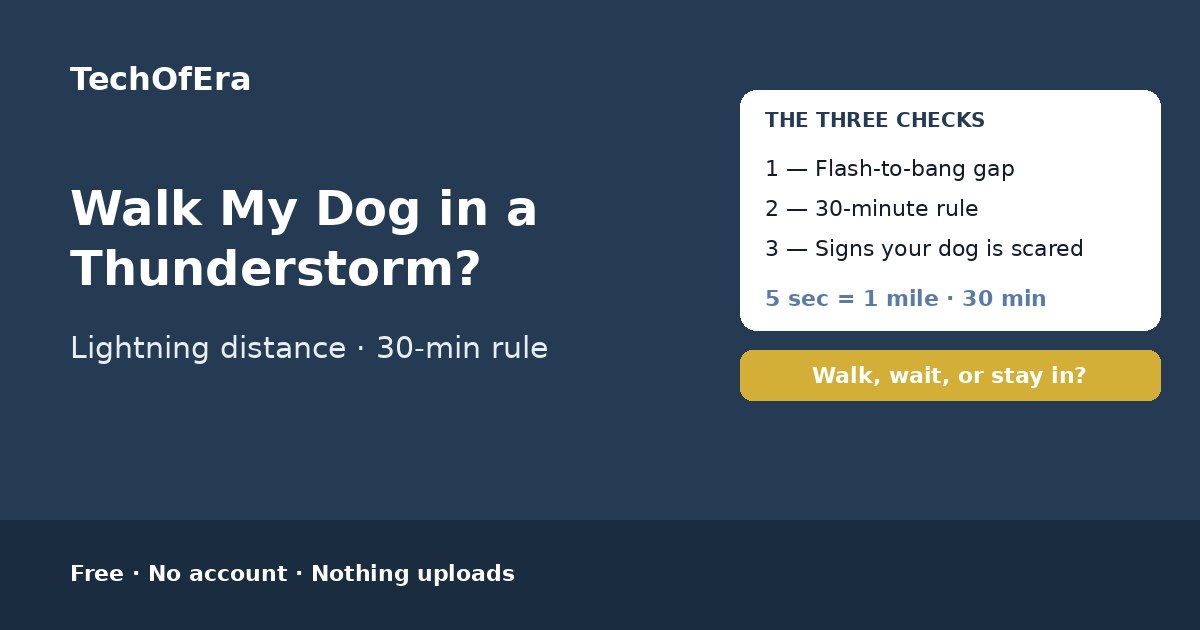
When thunder roars, go indoors: if you can hear thunder, you are close enough to be struck by lightning, and lightning can strike 10 to 15 miles from the rain — even under a blue sky. That is the US National Weather Service rule, and it applies to dogs on a walk as much as to people. The check starts with the flash-to-bang gap: sound travels about a mile in 5 seconds, so a 5-second gap means the lightning is about a mile away, 10 seconds about 2 miles, and 30 seconds about 6 miles. A gap under 10 seconds means the storm is close — do not go out. A gap of 10 to 20 seconds means wait it out. A gap over 30 seconds means the storm is distant, and a short walk close to home may be fine — if the storm is not coming towards you. Then it checks when you last heard thunder: wait at least 30 minutes after the last thunder before going back out, and the checker estimates how much of that wait is still to go. A wet coat in cold wind matters too: most dogs are fine down to about 45°F (7°C), but below 32°F (0°C) small, thin-coated, young, old or unwell dogs are at real risk, and below 20°F (-7°C) almost any dog can develop hypothermia or frostbite. Then it checks the rain, the feels-like temperature — the wind chill — how far safe shelter is, flooding, and your dog’s size, coat, age, health and fear of thunder, and gives you a verdict for your dog right now: walk as normal, a short walk only, wait it out, or do not go out — with the safe-time estimate and the thunderstorm dog-walk checklist.
To use it:
- Count the seconds between the lightning flash and the thunder. Watch for the next flash and count — 5 seconds is about a mile. If you have not heard any thunder, pick “No thunder at all” — that is an answer, not a guess.
- Say whether you can see lightning, and which way the storm is moving. Lightning overhead means the storm is on you, whatever the gap says — and a shortening gap means the storm is coming towards you.
- Say when you last heard thunder. The 30-minute wait is counted from the last thunder, not from when the storm started — this is what the safe-time estimate is built on.
- Say how hard it is raining, and enter the temperature and the wind. A storm can be dangerous before the first drop falls, so judge the walk by the lightning — but a wet dog feels cold far faster than a dry one, so the feels-like temperature matters too.
- Say how far safe shelter is, and whether the route is flooded. Safe shelter is a substantial building or a car with the windows closed — never a lone tree. Floodwater can conceal damaged surfaces and other hazards.
- Say how big your dog is, and what kind of coat they have. Small dogs chill far faster than big ones in a storm, and a thick double coat sheds rain while a thin single coat soaks through.
- Say how old your dog is, how their health is, and how they feel about thunder. Very young puppies, very old dogs and unwell dogs need extra care in a storm — and a dog that panics at thunder can bolt and get lost, so a terrified dog should stay inside whatever the numbers say.
- Say how long you plan to walk, and tick any signs your dog is showing. Trembling, panting, hiding, pacing, trying to bolt or refusing to walk all mean bring them in — the dog is the thermometer that matters most, whatever the numbers say.
What makes this checker different
The pages that rank for this search are guides — a dog walking site’s article on walking a dog in a thunderstorm, a magazine’s guide to walking dogs in bad weather, a pet magazine’s piece with a canine behaviourist, a breed site’s warning about taking a dog out in a thunderstorm, a trainer’s guide to caring for your dog in stormy weather, a professional dog walker’s guide to rain, wind and thunder, and The Kennel Club’s storm health page. They give you the rules and leave you to judge them against the sky on a stormy afternoon. The walkingdog.io article even has an embedded tool — but it is a breed-based walk calculator, not a lightning-distance checker. There is no free, standalone checker that counts the flash-to-bang gap, works out the distance in miles, checks which way the storm is moving, counts down the 30-minute wait after the last thunder, checks the shelter distance and flooding, adjusts for your dog’s size, coat, age, health and fear of thunder, asks how long you plan to walk and listens to the signs your dog is showing — and gives you a verdict: walk as normal, a short walk only, wait it out, or do not go out — with the safe-time estimate and the thunderstorm dog-walk checklist. This page is that answer: sixteen questions, an instant verdict for your exact dog and your exact storm, the blockers named, and the next steps. It is a self-assessment, so it says plainly what it cannot know: it cannot count the gap, tell which way the storm is moving, or feel your dog — and where your dog’s signs disagree with the numbers it says so instead of guessing.
When is this the right check?
On a stormy afternoon when the thunder is rumbling and the lead is hanging by the door — because the distant rumble that was fine last week can be a storm overhead today, and the lightning you just saw changes everything. Before the evening walk when a storm is forecast, when the rain is light but the thunder is getting louder and your dog will not settle. When a new puppy, a senior dog or a small thin-coated dog joins the house, and the storm limits you knew for your old dog no longer apply. When someone else walks your dog — a dog walker, a family member, a neighbour — because a long walk into a storm your dog cannot handle is the most common way a routine outing turns into a frightened, bolted dog. And whenever your dog starts trembling, hiding, pacing or pulling back towards home in a storm — because that is when a guide leaves you guessing and a checker earns its keep.
Honest limitations
A self-assessment, not veterinary advice
This checker cannot feel your dog or read the sky. It cannot count the flash-to-bang gap, tell which way the storm is moving, or see whether your dog is trembling. If you are worried about your dog, talk to your vet.
The dog’s signs beat the numbers
A dog showing storm fear in weather the numbers call fine is a dog that needs bringing in. The bands are guidance for an average dog of that size and coat — your dog’s own signs are the verdict that counts.
The wait estimate is an estimate
The safe-time estimate is counted from the band you pick for when you last heard thunder — not from a clock. If you heard thunder more recently than the band says, the real wait is longer. When in doubt, wait the full 30 minutes from the last thunder you actually heard.
The wind chill is an estimate
The National Weather Service wind chill is for a person standing in the open, and it is the best public estimate there is for what a wet dog feels. Sheltered streets, gusts and how hard your dog is running all move it — which is why the signs matter as much as the sum.
Breed ranges are approximate
The size and coat bands use the usual breed examples — a Chihuahua is toy, a Labrador is large — but mixed breeds and dogs between bands sit between the lines. Where your dog falls between two sizes, use the smaller one for a storm: it is the safer reading.
Rules from official sources, dated November 2026
The rules here are the US National Weather Service and Met Office thunderstorm guidance, the veterinary storm and cold guidance, and the CDC leptospirosis guidance, as they read in November 2026. Guidance changes: recheck with your vet if anything about your dog changes.