How the boil-notice check works
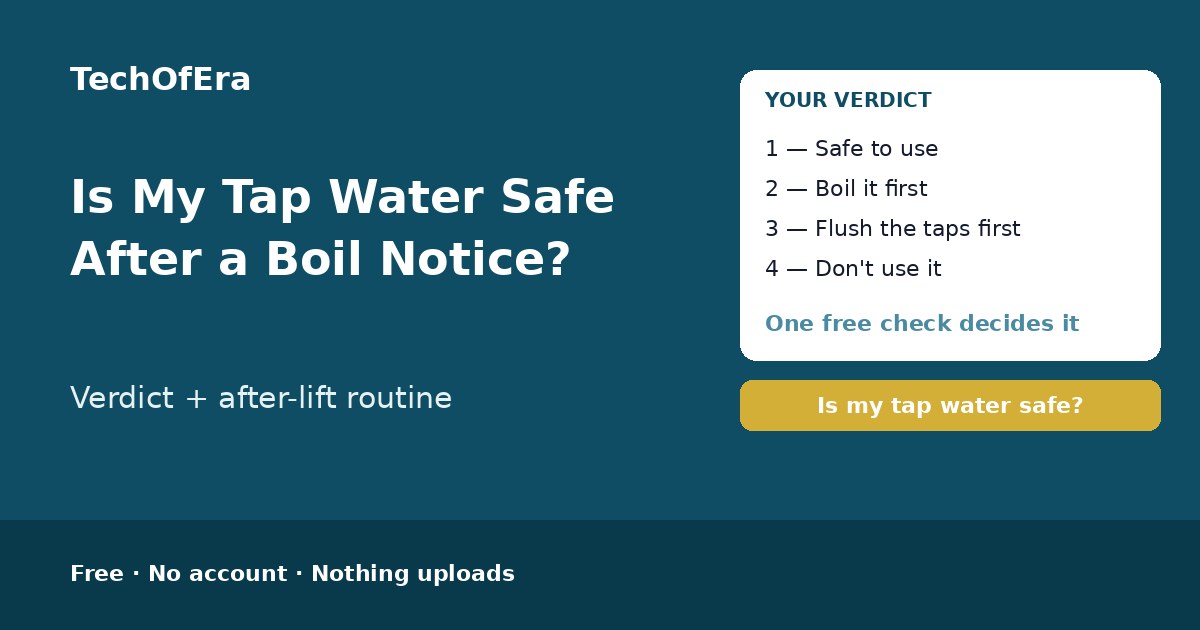
Whether your tap water is safe after a boil notice is a trade-off, not a yes-or-no question. During a boil water advisory, a full rolling boil for 1 minute — 3 minutes above 6,500 feet — kills the germs the advisory is about, and that boiled water is safe to drink. But a home filter does not replace boiling, a “do not drink” notice is about a chemical that boiling cannot fix, and after the notice lifts, the water sitting in your pipes and ice maker is still the old water until you flush it. This checker weighs all of it — what the notice says, what you did to the water, what you want to use it for, how it has been stored, whether you flushed after the notice lifted, who will use it, how it looks and smells, and where it comes from — and gives you a verdict: safe to use, boil it first, flush the taps first, or don’t use it, plus an after-lift routine.
To use it:
- Say what the notice says right now. Boil water advisory still in effect; advisory lifted today; advisory lifted more than a day ago; “do not drink” notice (chemical or toxin); or “do not use” notice (any contact could be harmful). A boil water advisory, a “do not drink” notice and a “do not use” notice call for very different responses — check your utility’s website or local news for the official notice.
- Say what you did to the water. Rolling boil for 1 minute, then cooled; rolling boil for 3 minutes (above 6,500 ft), then cooled; boiled, but for less than a minute — or just heated, not a rolling boil; ran it through a home filter or filter pitcher only; straight from the tap — nothing done to it; or bottled water (or water from a distribution point). A full rolling boil for 1 minute makes tap water safe to drink; a filter alone does not.
- Say what you want to use it for. Drinking; cooking or preparing food; making baby formula; brushing teeth; showering or bathing; washing dishes; laundry; or giving it to pets. Drinking, cooking and baby formula need boiled or bottled water; showering and laundry usually do not.
- Say how the water has been stored. Covered, clean container in the fridge; covered container at room temperature, under 24 hours; open container, or stored for more than a day; or using it straight away — not stored. Store boiled water in a clean, covered container in the fridge, and use it within a day.
- Say whether you flushed after the notice lifted. Flushed cold taps 5 minutes, dumped old ice, ran the dispenser; ran the cold taps for a few minutes; nothing flushed yet; or notice still in effect — not lifted yet. Run every cold-water tap for at least five minutes, dump the old ice, and run the dispenser.
- Say who will use it. Healthy adults only; a baby or small child; an elderly person, or someone with a weakened immune system; or someone with an open wound. Babies, elderly people and anyone with a weakened immune system or an open wound need extra care.
- Say how the water looks and smells. Clear, looks and smells normal; cloudy or discoloured; or smells odd — chemical, petrol or metallic. Cloudy water after a lift should be reported; a chemical smell means don’t use it at all.
- Say where your water comes from. Mains supply (utility water); private well; or bottled water or a distribution point. A utility advisory covers mains water; a private well needs its own test.
The four verdicts, and what each one means
Yes — this water is safe to use
It was boiled properly — a full rolling boil for 1 minute, cooled and stored covered — or the notice has lifted, the utility has tested the water twice, and you have flushed the taps and dumped the old ice. Showering and laundry are also safe during an advisory, as long as nobody swallows the water.
Boil it first — don’t drink it as it is
The advisory is still in effect and this water has not been boiled properly: straight from the tap, only filtered, or boiled for less than a minute. Bring it to a full rolling boil for 1 minute — 3 minutes above 6,500 feet — then let it cool and store it in a clean, covered container. A filter alone does not make it safe.
Flush the taps first — then it’s safe
The notice has lifted, which means the utility has tested the water twice and found it clean — but the water sitting in your pipes, ice maker and dispenser is still the old water. Run every cold-water tap for at least five minutes, dump the old ice, run a batch through the dispenser, and then use the tap as normal.
Don’t use it — not safe
A “do not drink” or “do not use” notice means a chemical or toxin, or the water smells of chemicals — and boiling does not remove chemicals. Use bottled water instead, and call your utility: the EPA Safe Drinking Water Hotline is 1-800-426-4791.
Your after-the-notice-lifts routine
Whatever the verdict, this is the routine the checker is aiming for once your utility lifts the advisory — the steps it builds from your answers:
- Wait for the official lift. The utility lifts an advisory only after two consecutive days of clean bacteria samples, so a lift means the water has been tested twice. Do not go back to normal on a rumour — check the utility’s website or local news.
- Run every cold-water tap for at least five minutes. Run them all at the same time, so the old water clears out of every pipe at once. This is the step the county guides agree on — five minutes, cold water, every tap.
- Dump the old ice and run the dispenser. Throw away all the ice and any drinks made with tap water during the advisory, run a batch of ice through the ice maker and throw that away too, and run the water dispenser until it runs clear.
- Replace or clean filters if your utility says so. A filter used during an advisory can itself be contaminated — most household filters are not designed to remove bacteria and viruses, and the filter may need replacing once the advisory ends.
- Check the water before you drink it. If it is cloudy or discoloured after the lift, run the taps for a few minutes until it runs clear, and call your utility if it stays cloudy. If it smells of chemicals, petrol or metal, do not use it at all — that is a chemical problem, and boiling will not fix it.
- Keep boiled water covered in the fridge. Store boiled water in a clean container with a cover, in the refrigerator, and use it within a day or two. Open or long-stored boiled water can be recontaminated — boil it again for a full minute.
- Look after the vulnerable people first. Babies get a sponge bath with boiled or bottled water instead of a bath, baby formula uses bottled water or ready-to-use formula, and anyone with an open wound bathes with boiled (cooled) water until the advisory lifts.
What makes this checker different
The pages that rank for this search are guides — a Pinellas County step-by-step for after a notice is lifted, an American Water explainer on what a boil water advisory is, a TapWaterSafety.org guide drawn from CDC advice, and city pages from Baltimore, Wake Forest and Maysville. None of them asks what your notice says, what you did to the water, or what you want to use it for — and none of them gives you a verdict for your glass of water. There is no free, standalone checker that takes your notice, your water and your use and turns them into a verdict with an after-lift routine. This page is that answer: eight questions, an instant verdict, the blockers named, and the next steps. It is a self-assessment, so it says plainly what it cannot know: it cannot read your utility’s notice, test your tap water, or know what you did to it.
When is this the right check?
When the boil water notice lands in your inbox and you are standing at the sink wondering whether the glass you just poured is safe — because the answer depends on the notice and the use, and the checker answers it in seconds. When you boiled a pot of water this morning and cannot remember whether it boiled for a full minute — because “just heated” is not a rolling boil, and the checker says so instead of letting you guess. When the advisory lifts and you are not sure whether the tap is safe again — because the lift means the water is clean, but the water in your pipes is still the old water until you flush. And when the notice says “do not drink” and you are wondering whether boiling helps — because it does not, and the checker says so plainly instead of letting you waste the evening boiling water that will never be safe.
Honest limitations
A self-assessment, not a water test
This checker cannot read your utility’s notice, test your tap water, or know what you did to it. It cannot tell whether your water actually contains germs or chemicals. Check your utility’s website or local news for the official notice before you answer, and where the answer is unclear it says boil it first instead of guessing.
Your utility’s notice is the authority
The notice for your street may say something different from the general guidance on this page — a longer boil, a different flush, or a local rule for your area. If the notice says something different from this page, follow the notice. The EPA Safe Drinking Water Hotline is 1-800-426-4791 if you cannot reach your utility.
A private well needs its own test
A utility advisory does not cover a private well: the notice is a warning for your area, not a clearance for your water. If you are on a well, an advisory in your area means your water might be affected too — get it tested, and boil it before drinking until you have a clean result.
“Clear” water can still carry germs
Water that looks and smells normal can still be contaminated during an advisory — germs do not cloud water or give it a smell. Clear water is not a reason to skip the boil. The only thing that makes tap water safe to drink during an advisory is a full rolling boil, or bottled water.
The 1-minute boil is a rule, not a guarantee
A full rolling boil for 1 minute kills the germs a boil water advisory is about — but it does not remove chemicals, and it does not help if the water is recontaminated afterwards in an open container. Above 6,500 feet, the rule is 3 minutes, because water boils at a lower temperature there.
Rules from official sources, dated November 2026
The rules here are the boil-water guidance from the US Centers for Disease Control and Prevention, the US Environmental Protection Agency, American Water, Pinellas County, Baltimore City, Wake Forest NC and Maysville KY, as they read in November 2026. Guidance changes: recheck with your water utility if anything about your notice, your water, or your household changes.