Is your dog too hot in this heat?

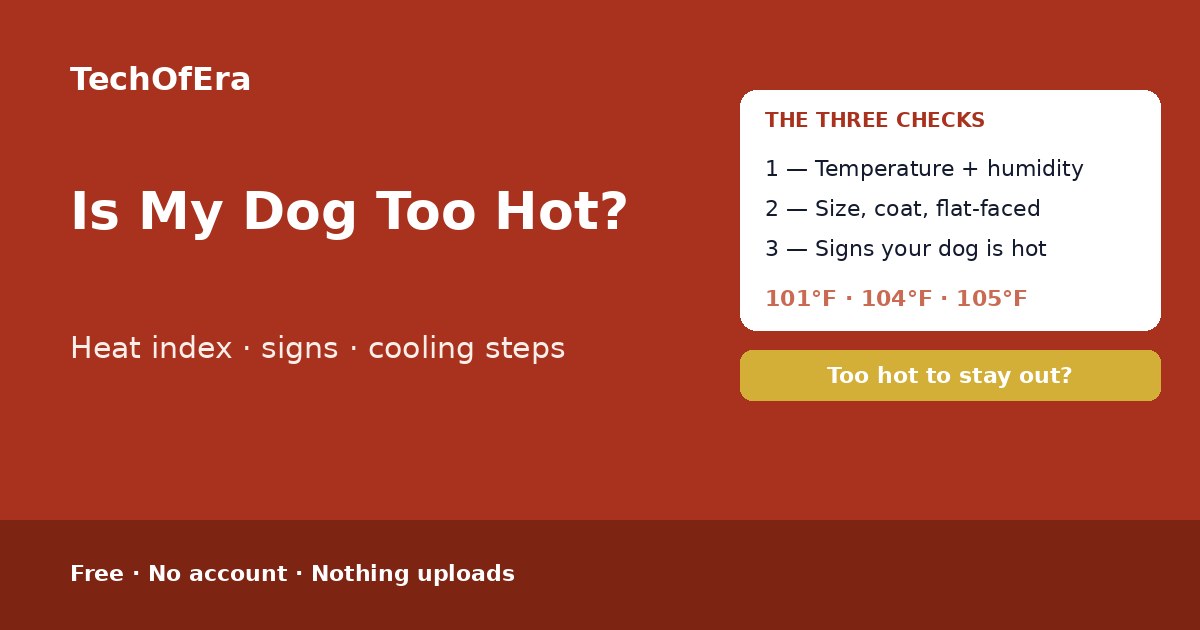
It is a sticky afternoon, your dog is panting on the rug, and the thermometer says 90°F — but is that dangerous for a Pug, and fine for a Greyhound? Dogs cool themselves almost entirely by panting, and once the air climbs above about 85°F, panting stops working well — humidity makes it worse. Enter the temperature, the humidity, your dog’s temperature if you know it, and the signs they are showing — this checker gives you the verdict in seconds: safe, cool down now, vet today, or emergency vet now, free, in your browser, nothing uploads.

  • 101–102.5°F normal range
  • Heat index, not just air temp
  • Cooling steps included
  • Free, no account, nothing uploads
Is your dog too hot?

Check whether your dog is too hot

Try a preset:
0 of 13 answered

Your result

Answer the questions Your verdict appears here as you answer.
What this heat calls for

Enter the air temperature above and the shade, water and time limit this heat calls for will appear here.

Blockers

Things that do not fit

Things to check

Still to confirm

What to do next

    Your result summary


    Answer the questions above — the verdict updates live.

    Privacy you can verify, not just trust

    Checking whether your dog is too hot by uploading your dog’s details to a website would be backwards — the check should never be the leak. This one can't: your answers are checked with plain JavaScript on your device, and they never leave the device — the only third-party requests are the site's own analytics, which count page views. Don't take our word for it:

    New cross-origin requests during use: 0
    1. Press F12 to open developer tools, then the Network tab.
    2. Answer a question above. Watch: apart from the site's analytics, nothing new is requested — no uploads, and no data ever leaves your device.
    3. Extra credit: disconnect your internet after this page loads — the checker still works.

    How the too-hot check works

    Dogs cool themselves almost entirely by panting. Moisture evaporates from the tongue and the lining of the mouth, and the heat leaves with it — but once the air climbs above about 85°F (29°C), panting stops working well, and humidity makes it worse, because humid air cannot take the moisture from a panting dog’s tongue. A dog’s normal body temperature is 101–102.5°F (38.3–39.2°C). Above 102.5°F to 104°F is elevated — call your vet. Above 104°F is an emergency, and 105°F or higher after heat exposure is possible heatstroke, which can be fatal within minutes. This checker works out the apparent temperature — the heat index — from the air temperature and the humidity, then moves the band for your dog’s size, coat, age and health, whether they are flat-faced, what they are doing, and whether shade and water are available, and gives you a verdict for your dog right now: safe, cool down now, vet today, or emergency vet now — with the cooling steps and the safe-time limit.

    To use it:

    1. Enter the air temperature where your dog is. Read a thermometer in the shade where your dog is, or check the weather where you are — not the hallway thermostat, which reads the hallway. Enter it in °C or °F.
    2. Enter the humidity. Humidity is half the heat question — the same 90°F feels far hotter to a dog at 70% humidity than at 30%. Leave it blank if you do not know it, and the checker uses the air temperature.
    3. Enter your dog’s temperature, if you know it. A rectal thermometer reading is the only sure way to know if your dog is overheating — and it can raise the verdict on its own: above 104°F is an emergency whatever the weather says.
    4. Say how big your dog is, and what kind of coat they have. Big dogs hold heat longer than small ones, and a thick double coat traps heat in summer.
    5. Say how old your dog is, how their health is, and whether they are flat-faced. Puppies, seniors and unwell dogs overheat faster — and flat-faced dogs cannot pant well enough to cool down at all.
    6. Say what your dog is doing, and whether shade and water are available. Hard exercise in the heat is the fastest way to overheat a dog, and shade and water are not optional on a hot day.
    7. Say how long your dog has been in the heat, and tick any signs they are showing. Heavy panting that will not settle, drooling, bright red or dark gums, lethargy, vomiting, confusion or collapse all mean cool them down and get help — the dog is the thermometer that matters most, whatever the numbers say.

    What makes this checker different

    The pages that rank for this search are guides — VetWayfinder’s articles on why a dog feels warm and on an overheated dog, a news piece warning of eight heatstroke symptoms, and a magazine article on pets in hot weather. They give you the signs and leave you to judge them against the thermometer on a sticky afternoon. There is no free, standalone checker that takes the temperature and the humidity, works out the real heat index, takes your dog’s own temperature into account, adjusts for your dog’s size, coat, age, health and whether they are flat-faced, asks what they are doing and whether shade and water are available, listens to the signs your dog is showing — and gives you a verdict: safe, cool down now, vet today, or emergency vet now — with the cooling steps and a safe-time limit. This page is that answer: thirteen questions, an instant verdict for your exact dog and your exact weather, the blockers named, and the next steps. It is a self-assessment, so it says plainly what it cannot know: it cannot feel your dog or take its temperature, and where your dog’s signs disagree with the numbers it says so instead of guessing.

    When is this the right check?

    On the first hot day of the year — because the temperature that was fine last week can be dangerous today once the humidity climbs. Before the midday walk in a heatwave, and before a game of fetch in the garden, because hard exercise in the heat is the fastest way to overheat a dog. When a new puppy, a senior dog or a flat-faced dog joins the house, and the heat limits you knew for your old dog no longer apply. When someone else looks after your dog — a dog walker, a family member, a neighbour — because a long walk in heat your dog cannot handle is the most common way a routine outing turns into a heat-stressed dog. And whenever your dog starts panting heavily, drooling or slowing down in the heat — because that is when a guide leaves you guessing and a checker earns its keep.

    Honest limitations

    A self-assessment, not veterinary advice

    This checker cannot feel your dog or take its temperature. It cannot check the air temperature, the humidity, or whether your dog is panting. If you are worried about your dog, talk to your vet.

    The dog’s signs beat the numbers

    A dog showing heat stress in weather the numbers call fine is a dog that needs cooling down. The bands are guidance for an average dog of that size and coat — your dog’s own signs are the verdict that counts.

    The heat index is an estimate

    The National Weather Service heat index is for a person standing in the shade, and it is the best public estimate there is for what a dog feels. Direct sun, a breeze and how hard your dog is running all move it — which is why the signs matter as much as the sum.

    Breed ranges are approximate

    The size and coat bands use the usual breed examples — a Chihuahua is toy, a Labrador is large — but mixed breeds and dogs between bands sit between the lines. Where your dog falls between two sizes, use the larger one for heat: it is the safer reading.

    The 101–102.5–104–105 bands are guidance, not a guarantee

    No dog reads the thermometer. A hardy dog can be fine above the line and a vulnerable dog can overheat below it. The bands are where vets say to start paying attention — not a promise that below them is safe and above them is not.

    Rules from official sources, dated November 2026

    The rules here are the VCA Animal Hospitals and veterinary heat guidance, as they read in November 2026. Guidance changes: recheck with your vet if anything about your dog changes.

    Frequently asked questions

    How hot is too hot for dogs?

    Dogs start struggling once the air climbs above about 85°F (29°C), because panting — almost their only way to cool down — stops working well at that point, and humidity makes it worse. A dog’s normal body temperature is 101–102.5°F (38.3–39.2°C): above 102.5°F to 104°F is elevated and worth a call to your vet, above 104°F is an emergency, and 105°F or higher after heat exposure is possible heatstroke, which can be fatal within minutes. Flat-faced dogs, puppies, seniors and unwell dogs reach those lines sooner, which is why this checker works from the apparent temperature — the heat index — and your dog’s profile, not just the air temperature.

    What is the heat index, and why does it matter for my dog?

    The heat index is what the air actually feels like once humidity is taken into account, and for a dog it matters more than the air temperature alone. A dog cools itself by panting: moisture evaporates from the tongue and the lining of the mouth, and the heat leaves with it. Humid air cannot take that moisture, so the same 90°F feels far hotter to a dog at 70% humidity than at 30%. The US National Weather Service heat index combines the air temperature and the humidity into one number, and this checker does the sum for you: enter the temperature and the humidity and it shows the apparent temperature your dog is actually feeling.

    How long can my dog stay out in the heat?

    It depends on the apparent temperature and your dog. In heat that feels below 80°F, a normal outing of up to about an hour is fine, with shade and fresh water within reach. At an apparent 80–90°F, keep it to about 30 minutes with shade and water breaks, and cool your dog down. At an apparent 90–100°F, about 15 minutes at most — and call your vet today if your dog shows any sign of overheating. Above 100°F apparent, five minutes at most, and only a brief supervised trip out. A flat-faced, thick-coated, young, old or unwell dog gets less time than a healthy adult at the same temperature, and hard exercise shortens every limit. This checker gives you a safe-time limit for your exact dog and weather.

    What are the signs my dog is overheating?

    Heavy panting that will not settle after a rest in the shade, drooling more than usual, bright red or dark gums, lethargy or weakness, not drinking or refusing water, vomiting or diarrhoea, confusion, stumbling or glazed eyes, and collapse or a seizure. Any one of them means cool your dog down and get help — the dog is the thermometer that matters most, whatever the numbers say. Vomiting, confusion, collapse or a seizure are signs of heatstroke: start cooling with cool water and a fan and get to an emergency vet at once.

    How do I cool my dog down safely?

    Move your dog into shade or air conditioning first, then wet their coat with cool or room-temperature water and put a fan on them — moving air over a wet coat is what takes the heat away. Offer fresh water to drink, but do not force it. Never use ice-cold water or an ice bath: it constricts the blood vessels in the skin and traps the heat inside. Keep cooling on the way to the vet if your dog needs one, and take the temperature again after 30 minutes — if it is still above 102.5°F, call your vet.

    Are flat-faced dogs more at risk in the heat?

    Yes — flat-faced, or brachycephalic, dogs face dramatically higher risk in the heat. Pugs, Bulldogs, Boxers, Shih Tzus and French Bulldogs have shortened airways, so they cannot pant effectively enough to cool themselves, and the same temperature that a long-nosed dog handles easily can put them in danger. On hot days, keep a flat-faced dog out of the heat entirely: short garden breaks in the shade, never a walk in the midday sun, and never hard exercise. This checker counts a flat-faced dog as more vulnerable, so the same heat can push their verdict a step hotter than a long-nosed dog’s.

    Does this checker give veterinary advice?

    No. This checker is a self-assessment: it runs your answers against the VCA Animal Hospitals and veterinary heat guidance as it reads in November 2026, entirely in your browser with plain JavaScript, and nothing you enter leaves your device. A web page cannot feel your dog or take its temperature — it cannot check the air temperature, the humidity, or whether your dog is panting — so it says plainly what still needs checking, and where your dog’s signs disagree with the numbers it says so instead of guessing. The only third-party requests are the site’s own analytics, which count page views. If you are worried about your dog, talk to your vet.