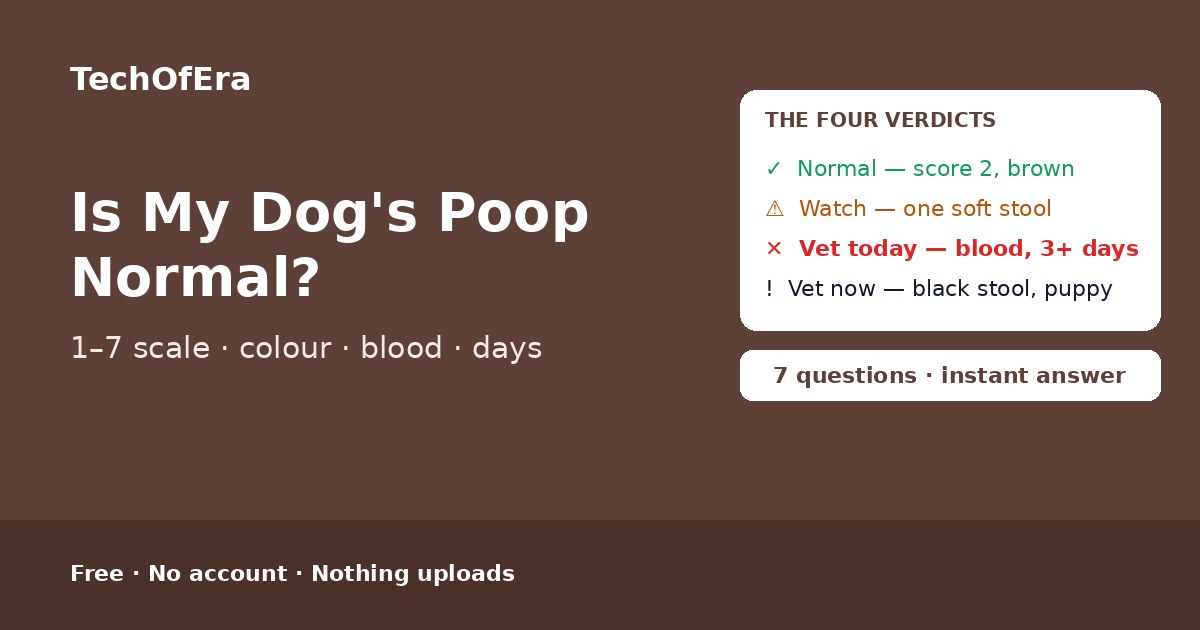
How to tell whether your dog's poop is normal
Your dog's stool is one of the easiest health checks you have — you pick it up twice a day, so you see it more often than your vet ever will. Vets read it the same way every time: by consistency, on the Purina 1–7 faecal scale, by colour, by blood or mucus, by how long it has lasted, and by how the dog is otherwise. Colour never stands alone — a brown stool can still be a problem if it is watery and the dog is lethargic, and a green stool is usually nothing if the dog is well. This checker asks exactly what decides it.
To use it:
- Score the consistency first. Judge by two things: whether the pile holds its shape, and how cleanly it lifts off the ground. Score 2 — firm, segmented, picks up cleanly — is ideal. Score 3 is still normal. Scores 4 to 7 are diarrhoea, and the higher the score the more fluid the dog is losing.
- Note the colour. Chocolate brown is normal. Black or tarry means digested blood from higher up the gut and needs a vet always. Bright red is fresh blood from the lower gut. Yellow, grey or greasy stool that keeps coming back can point to the liver or pancreas.
- Check for blood and mucus. Blood is the single most urgent thing to look for. A few red streaks still need a vet call today; a lot of blood needs one now. Mucus alone is often mild large-bowel irritation — with blood or watery stool it is not.
- Count the days. A single odd stool is usually nothing: a chew, extra treats or a long walk all show up in the stool the next day. Diarrhoea past 48–72 hours needs a vet even in a well dog, and a change that keeps coming back is a pattern.
- Check how the dog is. Vomiting, lethargy, appetite loss or straining upgrade any stool problem. A dog that is vomiting as well as having diarrhoea is losing fluid from both ends — and a puppy, a senior or a dog under 5 kg dehydrates fast.
- Collect a sample if you are calling the vet. About a teaspoon-sized amount, as fresh as possible, in a clean sealed bag, kept cool but not frozen. Write down what you saw — score, colour, blood, how long it has lasted, and whether the dog is eating and drinking — and take the note with you.
Stool situations and what to do at a glance
The table below is built from the same rules as the checker, so it can never disagree with your verdict. Where the stool sits on the 1–7 scale, its colour, and how long it has lasted decide together with how the dog is.
| Stool situation | Verdict | What to know |
|---|
What makes this checker different
The pages that rank for this search are charts and guides — thorough explanations of the 1–7 scale, what each colour can mean, and when to call the vet — but they leave you to work out what that means for the stool you just picked up: whether a score 4 once is the same as a score 4 for three days, whether green matters when the dog is well, whether a puppy with watery stool can wait until morning, and whether mucus on its own is worth a call. The one interactive rival is a small section on a generic chart site, with no age, duration or how-the-dog-is questions at all. This page is that answer: seven questions, an instant verdict, the reason named, and the red flags stated plainly instead of buried in the text — with nothing to install, no account, and nothing uploaded. It is a self-assessment, so it says plainly what it cannot know: a web page cannot examine the stool, feel your dog's belly, or know your dog's history, so anything you mark “Not sure” stays on the list until you confirm it.
When is this the right check?
Whenever you pick up a stool that does not look like your dog's usual: the watery puddle on a morning walk, the black tarry stool that was not there yesterday, the red streaks you only noticed when you bagged it, the soft stool that has now lasted three days. Also whenever the stool is fine but you are not sure what fine looks like — the first dog, the new puppy, the rescue whose normal you are still learning. And whenever you are about to call the vet and want to know what to say: the checker gives you the score, the colour, the blood, the duration and how the dog is, which is exactly what the vet will ask first.
Honest limitations
A self-assessment, not a diagnosis
This checker works only from the answers you enter. It cannot diagnose your dog — no web page can examine the stool, feel your dog's belly, or know your dog's history. If an answer is wrong, the verdict is wrong. When in doubt, call your vet.
Colour never stands alone
A stool's colour is only one clue. Green or orange stool in a well dog is usually dietary — grass, a new food, or something scavenged. The same colour with diarrhoea, vomiting or lethargy is a symptom, and the checker weighs the whole picture, not the colour by itself.
The 1–7 scale is a guide, not a lab test
The Purina faecal scale is the language vets use to describe stool, but two people can score the same stool a point apart. If your hands hesitated between two scores, take the worse one — and let your vet score it precisely at the next visit.
Puppies, seniors and small dogs are different
Watery diarrhoea that a healthy adult dog can ride out for a day is urgent in a puppy, a senior, or a dog under 5 kg — they dehydrate fast and have very little reserve. The checker treats them as urgent even on day one, and so should you.
Straining can mean a blockage
Straining with nothing coming out, or no stool at all for over 24 hours, can mean a blockage or severe constipation. If the dog is distressed, vomiting, or its belly is swollen or painful, that is an emergency — go to the vet now, do not wait for the next walk.
Rules from veterinary sources
The rules here follow the Nestlé Purina Fecal Scoring Chart (1–7), Cornell University College of Veterinary Medicine guidance on diarrhoea, VCA Animal Hospitals' diarrhoea questionnaire, and the Merck Veterinary Manual, as they read in November 2026. Guidance can be revised, so re-check if a new edition appears.