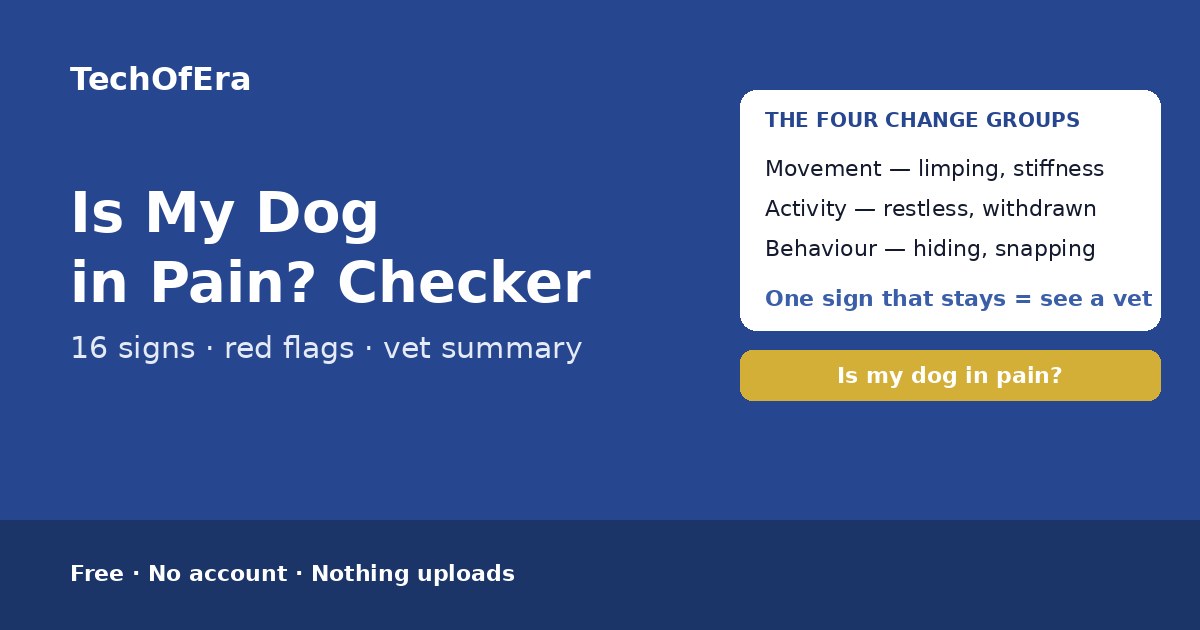
Is my dog in pain — or just having an off day?

Dogs hide pain — it is a survival instinct — so the signs are small changes from normal, not one dramatic moment. Tick the signs you see in the four groups vets use, say how long they have lasted, and this checker gives you a plain verdict: watch, log, book a vet visit, or call one now — free, in your browser, nothing uploads.

  • 16 signs, grouped the way Cornell groups them
  • Red flags give an emergency verdict on their own
  • Vet-visit summary to copy, download or print
  • Free, no account, nothing uploads
Is my dog in pain — or just having an off day?

Check the signs

Try a preset:

Movement changes

How your dog moves — tick every change that is new for them.

Activity and rest changes

How much your dog moves and rests in a day.

Behaviour and mood changes

How your dog acts with you and with the world.

Eating and daily-habit changes

The routines that change when a dog hurts.

Face and body cues

What the face and the body give away.

Red flags — call a vet now

Any one of these is an emergency on its own. Do not wait to see whether it passes.

0 of 2 answered

Your result

Answer the questions Your verdict appears here as you answer.
What you ticked

Tick the signs above and your dog’s picture will appear here.

Blockers

To fix

Things to check

Still to confirm

What to do next

    Your result summary — take it to the vet


    Tick the signs above — the verdict updates live.

    Privacy you can verify, not just trust

    Checking whether your dog is in pain by uploading what you see about them to a website would be backwards — the check should never be the leak. This one can't: your answers are checked with plain JavaScript on your device, and they never leave the device — the only third-party requests are the site's own analytics, which count page views. Don't take our word for it:

    New cross-origin requests during use: 0
    1. Press F12 to open developer tools, then the Network tab.
    2. Tick a sign above. Watch: apart from the site's analytics, nothing new is requested — no uploads, and no data ever leaves your device.
    3. Extra credit: disconnect your internet after this page loads — the checker still works.

    How the pain check works

    Dogs hide pain — it is a survival instinct, and it is one reason caring owners can miss early warning signs. So the check does not look for one dramatic sign: it looks for changes from your dog’s normal, in the four groups Cornell University’s Riney Canine Health Center uses — movement, activity, behaviour and daily habits — plus face and body cues from VCA and PetMD guidance, all checked in November 2026. One sign alone does not prove pain. A new sign that stays, or several signs together, is a reason to see a vet — and that is exactly how this checker scores: it counts the signs, and a week or more of signs moves the verdict one band up. A red flag (collapse, seizure, bloat, breathing trouble) is an emergency on its own, whatever else is ticked.

    To use it:

    1. Tick every sign that is new for your dog. Work through the five groups — movement, activity, behaviour, daily habits, and face and body. Compare against your dog’s normal, not against other dogs: a slow change in your own dog is the signal.
    2. Check the red flags. Collapse, a seizure, a swollen hard belly with retching and nothing coming up, or struggling to breathe are emergencies. If any of them is true, stop reading and call a vet now.
    3. Say how long the signs have been there. Pain that stays is a stronger signal than pain that just appeared, so a week or more moves the verdict one band up. If you are not sure, the checker says so instead of guessing.
    4. Say how old your dog is. Puppies, adults and seniors get pain for different reasons — arthritis is common in seniors, injury more often in puppies — so the advice changes with the life stage.
    5. Read the verdict, then take the summary to the vet. The copy, download and print buttons give you a summary with the signs, how long they have lasted and your dog’s life stage — the notes Cornell says to record, because the vet may not see the signs in the clinic.

    What makes this checker different

    The pages that rank for this search are guides — PetMD’s sign-by-sign guide, VCA’s owner guide, Adopt-a-Pet’s signs and safe pain-relief guide, and Whiskever’s 18-sign list, all grounded in Cornell’s four change groups. There is no free, standalone checker that takes the signs you actually see and gives you a verdict: watch and log, book a vet visit, or call one now — with the signs grouped, the duration weighed, and a vet-visit summary to take with you. The quality-of-life quizzes that do exist answer a different question: they score seven areas on the HHHHHMM scale for end-of-life decisions in seriously ill or senior dogs, not “my dog seems off today — is it pain?”. This page is that answer: sixteen signs, four red flags, an instant verdict for your dog, and the next steps.

    When is this the right check?

    When your dog seems off and you cannot put your finger on why — a little stiffer, a little quieter, a little less interested in the walk. When a limp or a new behaviour has appeared and you are not sure whether it needs a vet or just watching. When you are about to call the vet and want your notes in order first. And whenever a guide gives you a list of signs without telling you what to do with them: the list is only useful once it becomes a verdict.

    Honest limitations

    A self-assessment, not veterinary advice

    This checker cannot examine a dog. Only a vet who has seen your dog can diagnose pain or advise treatment. If you are worried, it is always okay to call your vet — the checker helps you describe what you see, it does not replace the examination.

    No single sign proves pain

    Every sign here can also mean something else: panting can be heat or stress, hiding can be fear, a limp can be a thorn. The verdict counts signs and weighs how long they have lasted, because several signs together — or one sign that stays — is the signal, not any one tick.

    Facial cues are one piece of the picture

    Squinting, a furrowed brow or flattened ears can signal pain, but they overlap with fear, anxiety, nausea and stress. The canine grimace scale is a real tool, and this checker treats its cues as supporting evidence, never as the verdict on their own.

    Never give human pain medicine

    Ibuprofen, aspirin and paracetamol can seriously harm dogs, and no over-the-counter pain medicine is approved for them. The safe thing to do at home is rest, comfort and a vet visit — not a tablet from your own cabinet.

    The red flags are the one hard rule

    Collapse, a seizure, bloat and breathing trouble are emergencies in veterinary first-aid guidance, full stop. The checker gives an emergency verdict on any one of them and does not wait for more signs to agree.

    Signs grounded in veterinary guidance, dated November 2026

    The signs here are Cornell University’s four change groups, VCA’s owner guide and PetMD’s sign list, checked in November 2026. Guidance changes: if your dog is getting worse, call the vet — do not wait for a web page to agree with you.

    Frequently asked questions

    How can you tell if a dog is in pain?

    Dogs hide pain, so look for changes from your dog’s normal rather than one dramatic sign. Cornell University’s Riney Canine Health Center groups the signs into four kinds of change: movement (limping, stiffness, trouble with stairs or jumping, slower on walks), activity (restlessness, sleeping more or less, less interest in play or walks), behaviour (whimpering, hiding, snapping when touched, licking one spot), and daily habits (eating less, toilet accidents, poor sleep). One sign alone does not prove pain, but a new sign that stays, or several signs together, is a reason to see a vet. This checker walks you through those four groups and scores what you tick.

    What are the signs of pain in dogs?

    The signs vets use are: limping or favouring a leg; stiffness when getting up, especially after resting; trouble with stairs, jumping or getting into the car; slower on walks; restlessness and not being able to settle; sleeping much more or much less; less interest in walks or play; withdrawing or hiding; growling or snapping when touched; whimpering, yelping or groaning; licking or chewing one spot over and over; eating less or drinking much more or less; new toilet accidents; panting when resting in a cool room; an arched back, low head or tucked tail; and trembling when not cold or excited. The checker above lists all sixteen, grouped by kind, so you can tick the ones you see.

    My dog is limping — should I call the vet?

    It depends on how long it lasts and what comes with it. A limp that appears suddenly after a run or a jump and is gone the next day is often a strain — rest the dog, keep walks short and on the lead, and watch it. A limp that stays for more than a day or two, gets worse, or comes with other signs (stiffness, not wanting to walk, licking the leg, whimpering) is a reason to book a vet visit. A dog that will not put weight on a leg at all, or a leg that looks swollen or bent, needs a vet the same day. Tick the limp and any other signs above and the checker gives you the verdict for your dog’s combination.

    Can I give my dog painkillers at home?

    No — never give a dog human pain medicine without a vet telling you to. Ibuprofen, aspirin and paracetamol (acetaminophen) can seriously harm dogs, and the US Food and Drug Administration says no over-the-counter anti-inflammatory pain medicine is approved for dogs at all: the safe ones need a vet’s prescription and a dose worked out for your dog’s weight and health. If your dog is in pain, the safe thing to do at home is rest, comfort and a vet visit — not a tablet from your own cabinet.

    What should I write down before the vet visit?

    Cornell’s advice is to record what you see, because the vet may not see the signs in the clinic: the signs themselves, when each one started, how long each lasts, and whether anything makes it better or worse. Photos or short videos of the sign — the limp, the stiffness getting up, the spot being licked — help the vet a lot. The checker’s Copy result button gives you a summary with the signs, how long they have lasted and your dog’s life stage, ready to take to the visit.

    When is dog pain an emergency?

    Call a vet or an emergency clinic now if your dog has collapsed or cannot stand, has had a seizure or fit, has a swollen hard belly and is retching or trying to vomit with nothing coming up (the classic sign of bloat), or is struggling to breathe or has blue, pale or very dark red gums. Those are the signs veterinary first-aid guidance treats as emergencies — do not wait to see whether they pass, and do not try to treat them at home. The checker has a red-flag section for exactly these four, and any one of them gives an emergency verdict on its own.

    Does this checker diagnose my dog or upload anything?

    No to both. This checker is a self-assessment: it runs the signs you tick against published veterinary guidance as it reads in November 2026, entirely in your browser with plain JavaScript, and nothing you enter leaves your device. It is not veterinary advice and not a diagnosis — only a vet who has examined your dog can diagnose pain or advise treatment. The only third-party requests are the site’s own analytics, which count page views. You can verify it yourself with the network-request counter in the privacy section below the checker.