Is your space heater safe to leave on — or should it go off?

Space heaters were involved in about 1,600 home fires a year in the United States — and most of the deaths happen overnight, while people are asleep. The safety rules are simple, but they turn on your exact setup: the clearance, the plug, the tip-over switch, the timer, the smoke alarm. Answer ten questions and this checker runs your heater against the CPSC and NFPA rules — free, in your browser, nothing uploads.

  • CPSC + NFPA rules
  • 10 questions, instant verdict
  • Every fix named, nothing guessed
  • Free, no account, nothing uploads
Is your space heater safe to leave on — or should it go off?

Check whether your space heater is safe to leave on

Try a preset:
0 of 10 answered

Your result

Answer the questions Your verdict appears here as you answer.
The right heater size for your room

Enter your room size above and the right heater size for it will appear here.

Blockers

Things that do not fit

Things to check

Still to confirm

What to do next

    Your result summary


    Answer the questions above — the verdict updates live.

    Privacy you can verify, not just trust

    Checking whether your space heater is safe to leave on by uploading your home details to a website would be backwards — the check should never be the leak. This one can't: your answers are checked with plain JavaScript on your device, and they never leave the device — the only third-party requests are the site's own analytics, which count page views. Don't take our word for it:

    New cross-origin requests during use: 0
    1. Press F12 to open developer tools, then the Network tab.
    2. Answer a question above. Watch: apart from the site's analytics, nothing new is requested — no uploads, and no data ever leaves your device.
    3. Extra credit: disconnect your internet after this page loads — the checker still works.

    How the space heater safety rules work

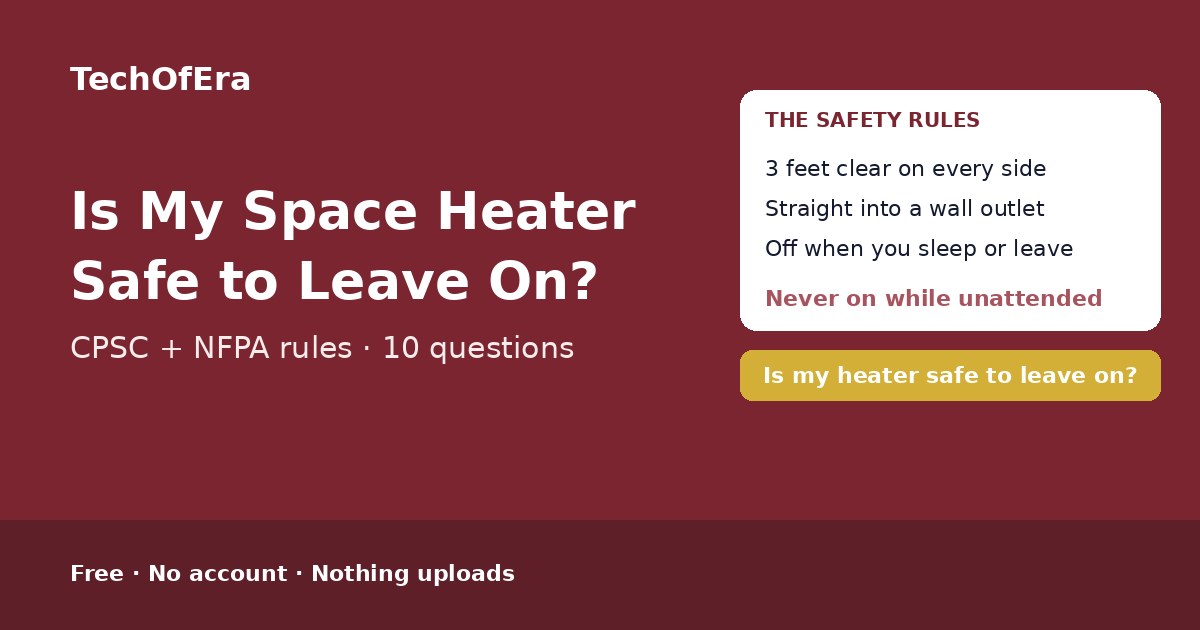
    The U.S. Consumer Product Safety Commission’s rules for portable electric heaters fit on one card: keep all sides of the heater at least 3 feet (about 1 metre) from anything that can burn; plug it directly into a wall outlet, never into an extension cord or a power strip; never leave it running while you are sleeping or while nobody is in the room; and buy one with the seal of a nationally recognised testing laboratory, such as UL, and a tip-over switch. The National Fire Protection Association adds two more: turn portable heaters off when you leave the room or go to bed, and keep a three-foot kid-free zone around them. The rules exist because the numbers are stark: the CPSC estimates portable heaters were involved in about 1,600 residential fires a year from 2020 to 2022, with about 70 deaths and 150 injuries a year, and the NFPA counts space heaters and heating stoves behind about 30% of home heating fires but about 73% of the deaths from them. December, January and February are the peak months for home heating fires. UK fire services give the same rules in metric: at least 1 metre from anything that can burn, plugged straight into a wall socket, never left on while you sleep or while you are out. This checker runs your heater’s exact setup against those rules, and names every fix.

    To use it:

    1. Say when the heater will run. Only while you are awake and in the room is the only safe answer — while you sleep, while you are out of the room, or all day with nobody home are all “do not leave it on”.
    2. Say what kind of heater it is. Electric heaters do not produce carbon monoxide. Fuel-burning heaters — kerosene, propane, gas — do, and must never run in a bedroom or an unventilated room.
    3. Say how far the nearest thing that can burn is, how the heater is plugged in, and what it sits on. At least 3 feet (about 1 metre) clear on all sides, directly into a wall outlet, on a hard, flat, level floor.
    4. Say whether it has tip-over protection, an auto-off timer and overheat shut-off, and whether a working smoke alarm is in the room. Each one changes the verdict — and a missing smoke alarm is a fix, not a shrug.
    5. Say how big the room is and how many watts the heater draws. About 10 watts per square foot is the rule of thumb, and a standard wall outlet should not carry more than 1,500 watts on one heater.

    What makes this checker different

    The pages that rank for this search are guides — the CPSC’s safety habits, the NFPA’s heating safety pages, and safety guides that all give the same flat answer: no, do not leave a space heater on overnight. That is the right answer for overnight use, but it is not the whole question. A heater used while you are awake and in the room can be safe — if the clearance, the plug, the tip-over switch, the timer, the surface, the smoke alarm and the wattage are all right. There is no free, standalone checker that takes your heater’s exact setup and gives you a verdict for it: safe as described, not safe yet with the fixes named, or do not leave it on like this. This page is that answer: ten questions, an instant verdict for your exact heater, the blockers named, and the next steps. It is a self-assessment, so it says plainly what it cannot know: it cannot see your heater, your cord or your outlet, and where the guidance depends on a detail it does not ask about — a carbon monoxide alarm for a fuel-burning heater, for example — it says so instead of guessing.

    When is this the right check?

    Before the first cold snap — run the checker while you get the heater out of storage, because the clearance, the cord and the smoke alarm are all decided before the first use. When you buy a new heater — because a tip-over switch, an auto-off timer and overheat shut-off are the features to check before you pay, not after. When you move a heater to a new room — because the clearance, the surface and the smoke alarm change with the room. When you are tempted to leave it on overnight — because the checker will tell you plainly that no safety feature makes that safe, and what to do instead. And after a recall notice — check whether your heater has been recalled on SaferProducts.gov before you plug it in again.

    Honest limitations

    A self-assessment, not fire-safety advice

    This checker cannot see your heater, your cord or your outlet. It cannot check whether the plug runs hot, whether the cord is frayed, or whether the heater has been recalled. If you are unsure, check the maker’s instructions or ask a qualified electrician — do not guess.

    The 3-foot rule is a minimum, not a target

    At least 3 feet (about 1 metre) is the distance every safety body gives — but more distance is always safer, and where your heater’s manual asks for more, follow the manual. A heater that only just clears the rule is not the same as a heater with room to spare.

    A timer does not make overnight use safe

    An auto-off timer and overheat shut-off are backups, not permission. The CPSC, NFPA and U.S. Fire Administration all say to turn a portable heater off when you go to bed or leave the room — a timer that switches it off an hour later does not change that.

    Fuel-burning heaters need a carbon monoxide alarm

    This checker does not ask whether you have a carbon monoxide alarm, so a fuel-burning heater’s verdict is about the questions asked — not the whole picture. If your heater burns fuel, fit a working carbon monoxide alarm nearby and keep the room ventilated, or switch to an electric heater indoors.

    A smoke alarm does not make an unsafe heater safe

    A working smoke alarm is your warning if something goes wrong — it is not a substitute for the rules. A heater with no clearance, on an extension cord, left running overnight is dangerous with or without an alarm. The rules come first.

    Rules from official sources, dated November 2026

    The rules here are the CPSC’s portable heater safety habits, the NFPA’s home heating safety guidance, the U.S. Fire Administration’s heater advice and UK fire-service advice, as they read in November 2026. Guidance changes: recheck with your heater’s maker if anything about your heater changes.

    Frequently asked questions

    Is it safe to leave a space heater on overnight?

    No. The U.S. Consumer Product Safety Commission says never to leave a space heater running while you are sleeping, and the National Fire Protection Association and the U.S. Fire Administration say to turn portable heaters off when you go to bed. The CPSC estimates portable heaters were involved in about 1,600 residential fires a year from 2020 to 2022, with about 70 deaths and 150 injuries a year — and most fatal heater fires happen overnight, while people are asleep. Warm the room before bed, switch the heater off, and use an extra blanket instead. No safety feature — a tip-over switch, a timer or a thermostat — makes overnight use safe.

    How far should a space heater be from curtains and bedding?

    At least 3 feet — about 1 metre — on every side. The CPSC, the NFPA and the U.S. Fire Administration all give the same distance, and UK fire services give 1 metre: beds, curtains, sofas, clothes, papers and anything else that can burn must stay that far from the front, sides and back of the heater. More than half of home heating fire deaths start when heating equipment sits too close to something that can burn. Where your heater’s manual asks for more distance, follow the manual.

    Can I plug a space heater into an extension cord or a power strip?

    No. Plug it directly into a wall outlet. A 1,500-watt heater draws 12.5 amps — more than many extension cords and power strips can carry — and they can overheat and catch fire. The CPSC says never to power a heater with an extension cord or power strip. If no outlet is close enough, move the heater to an outlet, or have a qualified electrician add one. If the plug, cord, wall outlet or faceplate ever feels hot, turn the heater off and have a qualified electrician check it.

    What safety features should a space heater have?

    Look for a listing mark from a recognised testing laboratory — UL, ETL or CSA — plus a tip-over switch that cuts the power if the heater falls over, overheat protection that switches it off if it gets too hot, a thermostat, and an auto-off timer. The CPSC advises buying a heater with the seal of a nationally recognised testing laboratory and a tip-over switch. Before you use a heater, check whether it has been recalled on SaferProducts.gov — the CPSC’s public database of recalled products.

    Are oil-filled radiators safer than fan heaters?

    Oil-filled radiators are often safer for supervised daytime use: they have no exposed heating element, their surface stays cooler than a fan heater’s, and they keep giving off heat after they switch off. But the same rules apply to them as to any portable heater — at least 3 feet (about 1 metre) clear on all sides, plugged straight into a wall outlet, and off when you sleep or leave the room. Fuel-burning heaters are different: kerosene, propane and gas heaters produce carbon monoxide, so never use one in a bedroom or in a room without ventilation, and fit a working carbon monoxide alarm nearby. Electric heaters do not produce carbon monoxide.

    What wattage space heater do I need for my room?

    About 10 watts per square foot of room — about 100 watts per square metre — is the rule of thumb. A 1,500-watt heater suits a room of about 150 square feet (about 14 square metres). A smaller room needs less: a 750-watt heater is usually enough under 150 square feet. A room over 300 square feet needs about 3,000 watts of heat, which one heater on one outlet cannot safely give — a standard wall outlet should not carry more than 1,500 watts. Use central heating, or a second heater on a different circuit, instead of a bigger single heater.

    Does this checker guarantee my heater is safe?

    No. This checker is a self-assessment: it runs your answers against the CPSC, NFPA and U.S. Fire Administration rules and UK fire-service advice as they read in November 2026, entirely in your browser, and nothing you enter leaves your device. A web page cannot see your heater, your cord or your outlet — it cannot check whether the plug runs hot, whether the cord is frayed, or whether the heater has been recalled. The only third-party requests are the site’s own analytics, which count page views. If the plug or outlet ever feels hot, or you smell burning, turn the heater off and call a qualified electrician.