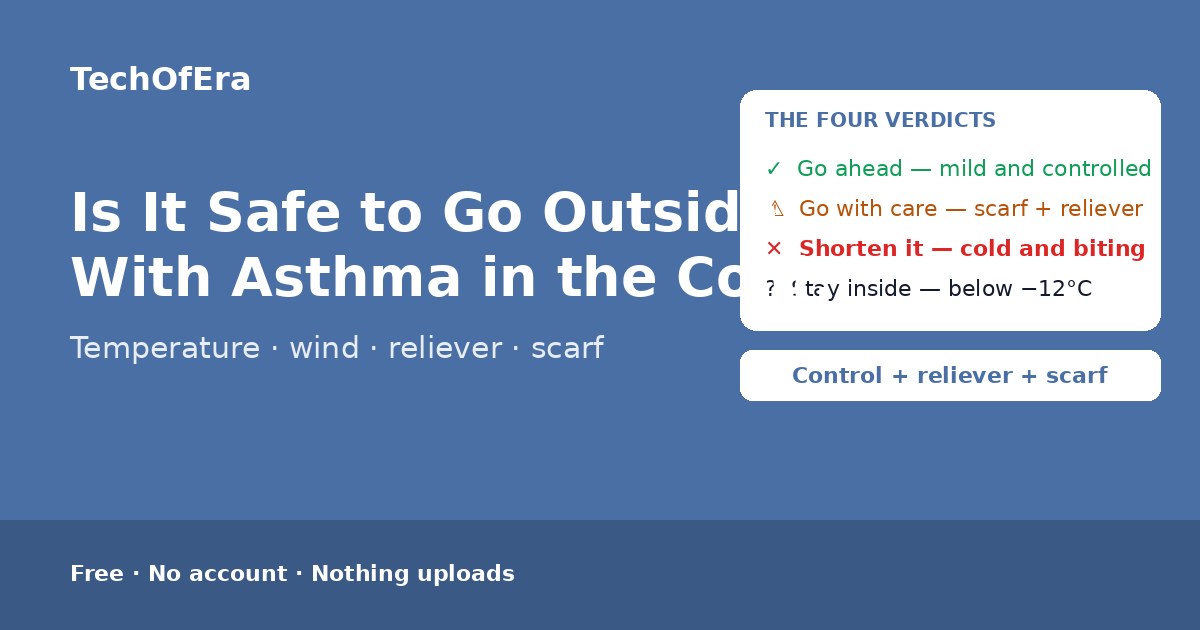
How to decide whether to go outside with asthma in the cold
The temperature on the thermometer is only half the story — how well controlled your asthma is, whether you have used your reliever, and whether you cover your face are the other half. Cold, dry air irritates the airways: it dries the lining of the bronchial tubes, which makes them narrow and twitchy, causing coughing, wheezing and tightness in the chest. It is worse when you breathe through your mouth, because mouth-breathing sends cold, dry air straight to the airways instead of warming it in your nose first — which is why exercise in the cold is a classic trigger, and why symptoms typically start 6 to 8 minutes into a cold-air outing. The American Lung Association notes that some experts suggest staying inside when temperatures drop below 10°F (−12°C). This checker asks exactly what decides it.
To use it:
- Enter the temperature and wind speed. Use the forecast for the time you will actually be out, where you will actually be — not an indoor reading, and not the morning low if you go out at midday. If either is missing, the checker says it cannot tell yet, rather than guessing.
- Be honest about your asthma control. Well controlled means symptoms rarely, with your preventer taken daily. Partly controlled means symptoms a few times a week; poorly controlled means daily symptoms, or needing your reliever four or more times a week. If you need your reliever that often, your asthma may not be controlled — talk to your doctor. If you are not sure, say so: the checker assumes the worst case rather than guessing.
- Use your reliever before you go out. The Met Office and Asthma UK advise one or two puffs before going outside in the cold; the American Lung Association advises 20 to 30 minutes before a cold-air activity. Do not go out in the cold without your reliever at all — that is the one hard stop in this checker, whatever the weather.
- Cover your nose and mouth. A scarf or mask worn loosely over your nose and mouth warms the air before you breathe it in. Breathe in through your nose and out through your mouth where you can.
- Warm up indoors, start easy outside. Warm up indoors for 10 to 15 minutes, then start at a gentle pace for another 5 to 10 minutes before picking up speed. Cold air hits unprepared airways hardest.
- Watch the first 10 minutes. Symptoms usually start early, not late. Coughing, wheezing, tightness in the chest, or unusual breathlessness mean stop and go inside — do not push through them. Use your reliever as your asthma action plan says, and get medical help if it does not ease quickly.
Conditions and what to do at a glance
The table below is built from the same rules as the checker, so it can never disagree with your verdict. The air temperature decides, together with your asthma control, your reliever, your scarf and the other triggers.
| Condition | Verdict | What to know |
|---|
What makes this checker different
The pages that rank for this search are guides — thorough explanations of why cold air triggers asthma, the 10°F line, the scarf, and the reliever — but they leave you to judge your own day: to weigh the temperature against how well controlled your asthma is, whether you used your reliever, whether you will cover your face, and whether a cold or poor air quality is stacking on top. No free interactive checker does that weighing for you. This page is that answer: the temperature and wind speed in, your asthma control, your reliever, your scarf and your other triggers scored alongside the weather, and a verdict for the exact outing you plan — with the reason named. It is a self-assessment, so it says plainly what it cannot know: a web page cannot measure the weather where you are or examine you, so anything you mark “Not sure” stays on the list until you confirm it.
When is this the right check?
Whenever you have asthma and the cold makes you hesitate before going out: the −8°C morning with a biting wind, the school run on a day the forecast calls “feels like −15°C”, the first cold snap of the season when you have not been out in the cold for months, or the walk you planned on a day you woke up coughing. Also whenever the decision turns on something specific — whether your asthma is controlled enough for today, whether you remembered your reliever, whether a scarf is enough, or whether a cold or poor air quality changes a day that would be fine on its own. And whenever you are new to managing asthma in winter and want a straight answer instead of a guide to interpret.
Honest limitations
A self-assessment, not a diagnosis
This checker works only from the temperature, wind speed and answers you enter. It cannot diagnose you — no web page can measure the weather where you are, take your temperature, or know your medical history. If an answer is wrong, the verdict is wrong. When in doubt, stay inside — or ask a clinician.
The temperature bands are guidance, not a prescription
The 10°F (−12°C) line comes from expert advice quoted by the American Lung Association, and the other bands are built from the same guidance. Your own threshold differs with your asthma, your medication and your history — which is why the checker scores your control, your reliever and your scarf alongside the weather, and why your own asthma action plan always wins over this page.
Wind chill is not the air temperature
Wind chill describes heat loss from exposed skin, not the temperature of the air you breathe — so the verdict turns on the air temperature, with wind scored as a modifier that drives cold, dry air into your airways faster. A windy day at −5°C is a worse day for asthma than a calm one at the same temperature, even though the air is the same cold.
Symptoms can start fast
Exercise-induced symptoms typically start 6 to 8 minutes into a cold-air outing, and they can escalate quickly. A go-ahead verdict is not a guarantee — watch the first 10 minutes, and stop at the first cough, wheeze or tightness, whatever the checker said.
Warning signs override the verdict
Coughing, wheezing or tight chest mean the symptoms are starting, whatever the checker said. Stop, go inside, and use your reliever as your action plan says. If it does not ease quickly, or you cannot speak in full sentences, get medical help.
Rules from public-health sources
The rules here follow American Lung Association, Met Office / Asthma UK and American College of Sports Medicine cold-weather asthma guidance, as they read in November 2026. Guidance can be revised, so re-check if a new edition appears — and follow your own clinician's advice over this page.