How to decide whether to run with knee pain
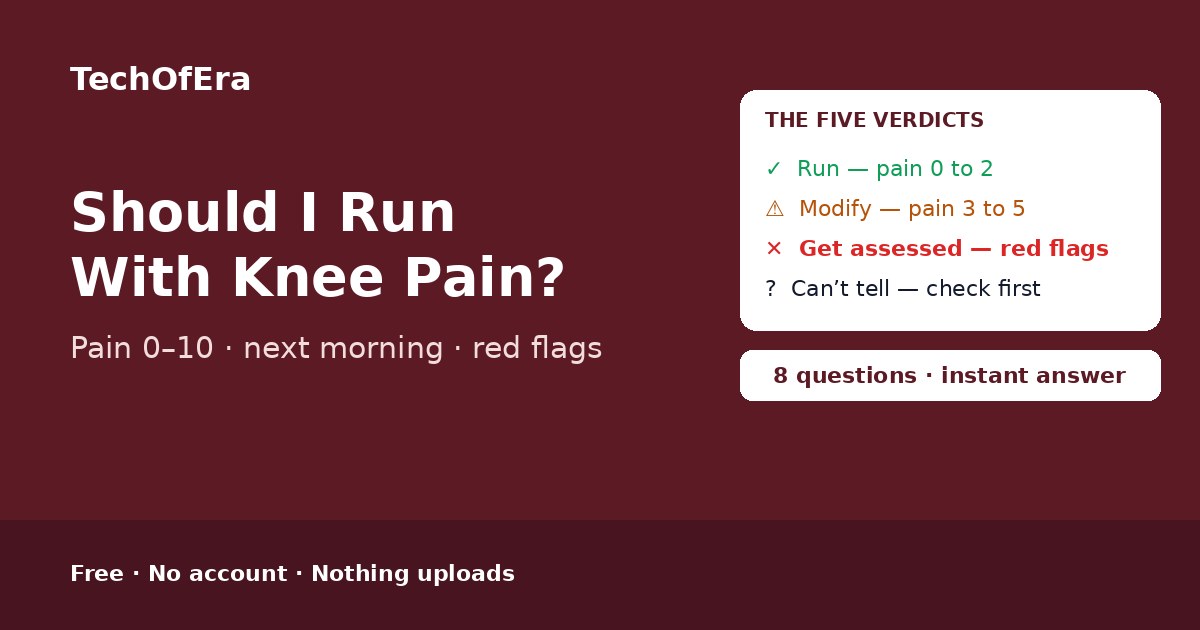
Sports-medicine trials use a simple rule — the pain-monitoring model. Rate your knee pain from 0 to 10 during and after exercise: 0 to 2 counts as safe, up to 5 as acceptable, and above 5 as too much, and aim for 0 to 3 most of the time. The second half of the rule is the next morning: by then, your knee should be back to its usual level. If it is not, drop back a step next time — a shorter run, more walking breaks, fewer hills — not to nothing. On top of the score, some signs override everything: swelling, locking, giving way, inability to bear weight, or pain after a twist, fall or pop mean stop running and get assessed, whatever the number is. This checker asks exactly what decides it.
To use it:
- Rate the pain 0 to 10. Think of your last run, not your best run. A mild ache you can ignore is 0 to 2; noticeable pain you can keep going through is 3 to 5; pain so bad you had to stop is 6 or more. With pain just below the kneecap, keep it to 3 or less.
- Watch what the pain does during the run. Pain that stays flat or eases as you warm up is more manageable than pain that builds with every mile. Sharp pain, pain that makes you limp, or pain that changes your stride are stop signs, not things to run through.
- Apply the next-morning test. Check the knee tomorrow morning: is it back to its usual level, a bit worse, or clearly worse? A knee that is worse the next morning has not recovered — the load was too high.
- Check for the mechanical red flags. Swelling within hours of a run, a knee that locks or catches, one that gives way, or one you cannot bear weight on all mean stop running and get assessed. So does deep bone pain that aches at night, and pain after a twist, fall or pop.
- Modify before you quit. Complete rest is rarely the answer. Cut the run by about a third, slow down, keep it flat, skip hills and intervals — and if even that leaves the knee worse the next morning, swap running for cycling or swimming until it settles.
- Build back by about 10% a week. A sudden jump in distance or speed is the commonest trigger for overload pain. Add strength work for hips, glutes and thighs — sit-to-stands, step-ups, glute bridges and calf raises — two to three times a week.
Knee situations and what to do at a glance
The table below is built from the same rules as the checker, so it can never disagree with your verdict. Where the pain is, how bad it is, and what it does during and after a run decide together.
| Knee situation | Verdict | What to know |
|---|
What makes this checker different
The pages that rank for this search are guides — thorough explanations of the 0 to 10 pain scale, the green-yellow-red zones, and the next-morning test — but they leave you to work out what that means for the knee you have right now: whether your pain is a 3 or a 6, whether it building through a run changes the answer, whether swelling or a knee that gives way overrides the score, and whether a long run is different from an easy one. This page is that answer: eight questions, an instant verdict, the reason named, and the red flags stated plainly instead of buried in the text — with nothing to install, no account, and nothing uploaded. It is a self-assessment, so it says plainly what it cannot know: a web page cannot examine your knee, test its stability, or know your medical history, so anything you mark “Not sure” stays on the list until you confirm it.
When is this the right check?
Whenever your knee hurts and a run is on the plan: the ache around the kneecap on a training day, the knee that is worse the morning after a long run, the pain that appeared after you jumped your distance, or the new shoes that changed how your knee feels. Also whenever you are coming back after a break and want to know whether today is the day — the checker ramps you back gradually instead of letting you jump straight into a hard session. And whenever the pain is new and you are not sure what counts: a dull ache versus a sharp pain, swelling versus stiffness, or a knee that feels unstable. If the answer is “get it assessed”, the checker names the next step too — a GP or physiotherapy appointment, today if you cannot bear weight or the knee locks or gives way.
Honest limitations
A self-assessment, not a diagnosis
This checker works only from the answers you enter. It cannot diagnose you — no web page can examine your knee, test its stability, or know your medical history. If an answer is wrong, the verdict is wrong. When in doubt, do not run — or ask a clinician.
The NHS says not to run with knee pain
The NHS advises reducing or avoiding painful loading while the knee is sore. This checker follows the pain-monitoring model from running trials, which lets people run within strict limits — 0 to 3 most of the time, knee back to usual by the next morning. If the two ever disagree for you, follow the stricter one: do not run.
Red flags override the score
Swelling, locking, giving way, inability to bear weight, deep bone pain that aches at night, or pain after a twist, fall or pop mean stop running and get assessed — even if the pain score is low. A low number does not clear a mechanical problem.
Pain that lasts needs a plan
Pain that has not gone after a week, or has not improved after two to three weeks of reduced running, needs a GP or physiotherapy assessment. This checker can tell you whether to run today; it cannot give you a rehabilitation plan.
Strength work is the fix, not rest alone
Pain around the kneecap — the commonest knee problem in runners — responds well to strength work for the hips, glutes and thighs. Rest alone rarely fixes it. This checker points you to strength work, but it cannot show you the exercises.
Rules from sports-medicine sources
The rules here follow NHS knee-pain and running-injury guidance, the NHS Inform exercise guide, the Princeton green-yellow-red guide, and running-trial pain-monitoring limits, as they read in November 2026. Guidance can be revised, so re-check if a new edition appears.