How the train-or-drive check works
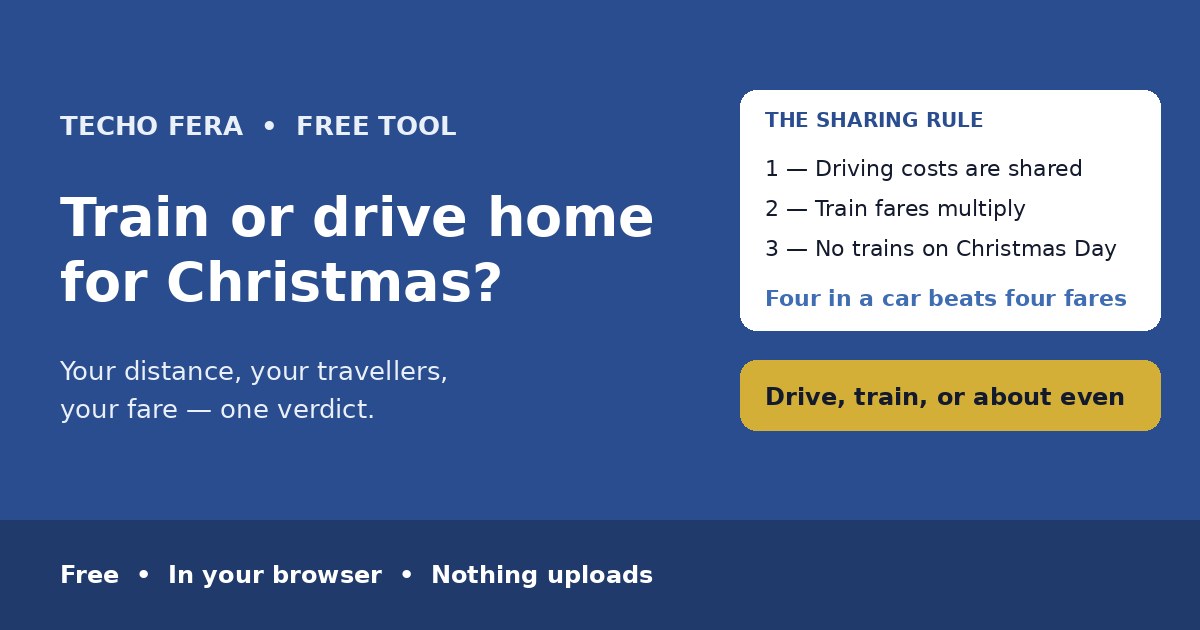
The rule is the sharing, not the distance. Driving costs are shared — fuel, tolls and parking cost the same whether one person or four are in the car — while a train fare is charged per person, so the train total grows with every extra traveller. That is why a family of four almost always drives cheaper and a solo traveller on a long route often does not. This checker takes your exact figures — how far, how many of you are travelling, what fuel costs, what the cheapest advance fare is — and gives one verdict: drive, take the train, about even, or drive because no trains run on your day. It also shows the full cost breakdown, so you can see whether fuel, wear, tolls or the fare is doing the work.
To use it:
- Say where you are travelling. United Kingdom, United States, Canada, Australia or Germany. That sets your currency and the typical fuel price, fuel economy and wear rate for your country — every one of them is editable, so enter the figures you actually pay.
- Say how far it is, one way, and whether you are coming back. The return doubles both sides. A 200-mile return is 400 miles of fuel against four train fares, not two.
- Say how many of you are travelling. This is the number that decides it: the driving cost stays the same no matter how many are in the car, while the train total is the fare times the number of travellers.
- Say which day you are travelling. 23 and 24 December are the busiest days and advance fares sell out fastest; in the UK there are no trains on Christmas Day and a limited service on Boxing Day.
- Say what fuel costs and how thirsty your car is. The price you actually pay, and your car's fuel economy. A typical UK petrol car does about 45 miles to the gallon.
- Add tolls, parking and wear and tear. Tolls on the route, parking at your destination, and the wear-and-tear box — fuel alone makes driving look cheaper than it is.
- Say the cheapest train fare you found, per person, one way. Trainline or National Rail in the UK, Amtrak in the US. Add any railcard or student discount, and what getting to and from the station costs — the hidden cost of the train.
What goes into each side
| Cost | Driving | Train |
|---|---|---|
| Fuel | Yes — the whole journey, shared | No |
| Wear and tear | Yes — 12p a mile in the UK, editable | No |
| Tolls | Yes — the total for the whole journey | No |
| Parking | Yes — at your destination | At the station, counted separately |
| Fares | No | Yes — per person, one way, doubled for a return |
| Discounts | No | Yes — railcard a third off, or 10% off |
| Getting to the station | No | Yes — taxis, station parking, the bus |
What makes this checker different
The pages that rank for this search are guides — a car site's worked example from Exeter to Edinburgh, a travel site's Amtrak-versus-driving comparison for commuters, a student union's holiday-travel tips, and a finance site's seasonal transport table. Every one of them gives you a single worked example — one route, one car, one fare — and leaves you to redo the maths for your own journey, your own travellers and your own fare. None of them asks how many of you are travelling, what your fuel costs, or what advance fare you actually found — and none of them tells you whether to drive or take the train. There is no free, standalone checker that takes your figures and gives you one verdict with the full cost breakdown. This page is that answer: your distance, your travellers, your fuel price, your fare — and a per-person verdict, with the breakdown showing exactly where the money goes. It is general information, so it says plainly what it cannot know: it cannot fetch live fares or fuel prices, and where the figures are yours to check — the cheapest advance fare for your day, whether trains run on it at all — it tells you to check instead of guessing.
When is this the right check?
When you are about to book the Christmas journey home and you are not sure whether to drive or take the train — because the answer depends on how many of you are travelling, and a family of four is a different question from a solo trip. When the advance fares have just gone on sale and you need to decide before they sell out — because this page tells you in seconds whether the fare you found beats driving. When someone in the family says the train is too expensive and someone else says driving costs a fortune — because the breakdown settles it with the actual numbers. And when you are travelling on Christmas Day itself — because in the UK there is no train to catch, and this page says so plainly instead of comparing a fare that does not exist.
Honest limitations
General information, not travel advice
This checker cannot fetch live fares or fuel prices. It cannot tell you whether the advance fare is still available, whether engineering works have closed your route, or what the traffic will be like — only the fare site and the timetable can. If the fare has sold out, or the trains are not running, the verdict changes with it.
The defaults are typical, not yours
The fuel prices, fuel economy and wear rates are typical November 2026 figures for each country — UK unleaded about £1.35 a litre, US petrol about $3.20 a gallon. Your car and your petrol station will differ. Enter the figures you actually pay: the verdict is only as good as the numbers you put in.
Money is not the whole journey
The checker compares money only. It does not count the time — the train can be faster on a long route, the car faster door to door — or the comfort: the train lets you relax and arrive rested, the car lets you leave when you like and carry presents without dragging them through stations. When the two are about even, pick on comfort, not money.
Christmas Day has no trains in the UK
In the UK no trains run on Christmas Day, 25 December, and only a limited service runs on Boxing Day, with engineering works on some routes. In the US, Amtrak runs a reduced service on Christmas Day. Pick 25 December with the UK selected and the checker tells you driving is the only option — check the timetable for your own country before you rely on it.
Fares change while you decide
Advance fares sell out, and the cheapest fare for 23 December can double once the cheap tickets are gone. The verdict you get today is for the fare you entered today. If you book a week later, run it again with the fare that is actually left.
Rules from cartakeback.com, thetravel.com, joingerald.com and upsu.com, dated November 2026
The rules here are the worked Christmas comparison from cartakeback.com, the Amtrak-versus-driving comparison from thetravel.com, the seasonal transport comparison from joingerald.com and the student holiday-travel guide from upsu.com as they read in November 2026: the shared-cost rule, the advance-fare rule, the railcard third, the split-ticket tip and the Christmas Day no-trains rule. Fares and fuel prices change weekly: recheck both on the day you book.