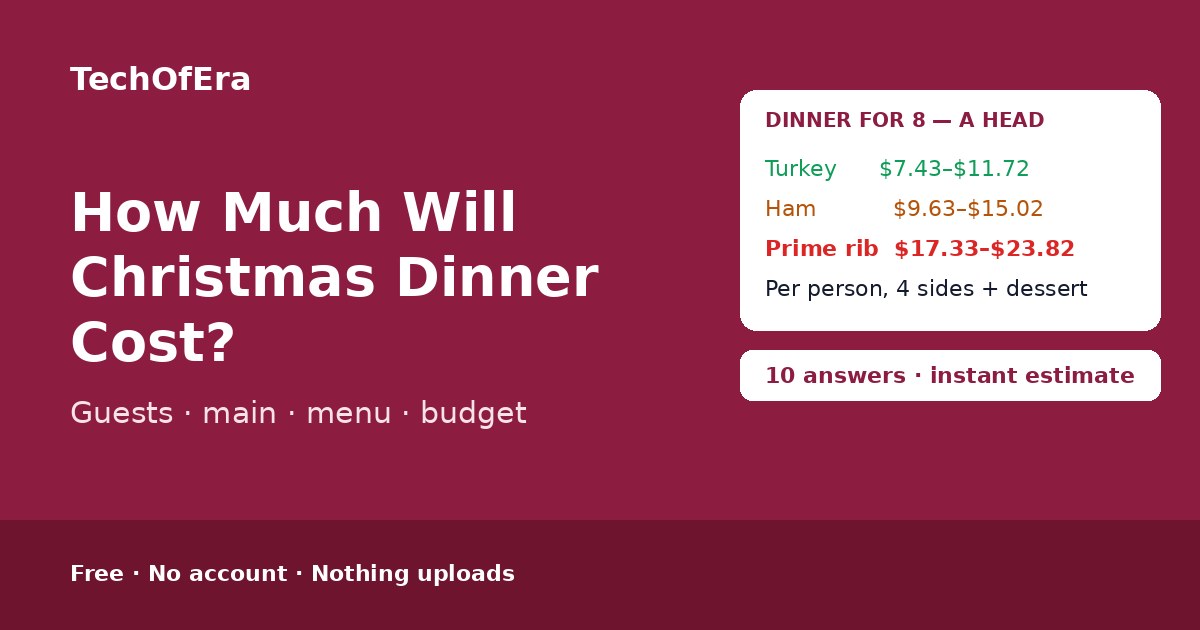
How much does Christmas dinner cost — and how this estimate is built
Most pages that rank for this question give a per-person range — $6 to $8 a head for a ham dinner, $10 to $14 for turkey, $22 to $28 for prime rib — and then leave you to multiply it by your guest count, guess at the sides, and work out whether the total fits your budget. The portion calculators do the other half of the job: how many pounds of turkey to buy, but never what it costs. And the budget tools start from a budget and split it, instead of pricing the menu you actually plan to cook. This checker does the missing job: it prices your exact dinner — your guests, your main, your sides, your drinks — and verdicts it against your budget, with the saving spelled out if it does not fit.
To use it:
- Count the portions. Adults count as one portion each; children under 12 count as half a portion. A hungry teenager eats like an adult, so count teenagers as adults — or pick the hearty appetite setting.
- Pick the main. The main is the biggest line, so it moves the total most: turkey $2–3 a head, whole chicken $2.50–4, a vegetarian main $3–5, ham $4–6, prime rib $11–14, at published US prices. Swapping prime rib for turkey is the single biggest saving on the page.
- Count the sides. Four is the usual Christmas table — potatoes, stuffing, a green vegetable and cranberry sauce, with gravy and rolls alongside. Each side costs about $0.75–1.10 a head, so one extra side adds roughly $1 a head across the table.
- Add dessert and drinks. Dessert is $1–2 a head; soft drinks $0.75–1.25; wine and beer $3–5 a head — the dearest drinks option, and the easiest line to trim without anyone noticing.
- Let it add the buffer. The total includes a 10% buffer for forgotten items — the rolls, the gravy granules, the extra butter — because every published holiday-meal guide recommends one, and every host forgets something.
- Enter a budget for the verdict. Without a budget you get the estimate only. With one, you get fits comfortably, fits but tight, over on the middle estimate, or over budget — and the exact saving each change would make.
- Check the main's price at your store. The figures are planning estimates from published US average grocery prices (October 2026), not quotes. Your store, region and week will move them, and the main is the line that moves the total most.
Christmas dinner costs at a glance
The table below is built from the same figures as the checker, so it can never disagree with your estimate. Each row is the standard dinner — 8 adults, 4 sides, dessert and soft drinks — with a different main.
| Menu | Cost band | What to know |
|---|
What makes this checker different
The pages that rank for this search are guides — careful per-person ranges for each main, worked examples for a dinner for 8 or 10, and the advice to set a number before you pick recipes — but they leave you to do the arithmetic for your own table: your guest count, your sides, your drinks, and whether the total fits the budget you actually have. The portion calculators answer a different question — how many pounds to buy — and the budget tools start from a number you already picked and split it into envelopes. None of them prices your menu and then says, plainly, whether it fits your budget and what to change if it does not. This page is that answer: your guests, your main, your menu, an estimated range instead of a false single number, how much of the main to buy, and the saving each change would make — with nothing to install, no account, and nothing uploaded. It is a planning estimate, so it says plainly what it cannot know: your store's prices this week, which is why it gives a range and tells you to check the main first.
When is this the right check?
Whenever you are planning the Christmas shop and wondering whether the dinner you have in mind fits the money you have: the turkey-versus-prime-rib decision, the "can we afford six sides" question, the "what if the in-laws bring four more people" recalculation. Also whenever the budget is fixed and the menu is not — a $100 budget and a family of 8 means the main has to be turkey or chicken, and this checker shows that in one number instead of a spreadsheet. And whenever you want the quantities as well as the cost: how many pounds of bird to buy is part of the same answer, so the shopping list writes itself. If you are cooking turkey, work out the thaw start at the same time — a 12–15 lb bird needs 3 days in the fridge, and a frozen bird on Christmas Eve is a real problem.
Honest limitations
A planning estimate, not a quote
The figures are grounded in published US average grocery prices (October 2026), not your store's prices this week. Your store, region and week will move them — so the result is a range, never a single number, and the guide says to check the main's price first.
The meal only — not the whole Christmas
The estimate covers food and drink for the dinner. It does not cover decorations, gifts, crackers, travel, or a private chef or restaurant. If those are part of your Christmas, budget them separately.
US prices by default
The default prices are US planning figures. Outside the US, change the currency and treat the total as a guide — the portion rules work anywhere, but the prices are the part to adjust first, from your own store.
Children are half portions — roughly
Children under 12 are counted as half a portion each. That is a planning rule, not a measurement: a hungry teenager eats like an adult, and a toddler eats far less. Count teenagers as adults.
Appetite is a guess
Light, typical and hearty scale the food by 0.85, 1.0 and 1.15. They are planning multipliers, not measurements — if your family always clears the table, pick hearty and buy the bigger bird.
Prices move by the week
Grocery prices move with the season, the sales and the region. A turkey on a December sale costs far less than the same bird in November. The estimate cannot know this week's sale — check the flyer before you shop.