How much should you spend on Christmas gifts?

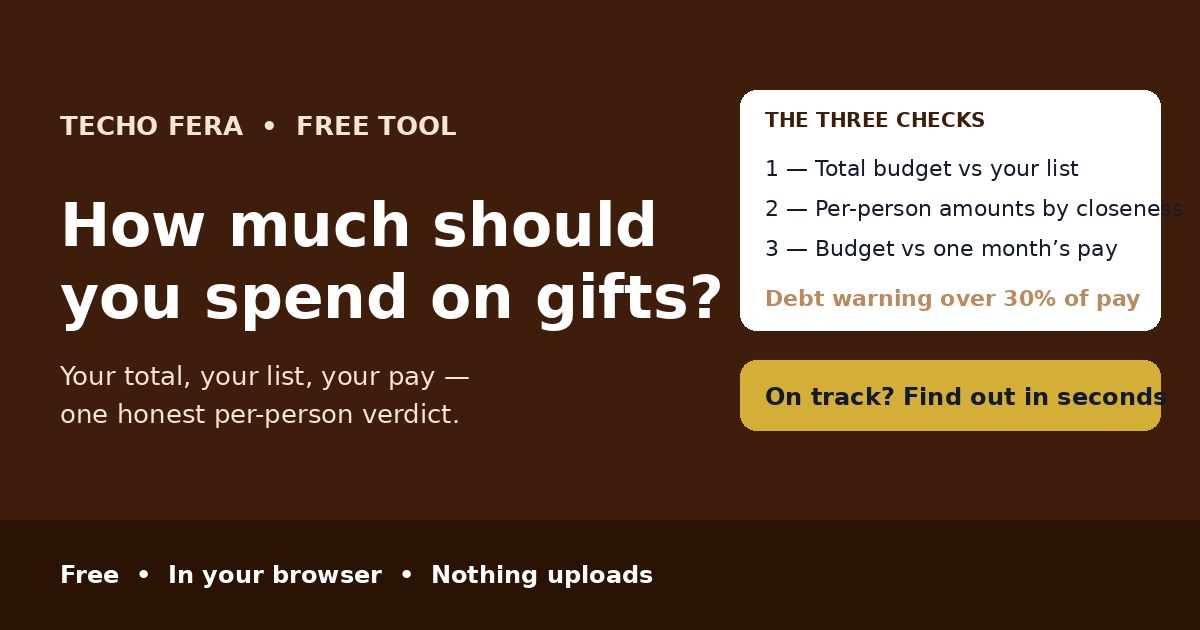
Americans expect to spend about $1,011 on gifts this Christmas — but the guides only tell you the usual range per person, and none of them does the maths for your list. Enter your total budget and who is on it, and this checker shares it out by closeness into a per-person amount for everyone, tests whether the budget fits your pay, and warns you before the plan turns into January debt — free, in your browser, nothing uploads.

  • Gallup average $1,011 this Christmas
  • Per-person amounts by closeness
  • Debt warning over 30% of pay
  • Free, no account, nothing uploads
How much should you spend on Christmas gifts? Check it in seconds.

Work out your Christmas gift budget

Try a preset:
0 of 11 answered

Your result

Answer the questions Your verdict appears here as you answer.
Recommended action

Enter your total gift budget above and the recommended action will appear here.

Your per-person amounts

Blockers

Things that do not fit

Things to check

Still to confirm

What to do next

    Your result summary


    Answer the questions above — the verdict updates live.

    Privacy you can verify, not just trust

    Checking what you can afford by uploading your pay and your gift list to a website would be backwards — the check should never be the leak. This one can't: your answers are checked in your browser, and they never leave the device — the only third-party requests are the site's own analytics, which count page views. Don't take our word for it:

    New cross-origin requests during use: 0
    1. Press F12 to open developer tools, then the Network tab.
    2. Answer a question above. Watch: apart from the site's analytics, nothing new is requested — no uploads, and no data ever leaves your device.
    3. Extra credit: disconnect your internet after this page loads — the checker still works.

    How the gift-budget check works

    There is no single right amount to spend on Christmas gifts — there is only your total, and a fair way to share it. In Gallup’s November 2026 poll, Americans expected to spend an average of $1,011 on gifts, and 36% expected to spend $1,000 or more while 27% planned less than $500. NerdWallet’s September 2026 poll found a lower average of $879. Income matters most: in Gallup’s 2025 poll, households earning under $50,000 planned about $651, those earning $50,000 to $99,999 about $847, and those earning $100,000 or more about $1,479. The guides agree on the shape — a partner and your own children get the most, parents next, then siblings and friends, then coworkers — but none of them does the maths for your list. This checker does: it shares your total out by closeness, compares every per-person amount with the usual range for that circle, and tests the total against your monthly take-home pay.

    To use it:

    1. Set your total gift budget. Decide the whole amount for gifts before you buy a single present — the figure you can clear by the end of January. Starting with people and adding up afterwards is how budgets double.
    2. Count the people on your list, by closeness. Partner, children, parents, siblings, friends, coworkers and anyone else. A partner gets four shares, each child three, each parent two, each sibling one and a half, and each friend, coworker or other person half to one share — so the closest people get the most, and everyone inside one circle gets the same.
    3. Enter your monthly take-home pay. The checker tests your budget against it: inside a fifth of one month’s pay is the comfortable zone, between a fifth and a third is tight, and over 30% is where most people reach for a credit card. Availa Bank’s rule is no more than 1.5% of gross yearly income on gifts — roughly a fifth of one month’s pay.
    4. Add your other Christmas costs. Food, travel, décor, cards and wrapping add up fast, and gifts are only part of the season. The checker counts the whole season against your pay, not just the gifts.
    5. Read the per-person amounts and the verdict. Every circle gets a per-person figure that adds up to your total, a score out of 100, and a verdict: on track, tight, very tight, or overstretched — with the fix named, whether that is raising the total, cutting the list, or switching a circle to a name draw.

    What makes this checker different

    The pages that rank for this search are guides — a long article that lists the usual range per person and tells you to set a total first, and a budget guide that shows a worked example you can copy. Neither one asks what your total is, who is on your list, or what you earn, and neither one tells you whether your budget actually fits. There is no free, standalone checker that takes your total, your list and your pay — and gives you a per-person amount for everyone, a score, a verdict, and a debt warning when the plan turns into January debt. This page is that answer: one total, one list, one verdict. It is a planning aid, so it says plainly what it cannot know: it cannot see your debts, your savings or your January bills, and where the budget is over 30% of one month’s take-home pay it says so instead of letting you borrow to close the gap.

    When is this the right check?

    When the list keeps growing and you are not sure the budget still covers it — because the per-person table shows exactly which circle falls below the usual range. When you are deciding between raising the total and cutting the list — because the checker prices both: how much more the total needs, or which circle to move to a name draw. When Christmas is already on a credit card — because the pay check names the line where the debt risk starts, and the fix is a total you can clear by the end of January, not a bigger budget. And when you are buying in pounds, euros, Canadian or Australian dollars — because the ranges are converted at approximate November 2026 rates and shown in your currency.

    Honest limitations

    A planning aid, not financial advice

    This checker cannot see your debts, your savings or your January bills, and it cannot tell you what you can afford in the round. It shares a total you choose and tests it against published ranges — it does not choose the total for you. If Christmas spending is already debt, talk to a free debt adviser before you borrow more.

    The ranges are guides, not rules

    The usual ranges come from gift guides, not from a law: $10 to $25 for coworkers, $15 to $60 for friends, $25 to $100 for siblings, $50 to $150 for parents, $50 to $200 for children and $75 to $300 for a partner. A thoughtful homemade gift can beat a bought one at any price, and the checker flags below-range amounts as tight, not as wrong.

    Currency conversion is approximate

    The ranges are compared in US dollars, then shown in your currency at approximate November 2026 rates — pounds 0.79, euros 0.92, Canadian dollars 1.38 and Australian dollars 1.52 per US dollar. Exchange rates move daily, so the converted figures are planning amounts, not exact prices.

    One total is not the whole season

    Gifts are only part of Christmas: food, travel, décor, cards and wrapping add up fast, and a gift budget that fits your pay can still be too much once the rest of the season is counted. Enter your other Christmas costs and the checker counts the whole season — but it cannot know what you have forgotten to list.

    Reciprocity is not in the maths

    The checker shares by closeness, not by what someone spent on you last year — and for friends who swap presents every year, matching last year’s amount is usually the right call. If a friend always spends about $30 on you, a $100 present does not come across as generous. The amounts are a starting point, not a verdict on the relationship.

    Rules from published surveys, dated November 2026

    The rules here are the Gallup holiday spending polls (about $1,007 in October 2025, $1,011 in November 2026), the NerdWallet holiday surveys ($879 in September 2026, and 31% of card shoppers still in debt almost a year later), the Availa Bank 1.5% of gross yearly income rule, and the per-person ranges in the ranking gift guides — as they read in November 2026. Surveys change every year: recheck the averages before next Christmas.

    Frequently asked questions

    How much should I spend on Christmas gifts per person?

    There is no single right amount — it depends on how close you are and what you can afford. The ranges most guides agree on are $10 to $25 for coworkers, $15 to $60 for friends, $25 to $100 for siblings, $50 to $150 for parents, $50 to $200 for children and $75 to $300 for a partner. The fair way to use them is to set one total first, then share it out by closeness — this checker does exactly that, turning your total into a per-person amount for everyone on your list, and flagging anyone who lands below the usual range.

    How much do most people spend on Christmas gifts in total?

    In Gallup’s October 2025 poll, Americans expected to spend about $1,007 on holiday gifts in total, and the November 2026 poll put the average at $1,011 — 36% expected to spend $1,000 or more and 27% less than $500. NerdWallet’s September 2026 poll found a lower average of $879. Income matters most: in Gallup’s 2025 poll, households earning under $50,000 planned about $651, those earning $50,000 to $99,999 about $847, and those earning $100,000 or more about $1,479. So a $300 budget and a $3,000 budget can both be normal — the only number that matters is the one you can pay for.

    What percentage of my income should I spend on Christmas gifts?

    Availa Bank’s rule is to spend no more than 1.5% of your gross yearly income on gifts for everyone on your list — that works out to roughly a fifth of one month’s pay. This checker uses the same idea in a simpler form: if your gift budget is more than 30% of one month’s take-home pay, it flags the plan as overstretched, because that is the point where most people reach for a credit card. Enter your monthly take-home pay and the checker will test your budget against it.

    How do I split a Christmas gift budget fairly?

    Set one total first, then share it out by closeness, not by headcount. This checker gives a partner four shares, each child three, each parent two, each sibling one and a half, and each friend, coworker or other person half to one share — so a $1,000 budget for a partner, two children, two parents and two siblings works out to about $235 for your partner, $176 per child, $118 per parent and $88 per sibling. Write the number next to every name before you shop, and if the total will not stretch, cut the list — a name draw, where each adult buys one good present instead of six small ones, is the usual fix.

    Should I spend the same amount on everyone?

    No — and nobody expects you to. Spending different amounts on different people is normal: a partner and your own children usually get the most, parents next, then siblings and friends, then coworkers and acquaintances. What people do notice is unfairness inside one circle — two sisters, or two sets of grandparents, getting very different amounts. Keep the amounts level inside each circle, and if the budget will not stretch to everyone, switch the wider circle to a name draw or a homemade gift instead of buying everyone a small present.

    How can I avoid going into debt at Christmas?

    Decide the total before you buy a single present, and only spend money you can clear by the end of January. In NerdWallet’s 2025 holiday survey, 31% of shoppers who paid with credit cards still had not cleared those balances almost a year later. The habits that work: set the total first, write a per-person amount next to every name, pay in cash or debit where you can, and keep a reserve for January bills before you spend the rest. If your budget is more than 30% of one month’s take-home pay, this checker will flag it — that is the point where the debt risk starts.

    Does this checker give financial advice?

    No. This checker is an educational planning aid: it shares your total gift budget out by closeness and tests it against the ranges published in gift guides and the survey averages from Gallup and NerdWallet, as they read in November 2026, entirely in your browser, and nothing you enter leaves your device. It is not financial advice, and it cannot see your debts, your savings or your January bills. The only third-party requests are the site’s own analytics, which count page views. If Christmas spending is already debt, talk to a free debt adviser before you borrow more.