How the Christmas drive check works
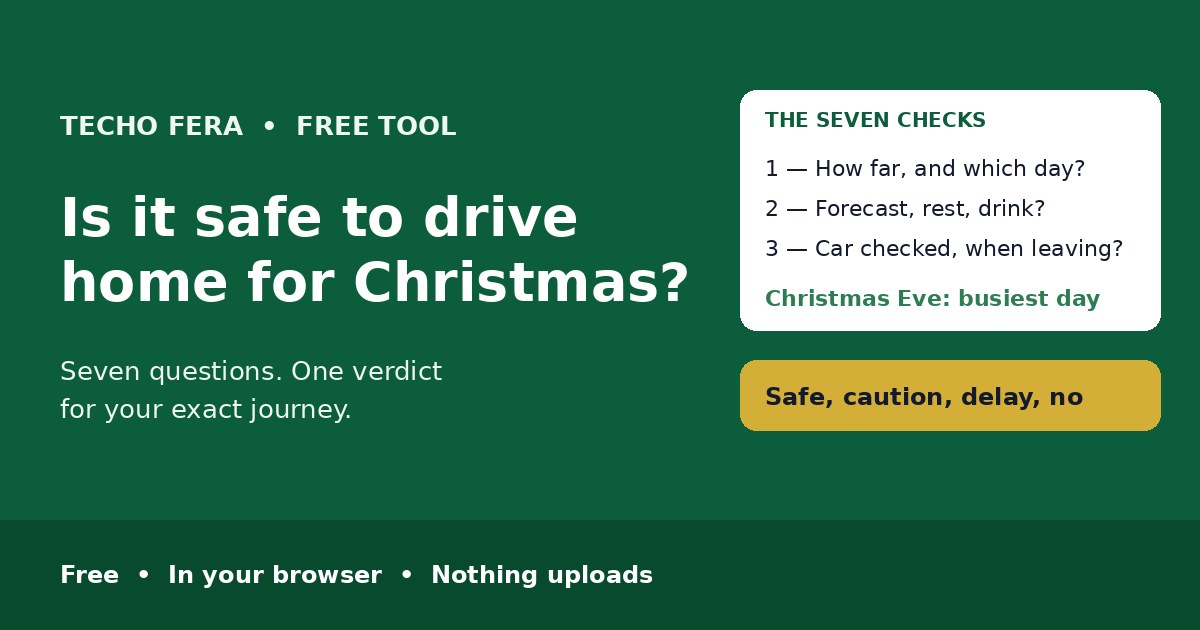
The rule is the combination, not any one thing. A short daytime drive in clear weather, well rested, with the car checked, is safe on almost any day. A long night drive on Christmas Eve, tired, in snow, after a drink, is not — and no single factor tells you that on its own. This checker asks seven questions — how far, which day, the forecast, how rested you are, whether you have had a drink, whether the car is checked, and when you leave — and gives one verdict: safe to drive, drive but take extra care, delay the trip or take another way, or do not drive. It also gives you a risk score from 0 to 40, which is the checker's own estimate, built from the National Safety Council, Hello Magazine, Northwest Driving School and UK Highway Code guidance as it reads in November 2026.
To use it:
- Say how far you are driving. Under an hour, 1 to 3 hours, 3 to 6 hours, or over 6 hours. Distance is the base of the risk: under an hour is fine in almost any conditions, over six hours needs an overnight stop.
- Say which day you are travelling. 22 December or earlier, 23 December, Christmas Eve, Christmas Day, Boxing Day, or 27–28 December. Christmas Eve is the busiest day of all; Christmas Day itself is one of the quietest on the road.
- Say what the forecast is for your route. Clear and dry, rain, snow or ice, a storm or weather warning — or that you have not checked it yet. In December, do not guess the forecast: snow or ice changes everything.
- Say how rested you are. Well rested, tired, or exhausted. Fatigue is as dangerous as drink: a tired driver reacts slowly and can fall asleep at the wheel. Be honest with yourself.
- Say whether you have had a drink. None, one drink several hours ago, drinking at a party today, or not sure. The rule is absolute: if you have been drinking, do not drive — and if you lost count, that is itself the answer.
- Say whether the car is checked. Tyres, fuel or charge, lights, screenwash — or a warning light is on. A warning light means get the car looked at before a long journey, never take it on a long drive with one on.
- Say when you are leaving. Daytime, evening, night after 10 p.m., or very early morning. It is dark by late afternoon in December, and leaving after 10 p.m. is the worst time, especially on a long drive.
The risk factors at a glance
| Factor | Worst case | Why it matters |
|---|---|---|
| Distance | Over 6 hours | Over six hours needs an overnight stop; fatigue builds with every hour |
| Travel day | Christmas Eve | The busiest day of all — the roads jam by mid-afternoon |
| Forecast | Storm or weather warning | Roads may close, and a breakdown in a storm is dangerous |
| Rest | Exhausted | An exhausted driver is as dangerous as a drunk one |
| Alcohol | Drinking at a party | Even one drink impairs judgement; 39% of Christmas-holiday deaths in 2020 involved an impaired driver |
| Car | Warning light on | A long festive journey is the worst time to find out what the light means |
| Departure | Night, after 10 p.m. | Dark, tired, and fewer places open if you break down |
What makes this checker different
The pages that rank for this search are guides — a driving school's tips, a magazine's ten festive road-trip tips, the National Safety Council's holiday fatality figures, and a lawyer's three common-sense reminders. Every one of them gives you the same static list — drive defensively, use your headlights, give yourself more time, stay rested, do not drink — and leaves you to work out what it means for your journey, your day and your weather. None of them asks how far you are driving, which day, what the forecast is, how rested you are, whether you have had a drink, whether the car is checked, or when you leave — and none of them tells you whether to go, delay or stay put. There is no free, standalone checker that takes your seven answers and gives you one verdict with the reason, the risk score, and the next steps. This page is that answer: seven questions, an instant verdict for your exact journey, the blockers named, and what to do instead when the answer is do not drive. It is general information, so it says plainly what it cannot know: it cannot see your road, your weather or how tired you are, and where the guidance is thinner — the forecast you have not checked, the drink you lost count of — it tells you to check or not to drive instead of guessing.
When is this the right check?
When you are about to drive home for Christmas and you are not sure whether the journey is safe — because the answer depends on the combination, and a short drive on a quiet day is a different question from a long drive on Christmas Eve. When you have been at a party and someone is offering you the keys — because this page is the quick check that says do not drive, plainly, before you decide. When the forecast has turned and you are wondering whether to leave a day earlier, a day later, or take the train — because the checker shows you which factor is pushing the score up, and what changes it. And when you are tired after a full working day and thinking of driving through the night anyway — because the checker names exhaustion for what it is: as dangerous as drink.
Honest limitations
General information, not driving advice
This checker cannot see your road, your weather or how tired you are. It cannot tell you whether the road ahead is icy, whether the traffic has cleared, or whether you are fit to drive — only you can. If conditions are dangerous, or you are not fit to drive, stay put.
The risk score is an estimate, not a prediction
The 0–40 score is the checker's own estimate, built from the factors above — it is not a prediction and it cannot see your road. A low score does not make a bad road safe, and a high score does not mean you will crash. Treat it as a guide to which factors matter most.
Not sure means the cautious answer
If you have not checked the forecast, the checker adds risk instead of assuming clear skies. If you are not sure how much you have had to drink, the checker says do not drive. That is deliberate: the safe mistake is to stay put when you could have driven.
Drink-driving rules differ by country
Legal blood-alcohol limits differ — England, Wales and Northern Ireland allow 80 mg per 100 ml of blood, Scotland 50 mg, most of Europe 50 mg or lower, and several countries have a zero limit. This checker does not use the legal limit at all: if you have been drinking, it says do not drive, whatever the limit is where you are.
Weather changes while you drive
A clear forecast at home does not mean clear roads two hundred miles away. Check the forecast for your whole route, and again the morning you leave — December weather changes fast, and a storm can arrive mid-journey.
Rules from the NSC, Hello Magazine, Northwest Driving School and the Highway Code, dated November 2026
The rules here are the National Safety Council holiday fatality figures, the Hello Magazine festive-driving guide, the Northwest Driving School Christmas tips and the UK Highway Code as they read in November 2026: the busiest days, the drink-driving figures, the car checks and the fatigue warnings. Guidance changes: recheck the forecast and the official travel advice before you set off.