How to store Christmas decorations so they survive the year
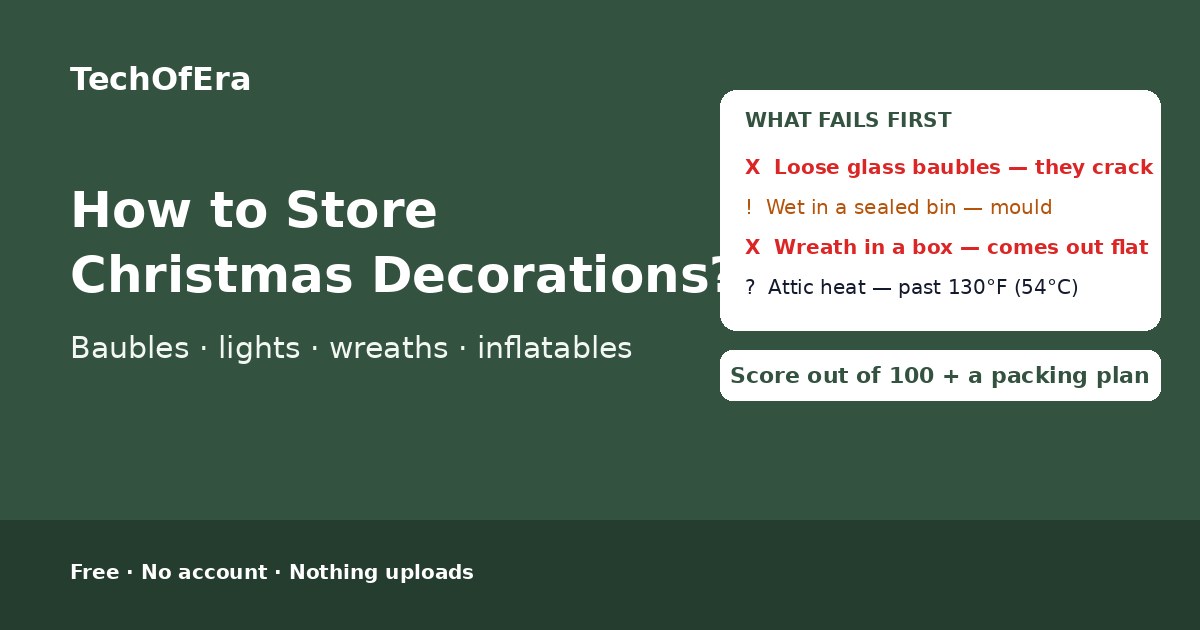
Most Christmas decorations do not die from old age — they die from the eleven months in storage. Glass baubles crack when they knock together in a loose bin, lights tangle into a knot and the wire kinks where it bends tight, wreaths come out flat from a box they were crushed in, and fabric grows mould when it is packed away damp. Storage.com puts it plainly: hard plastic bins with tight lids keep out dust, moisture and pests, divider boxes stop fragile ornaments knocking into each other, and every bin should be labelled on all sides. Family Handyman’s organisers add the detail: each ornament in its own plastic cup inside a tub, cardboard between layers, never overpacked — and lights wound on DIY cardboard spools or kept in their own labelled bags.
The spot matters as much as the packing. A dry closet indoors is the kindest place a decoration can spend the year; a damp basement or an unheated shed is the harshest, and an attic runs hot enough in summer — past 130°F (54°C) — to dry out fabric and warp plastic. Inflatables have their own rule, from the makers themselves: Gemmy’s instructions say to clean the figure, let it air dry thoroughly, and store it in a cool, dry place, because mildew forms easily when an inflatable is stored damp — and mould is harder to remove than to prevent. A well-stored inflatable lasts five to ten years. This checker scores all of it at once, so you can see which risk is actually driving the verdict.
To use it:
- Answer the eight questions honestly. The decoration type, where it will spend the year, how it is packed, what container it is in, the climate, how fragile it is, what condition it is in, and whether the bins are labelled. If you are not sure about the spot, the packing or the climate, say so — the checker scores the unknown as a risk and lists it as something to confirm, rather than guessing.
- Read the score and what fails first. The verdict is a score out of 100, and what fails first is named in plain words. A decoration can score well on seven questions and still be ruined by one bad one — wet fabric in a sealed bin, or glass baubles loose in a damp shed.
- Fix the blockers first. Anything in the do-not-store-here list means the decorations must not go away like this: wet decorations in a sealed bin, a wet inflatable, or glass baubles loose in damp air. Dry everything first, then re-pack.
- Work down the cautions. Every caution is a ten-minute fix or a decision: wrap each piece, swap the cardboard for a sealed bin, move the fragile pieces indoors, or hang the wreath instead of boxing it. Each fix moves the score up — re-run the checker after the fixes to see the new verdict.
- Label everything. Label every bin on all sides with what is inside — “red ornaments and garlands”, not just “decorations” — and tape a photo of the display to the bin if you have one. Next December you will find the right bin first time, instead of opening, moving and dropping them all.
- Know the warning signs. A bin that smells damp when you open it, a cardboard box gone soft, or mould on a single piece means check the whole box — and throw out anything already mouldy, because mould spreads to the rest of the box.
Conditions and what to do at a glance
The table below is built from the same rules as the checker, so it can never disagree with your verdict. The biggest risk decides, not the number of small ones.
| Condition | Verdict | What to know |
|---|
What makes this checker different
The pages that rank for this search are guides — good ones, from Storage.com, Family Handyman, Reader’s Digest and Tom’s Guide — but they leave you to judge your own combination: to weigh glass baubles against a damp shed against a cardboard box against loose packing, and to decide which of those matters most. This page is the answer for your decorations: eight questions in, a score out of 100, what fails first named, and a verdict that says store it, re-pack first, or do not store it here — with the packing plan in the order that matters, and the mould cases handled as do-not-store, not a low score. It is a self-assessment, so it says plainly what it cannot know: a web page cannot see your decorations, so anything you mark “Not sure” stays on the list until you confirm it.
When is this the right check?
The day the decorations come down: the day you take the tree apart, the day the lights come off the house, the day the inflatable deflates for the last time this year. Also whenever the setup changes — the decorations move from a closet to a shed, a new bin replaces a cardboard box, or you inherit a box of glass baubles. And whenever something has already gone wrong: a bauble came back chipped, a string came back tangled, or a bin smells damp when you open it — the last one means dry everything before you seal the lid again.
Honest limitations
A self-assessment, not an inspection
This checker works only from the answers you enter. It cannot see your decorations — no web page can tell how your baubles are packed or whether the shed is damp. If an answer is wrong, the verdict is wrong. When in doubt, open the bin and look.
The score is a guide, not a guarantee
A high score means the risks you described are handled — not that nothing can happen. A bin can fall, a roof can leak, and mice can get into a garage. Check the bins once during the year if the spot is damp.
The mixed-box estimate is the checker’s own
The penalty for a mixed box is the checker’s own planning estimate, not a published rule: sorting by type is safer, but no storage guide puts a number on it. Everything else follows published guidance, and the estimate is labelled wherever it appears.
“It survived last year” proves nothing
A decoration that came back fine once can still be living on borrowed time: a chip spreads, a damp patch grows, a wire kinks a little more each year. Pack for this year, not last year.
Damp overrides the verdict
Wet decorations sealed in a bin, or an inflatable stored damp, will grow mould whatever the score says. Dry everything first — the checker says so, and so do the makers.
Rules from storage guides
The rules here follow published guidance from Storage.com, Family Handyman, Reader’s Digest, Tom’s Guide and the inflatable makers’ own instructions, as they read in November 2026. Guidance can be revised — and a professional organiser who can see your decorations always outranks a web page.