How the tinsel calculation works
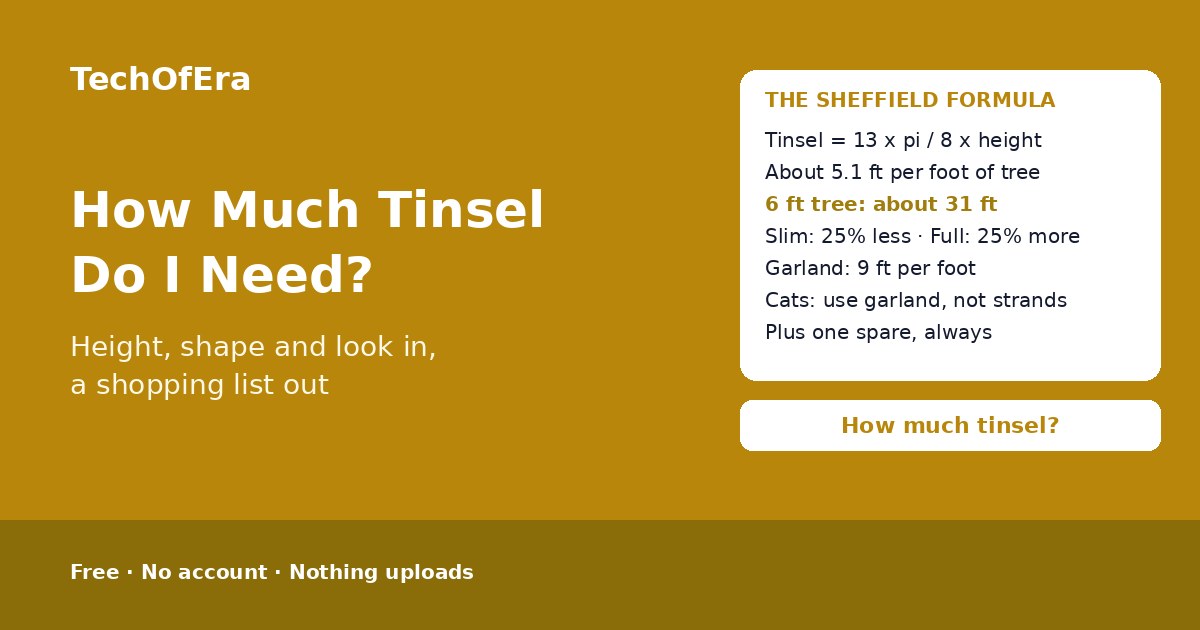
How much tinsel a tree needs is one of the most-searched Christmas questions, and the guides that rank for it disagree with each other by a factor of five. One guide says 3 to 5 feet of tinsel per foot of tree; another says 10 to 15 feet per foot; a third says one foot of tinsel per inch of tree height — 12 feet per foot; a fourth says one 36-inch roll per foot. For a 6 ft tree, those rules give anything from 18 feet to 90 feet. None of them shows its working. The only published rule with a derivation behind it is the University of Sheffield's treegonometry formula, worked out by its Maths Society in 2012: tinsel length = 13 x pi / 8 x tree height, about 5.1 feet of tinsel per foot of tree. For a 6 ft tree that is about 31 feet — six 6 ft strands, plus a spare. A retailer cross-check lands in the same place: 2 to 3 fine-cut 3 m strands on a 6 ft tree, or about 20 to 30 feet. This calculator uses the Sheffield figure as the anchor for the classic look, then adjusts it for the shape of your tree, the look you want, and whether the tree is pre-lit.
To use it:
- Measure the tree without the topper. The height you enter is the whole calculation, and a topper adds 6 to 12 inches. Measure from the base of the trunk to the top of the tree. You can enter feet or centimetres.
- Say what shape the tree is. Slim or pencil trees have less branch surface to cover, so they need about 25% less tinsel than a standard tree of the same height; full, wide trees need about 25% more. A 6 ft slim tree takes about 23 ft at the classic look, against about 31 ft for a standard tree and about 38 ft for a full one.
- Pick loose strands or garland. They are different products and they need different rules. Loose icicle strands drape from branch tips and follow the Sheffield formula. Tinsel garland wraps around the tree in a spiral, so it needs about 9 feet of garland per foot of tree height for a full wrap — a 6 ft tree takes about 54 ft of garland.
- Pick the look. A light shimmer takes about 40% less tinsel than classic; a full retro look takes about 60% more. A 6 ft standard tree takes about 18 ft for a light shimmer, about 31 ft for classic, and about 49 ft for full retro.
- Say how long each strand or garland is. Loose tinsel usually comes in 3 ft or 6 ft strands, garland in 6 ft or 9 ft lengths. The calculator divides your total by the strand length and rounds up — then adds one spare, because strands snap, tangle and shed, and running out halfway up the tree is the worst time to find out.
- Say whether a cat lives in the house, and whether the tree is pre-lit. Loose tinsel can block a cat's gut if swallowed, so with a cat the calculator treats loose strands as a blocker and tells you to use garland instead. A pre-lit tree needs about 25% less tinsel, because the built-in lights already fill the tree — the calculator takes that off for you.
What makes this calculator different
The pages that rank for this search are guides — a retailer explaining how to wrap a tree in tinsel, a decorating blog with a rule of thumb, a marketplace article with a checklist. None of them calculates anything for your tree: none takes your height, your shape, your tinsel type and your look, and none gives you a shopping list in strands. The one general tree calculator that mentions tinsel at all treats it as a side output of a lights calculation. This page is the dedicated answer: one question, seven inputs, and a shopping list — with the disagreement between the guides shown plainly, so you can see why the Sheffield formula was chosen and what the other rules would have given you. It is a calculator, so it says plainly what it cannot know: it cannot measure your tree, count the strands in the pack you buy, or meet your cat — and where a cat lives in the house it tells you to use garland instead of giving you a maybe.
When is this the right check?
When you are standing in the shop with a pack of tinsel in your hand and no idea whether one pack is enough. When the guides have given you four different numbers and you want the one with a derivation behind it. When you are decorating a slim tree for a flat and the standard rule would leave you with a bag of spare tinsel. When you want the full retro look and need to know whether that means six strands or sixteen. And when there is a cat in the house and you need to know whether loose tinsel is safe at all (it is not — use garland).
Honest limitations
A calculator, not shopping advice
This calculator cannot measure your tree, count the strands in the pack you buy, or meet your cat. It runs the numbers you give against published tinsel guidance — it cannot tell you which tinsel to buy, and it is not shopping advice.
The guides disagree — the formula is a choice
Published rules for loose tinsel range from 3 to 15 feet per foot of tree. The Sheffield figure of about 5.1 feet per foot sits in the middle and is the only one with a derivation behind it — but it is still a choice, and a very full tree or a very sparse one will want more or less. Step back and look as you hang it.
Garland and strands are different products
Garland wraps in loops, so it needs about 9 feet per foot of tree; loose strands drape, so they need about 5.1 feet per foot. Mixing the two rules up is the most common mistake — make sure the type you pick matches the product in your hand.
Packs vary — count the feet, not the packs
Some packs hold one long strand, others hold several short ones, and some count the hanging loop in the length. The shopping list counts feet of tinsel; check the total feet in the pack you buy, not the number of packs.
Cats and tinsel are a vet matter
Swallowed tinsel can cause an intestinal blockage in cats, which is a veterinary emergency. This calculator is not a vet. If a cat has swallowed tinsel, call your vet — do not wait to see if it passes.
Facts from the tinsel guides, dated November 2026
The facts here are the guides that rank for this question — the University of Sheffield, Alibaba's tinsel guides, tipsterdaily, hollyjollychristmas and christmasworld.com.au — as they read in November 2026. Guides change and prices move: recheck the numbers if anything about your tree changes.