How the bedding check works
Washing your bedding is an interval problem and a last-wash problem at the same time. The interval is simple — the published guidance says sheets and pillowcases at least once a week — but the item is the real test: a duvet cover is washed every two weeks, a comforter every two to three months, and a pillow every four to six months, and the same sheets are washed every three to four days when a pet sleeps on the bed. This checker weighs both — which item it is, how many people sleep in the bed, whether a pet sleeps on it, allergies or skin trouble, how much you sweat at night, the season, whether anyone has been ill, and when it was last washed — and gives you a verdict: wash it now, wash it soon, on track, or wash it now after the illness, plus a wash-every-X-days interval and your next wash date.
To use it:
- Say which bedding item it is. Sheets and pillowcases, a duvet cover, a blanket or throw, a comforter or duvet, pillows, or a mattress protector or cover. Sheets are washed weekly, a duvet cover every two weeks, and a comforter every two to three months — and the checker cannot give you an interval without knowing which one you mean.
- Say how many people sleep in the bed. Just you, two of you, or three or more with children sharing the bed. Two sleepers leave twice the sweat, oils and skin cells, so the interval is shorter — and three or more shorten it further.
- Say whether a pet sleeps on the bed. No pets, a pet in the bedroom but not on the bed, or a pet that sleeps on the bed. The Sleep Foundation recommends washing sheets every three to four days when a pet sleeps in the bed — the interval for sheets halves.
- Say whether anyone has allergies or skin trouble. None, mild allergies or sensitive skin, or a dust-mite allergy, eczema or asthma. Dust mites thrive in warm, damp bedding, and the guidance says to try washing more often to see if symptoms improve.
- Say how much you sweat at night. Barely at all, an average amount, or heavily. Heavy night sweating raises the moisture in the bedding, which is where dust mites and bacteria thrive — so the interval is shorter. The microbiologist Primrose Freestone puts heavy sweaters on the three-to-four-day sheet rhythm.
- Say which season it is. Winter with cold nights, spring or autumn, or summer with hot nights. Hot nights mean more sweat, so the interval is shorter in summer and stretches a little in winter.
- Say whether anyone has been ill in the last few days. No, or yes. A recent illness means fresh bedding whatever the interval says — the Cleveland Clinic lists illness and infection alongside pets and allergies as the reasons to wash more often.
- Say when it was last washed. Just washed, a few days ago, about a week ago, about two weeks ago, or a month or more ago. The next-wash date depends on when the last wash was — a week-old sheet is already at its weekly interval, while a week-old comforter has months left.
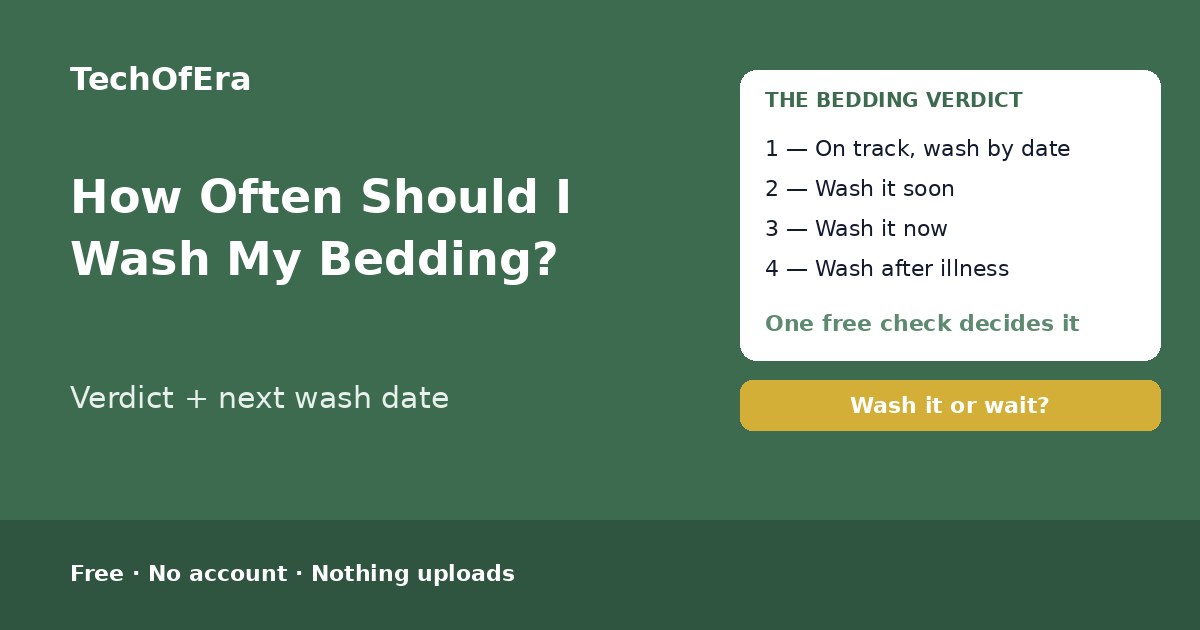
The four verdicts, and what each one means
On track — wash it by the date below
The bedding was washed recently enough that its wash-every-X-days interval has not run out yet. The checker gives you the next wash date — the interval counted forward from the last wash — so you can plan the next one instead of guessing.
Wash it soon — within the next few days
The interval is nearly up: the next wash is due within a couple of days, or within a week for the slower items like comforters and pillows. It is not overdue yet, but it will be — put it in the diary now.
Wash it now
The last wash was longer ago than the item's interval — the sheets are a week old, or the duvet cover a month old. Wash it today, at 60°C or as hot as the care label allows, and dry it fully before it goes back on the bed.
Wash it now — after the illness
Someone has been ill in the last few days. The published guidance says to wash bedding more often after an illness or infection, so the interval does not matter: wash this bedding today, and wash it again once the person feels better.
Your washing plan
Whatever the verdict, this is the routine the checker is aiming for — the plan it builds from your answers:
- Wash sheets and pillowcases at least once a week. That is the guidance from the Cleveland Clinic, the Sleep Foundation and The Spruce, and it applies to the top sheet, the bottom sheet and the pillowcases alike. Never go more than two weeks without washing your sheets.
- Wash them every three to four days with a pet on the bed, heavy sweating, or an illness. That is the three-to-four-day rhythm the Sleep Foundation and microbiologist Primrose Freestone both give for those cases — and it is the rhythm this checker builds into the interval when those answers are given.
- Wash duvet covers every two weeks to a month. Every two weeks, according to the Sleep Foundation and Primrose Freestone — stretch it to a month only if nobody sweats much and no pet sleeps on the bed.
- Wash blankets every two to three months, and comforters the same. The Spruce puts blankets at once to twice a month and the Sleep Foundation at every two to three months; the checker takes the middle of that range. A comforter with a cover that is washed regularly can wait three to four months.
- Wash pillows every four to six months, if the label allows. With a pillow protector, the pillows themselves need washing about three times a year, and the protectors monthly. Some pillows need professional cleaning — check the label first.
- Wash mattress protectors monthly, and vacuum the mattress weekly. The protector catches the sweat and skin cells that would otherwise reach the mattress, and a weekly vacuum keeps dust down while it is in the wash.
- Wash at 60°C or higher, and dry it fully. Heat and detergent are what kill bacteria and dust mites — and bedding that goes back on the bed damp is where mildew and mites thrive. Always check the care label first: delicate fabrics may need cooler water.
What makes this checker different
The pages that rank for this search are articles — a Cleveland Clinic explainer from a dermatologist, a The Spruce guide with a per-item table, a USA Today health piece, a Sharecare guide, a Sleep Foundation guide, and a phys.org piece from a microbiologist. None of them asks which item you mean, how many people sleep in the bed, whether a pet sleeps on it, or when it was last washed — and none of them gives you a verdict for your bedding, or a next-wash date. This page is the answer the articles do not give: eight questions, an instant verdict, a wash-every-X-days interval, the blockers named, and a next-wash date. It is a self-assessment, so it says plainly what it cannot know: it cannot see your bed, your bedding, or your skin.
When is this the right check?
When you cannot remember when the sheets were last changed — because a week-old sheet is already at its weekly interval, and the checker will say so instead of guessing. When a pet has started sleeping on the bed and you are not sure whether that changes anything — because it does, from weekly to every three to four days. When someone in the house has just been ill and you are not sure whether the bedding needs to go in the wash — because it does, whatever the interval says. And when you are not sure whether the duvet cover, the comforter and the pillows all run on the same schedule — because they do not, and the checker gives each one its own interval.
Honest limitations
A self-assessment, not medical advice
This checker cannot see your bed, your bedding, or your skin. It cannot tell whether your skin needs a doctor. If you have a skin infection, a rash that will not clear, or severe allergies, talk to a doctor.
The intervals are the checker's own estimates
The base interval for each item comes from the published guidance, but the adjustments for sleepers, pets, allergies, sweating and season are the checker's own judgement — they are labelled as planning estimates wherever they appear, not as medical figures.
Without the last wash, the next-wash date is a rhythm, not a date
The next-wash date depends on when the bedding was last washed, and guessing it wrong by a week moves the whole plan. The checker still works without it, but it gives the wash-every-X-days interval instead of a date — and the verdict drops to low confidence until the last wash is known.
“A few days ago” is a judgement, not a measurement
Most people judge the last wash by memory, and a few days and a week can blur together. If you are not sure which one it is, the checker treats a few days as three and a week as seven — and says so in the answer, rather than pretending it measured them.
Other bedding in the house counts too
This checker looks at one item at a time. It does not check the other bedding in the household, and it does not ask whether anyone else in the house is ill — so run it once per item, and wash any bedding a sick person slept in.
Rules from official sources, dated November 2026
The rules here are the published guidance from the Cleveland Clinic, the Sleep Foundation, The Spruce, USA Today, Sharecare and microbiologist Primrose Freestone, as they read in November 2026. Guidance changes: recheck with a doctor if anything about your skin, your allergies, or your health changes.