How much does underfloor heating cost per hour?
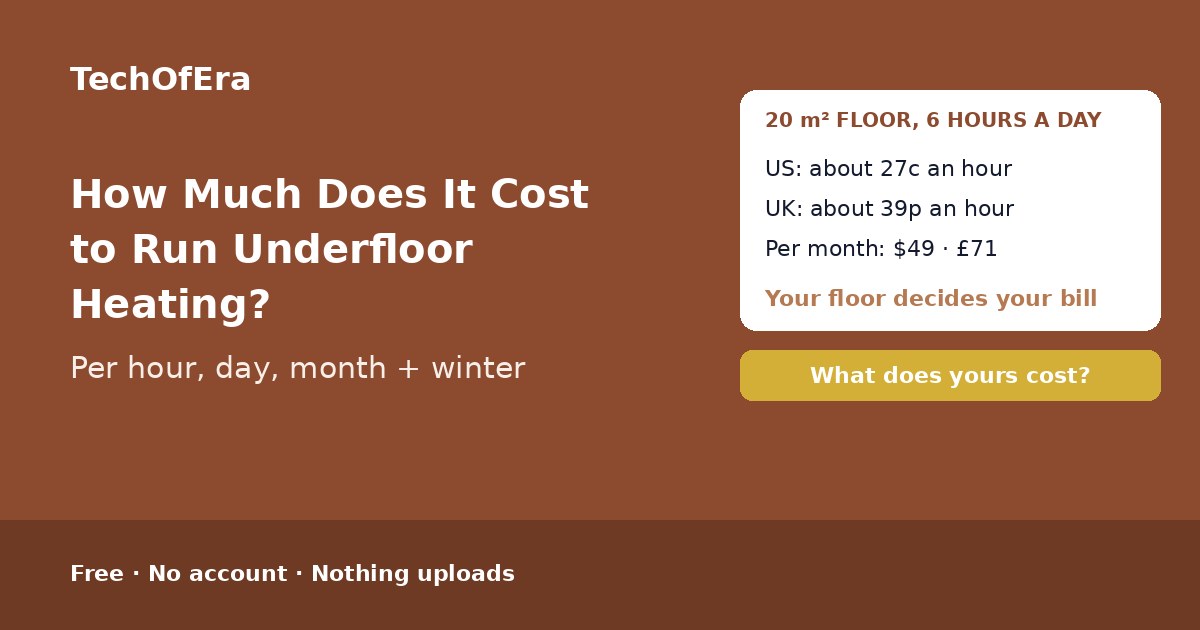
It comes down to four numbers: the heated floor area, the watts per square metre, how much of the time the thermostat keeps the system on, and your price per kilowatt-hour. A kilowatt-hour is the unit your bill uses — one kilowatt of power running for one hour. A 20 m² floor at 150 W/m² draws 3 kW at full power; heating half the time it averages 1.5 kW, so one hour uses 1.5 kWh. Multiply that by your price per kWh and you have the hourly cost: about 27 cents at the US average residential rate of 18.16 cents per kWh, or about 39p at the UK Ofgem price cap of 26.32p per kWh. The table below works it out for the usual rooms, at 150 W/m², heating half the time, 6 hours a day for 30 days — enter your own numbers in the calculator above for your exact figure.
| Heated floor | US per hour | US per month | UK per hour | UK per month |
|---|---|---|---|---|
| Bathroom, 4 m² | $0.05 | $9.81 | 8p | £14.21 |
| Kitchen, 12 m² | $0.16 | $29.42 | 24p | £42.64 |
| Living room, 25 m² | $0.34 | $61.29 | 49p | £88.83 |
| Whole home, 60 m² | $0.82 | $147.10 | £1.18 | £213.19 |
US rate: 18.16 cents per kWh (US Energy Information Administration, average residential rate, August 2026). UK rate: 26.32p per kWh (Ofgem price cap, 1 October to 31 December 2026). All figures are estimates, at 150 W/m², heating half the time — a thermostat cycling the system off more brings them down.
How much electricity does underfloor heating use?
A 20 m² floor at 150 W/m², heating half the time, uses 1.5 kWh for every hour it runs — 9 kWh over a 6-hour day, about 270 kWh over a 30-day month. A small bathroom floor uses about 54 kWh a month, less than a fridge; a 60 m² whole-home electric floor uses about 810 kWh a month, which is a large share of a household bill. That is why the hours matter more than the floor: the same system costs twice as much running 12 hours a day as it does running 6. The rated watts per square metre is the maximum — once the floor is warm, the thermostat cycles the system off for part of the time. That is why the calculator asks how much of the time the system is actually heating: at 50% duty, a 150 W/m² floor uses 75 watts per square metre on average, and costs about half as much as the full-power figure.
Is underfloor heating cheaper than radiators?
Per unit of heat, an electric floor costs the same as any electric heater: a kilowatt-hour of warmth costs what a kilowatt-hour of electricity costs. A water-fed floor heated by a gas boiler is cheaper per unit — gas costs about 7.97p per kWh under the UK Ofgem price cap against 26.32p for electricity, and a boiler turns about 90% of the gas it burns into heat, so gas heat costs roughly a third of electric heat. But underfloor heating runs at a lower water temperature than radiators, so it pairs well with a heat pump, and heating only the rooms you use beats heating the whole house through radiators. The honest answer is to compare both: the calculator above prices the same floor through the other system, so you can see the trade-off with your own rates. The other half of the comparison is installation — a water-fed floor costs far more to put in, so the cheaper running cost takes years to pay back.
How to work out your own cost
- Pick your country. The calculator fills in the published average electricity price — the US Energy Information Administration average, the UK Ofgem price cap, Eurostat for Germany, and published averages for Canada and Australia. Your own bill is more accurate: check the price per kWh on it and enter that instead.
- Say which system heats your floor. Electric mats and cables run on electricity; a water-fed (hydronic) floor runs on hot water from a boiler. The water-fed cost needs your gas price — the calculator asks for it rather than guessing one.
- Say how big the heated floor is, and its watts per square metre. Measure the floor area that is actually heated — mats stop short of the walls and fixed furniture — and check the mat or system specification for the rating. 150 W/m² is the common standard; bathrooms are often 150 to 200 W/m².
- Say how much of the time it is actually heating. Once the floor is warm, the thermostat cycles the system off for part of the time. If you are not sure, 50% is a fair guess for a floor with a thermostat and a floor sensor; 100% is the maximum, for a floor heating up from cold.
- Say how many hours a day, how many days a month, and how many winter months. The calculator gives you the cost per hour, per day, per month and per winter — and the heat used, in kWh, at each step — plus the same warmth priced through the other system.
What makes this calculator different
The pages that rank for this search are mostly installation guides: what a floor costs to put in, per square metre or per room. The running-cost answers are tables at one rate, or calculators that only work in US square feet and dollars, only cover electric systems, and stop at the monthly cost. This page is the interactive answer for your exact floor: your area in square metres or square feet, your watts per square metre, your thermostat, your hours, your rate — with country presets grounded in published figures (the US EIA, the UK Ofgem price cap, Eurostat), both electric and water-fed systems priced side by side, a cost band that says plainly whether the result is cheap or pricey, and a winter-season total. And the difference from the room-heater question is kept clear: this calculator answers the cost of heating a floor, not a plug-in heater — for that, use the How Much Does It Cost to Run a Space Heater? Calculator.
When should you check the cost?
Before you choose a system — run the numbers while you are deciding between electric mats and a water-fed floor, because the running cost is decided before the first use and the installation cost is paid once. Before the first cold snap — because the hours and the tariff are decided before the first use. When your bill jumps — because the hours, not the floor, are usually what changed. When you are choosing between heating one room and heating the whole house — because the comparison shows the trade-off with your own rates. And when you buy a new thermostat — because a floor sensor and a timer that only heats the rooms you use are the cheapest upgrades you can make.
Honest limitations
Estimates, not your bill
Every figure here is an estimate. Your real cost depends on your tariff, how well the floor and room are insulated, how long the floor takes to warm up from cold, and the fixed standing charge on your bill — which is not included, because you pay it whether the heating runs or not.
Rates change — check your bill
The preset rates are published averages: the US EIA average, the UK Ofgem price cap for October to December 2026, Eurostat for Germany, and published averages for Canada and Australia. Your tariff may be higher or lower, and caps reset — your own bill is the most accurate input.
The thermostat decides the real cost
The duty setting — how much of the time the system is actually heating — is a guess, and it is the number the answer turns on. A cold slab heated from scratch draws full power for longer before the thermostat starts cycling; in a warm, well-insulated room a floor may run far less than you pick. Watch how often yours cycles and adjust it.
Running cost only — not installation
This calculator answers what a floor costs to run, not what it costs to put in. A water-fed floor is cheaper to run but far dearer to install — pipes, a manifold and a boiler or heat pump — so compare both sides before you choose a system.
Canada and Australia are approximate
Canada has no single national electricity rate — Quebec is far cheaper than Alberta — and Australian rates vary by state and network. The presets for both are published averages and are labelled approximate: enter your own rate from your bill for a figure you can rely on.
Water-fed needs your gas price
The water-fed cost divides your gas price by 0.9, because a boiler turns about 90% of the gas it burns into heat. No gas default is given for Germany, Canada or Australia — enter your own gas price and the cost appears. Without it, the calculator says so rather than guessing.