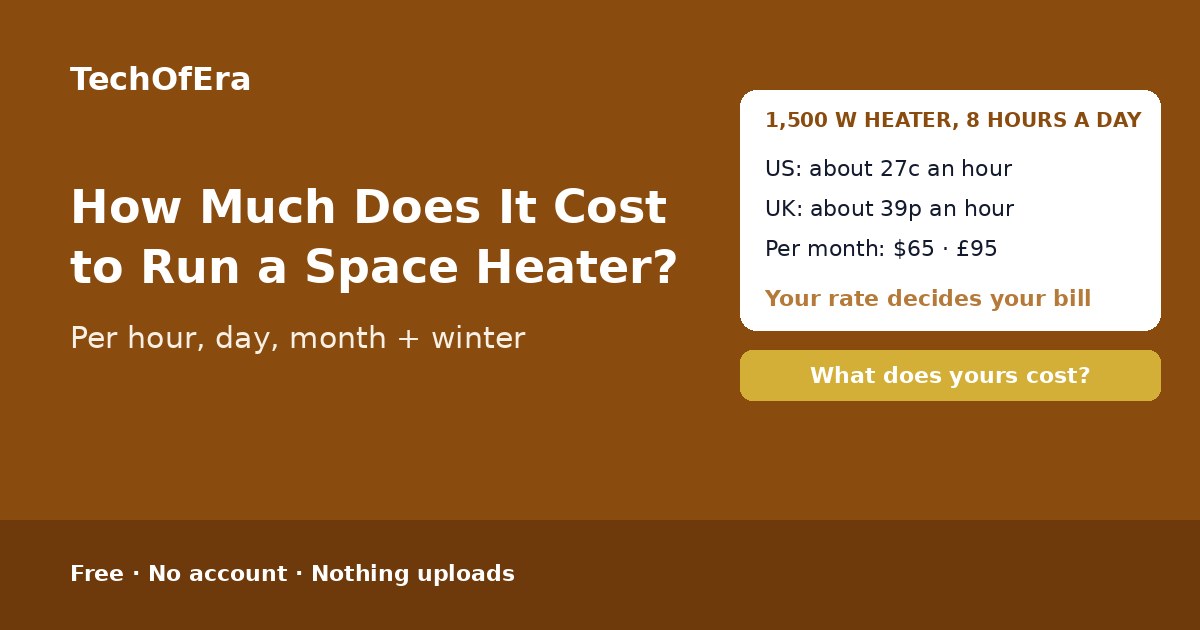
How much does a space heater cost per hour?
It comes down to three numbers: the heater's wattage, how long it runs, and your price per kilowatt-hour. A kilowatt-hour is the unit your bill uses — one kilowatt of power running for one hour. A 1,500-watt heater draws 1.5 kilowatts, so one hour on full power uses 1.5 kWh. Multiply that by your price per kWh and you have the hourly cost: about 27 cents at the US average residential rate of 18.16 cents per kWh, or about 39p at the UK Ofgem price cap of 26.32p per kWh. The table below works it out for the usual heater sizes, at 8 hours a day for 30 days, on full power — enter your own numbers in the calculator above for your exact figure.
| Heater size | US per hour | US per month | UK per hour | UK per month |
|---|---|---|---|---|
| 500 W | $0.09 | $21.79 | 13p | £31.58 |
| 750 W | $0.14 | $32.69 | 20p | £47.38 |
| 1,000 W | $0.18 | $43.58 | 26p | £63.17 |
| 1,500 W | $0.27 | $65.38 | 39p | £94.75 |
| 2,000 W | $0.36 | $87.17 | 53p | £126.34 |
US rate: 18.16 cents per kWh (US Energy Information Administration, average residential rate, August 2026). UK rate: 26.32p per kWh (Ofgem price cap, 1 October to 31 December 2026). All figures are estimates, on full power — a thermostat cycling the element off brings them down.
How much electricity does a space heater use?
A 1,500-watt heater uses 1.5 kWh for every hour it runs on full power — 12 kWh over an 8-hour day, about 360 kWh over a 30-day month. That is more than a fridge, a TV and a laptop use together, which is why the hours matter more than the heater: the same heater costs eight times as much running 8 hours a day as it does running one hour. The label wattage is the maximum — a heater on a low setting draws less, and once the room is warm a thermostat-controlled heater switches the element off for part of the time. That is why the calculator asks how much of the time the heater is actually heating: at 50% duty, a 1,500-watt heater uses 0.75 kWh an hour, and costs about half as much.
Is a space heater cheaper than central heating?
Per unit of heat, no: gas central heating is cheaper. Under the UK Ofgem price cap gas costs 7.97p per kWh against 26.32p for electricity, and a gas boiler turns about 90% of the gas it burns into heat — so electric heat costs roughly three times as much per kWh of warmth. But a space heater warms one room, while central heating warms the whole house. If you only need one room warm for a few hours — a home office through the working day, a bedroom in the evening — the space heater can still cost less in total, because you are not paying to heat empty rooms. The honest answer is to compare both: the calculator above shows the same warmth priced from gas, so you can see the trade-off with your own rates.
How to work out your own cost
- Pick your country. The calculator fills in the published average electricity price — the US Energy Information Administration average, the UK Ofgem price cap, Eurostat for Germany, and published averages for Canada and Australia. Your own bill is more accurate: check the price per kWh on it and enter that instead.
- Say how many watts your heater draws. Check the label on the heater or its box. Most plug-in heaters top out at 1,500 watts; UK and European heaters go up to about 3,000 watts.
- Say how much of the time it is actually heating. Once the room is warm, a thermostat-controlled heater switches the element off for part of the time. If you are not sure, 75% is a fair guess for a heater with a thermostat; 100% is the maximum, for a heater running flat out.
- Say how many hours a day, how many days a month, and how many winter months. The calculator gives you the cost per hour, per day, per month and per winter — and the energy used, in kWh, at each step.
- Compare with gas, if you have it. Enter your gas price per kWh and the calculator prices the same warmth from a gas boiler at about 90% efficiency, so you can see whether heating one room beats heating the whole house.
What makes this calculator different
The pages that rank for this search are mostly guides and tables: a per-hour cost at one rate, a table of wattages, a cost by US state. They answer the average case, not yours. There are a few calculators, but they are US-only, or they ask for a rate without saying where it comes from, or they stop at the monthly cost. This page is the interactive answer for your exact heater: your wattage, your hours, your thermostat, your rate — with country presets grounded in published figures (the US EIA, the UK Ofgem price cap, Eurostat), a cost band that says plainly whether the result is cheap or pricey, a winter-season total, and the gas central-heating comparison next to it. And the difference from the safety question is kept clear: this calculator answers cost only. Whether your heater is safe to leave on is a different question, answered by the Is My Space Heater Safe to Leave On? Checker.
When should you check the cost?
Before the first cold snap — run the numbers while you get the heater out of storage, because the hours and the tariff are decided before the first use. When your bill jumps — because the hours, not the heater, are usually what changed. When you are choosing between heating one room and heating the whole house — because the gas comparison shows the trade-off with your own rates. And when you buy a new heater — because a smaller heater on a lower setting often warms a small room just as well for less, and about 10 watts per square foot is the rule of thumb.
Honest limitations
Estimates, not your bill
Every figure here is an estimate. Your real cost depends on your tariff, whether your heater's thermostat cycles the element off, how well the room holds heat, and the fixed standing charge on your bill — which is not included, because you pay it whether the heater runs or not.
Rates change — check your bill
The preset rates are published averages: the US EIA average, the UK Ofgem price cap for October to December 2026, Eurostat for Germany, and published averages for Canada and Australia. Your tariff may be higher or lower, and caps reset — your own bill is the most accurate input.
The thermostat decides the real cost
The duty setting — how much of the time the element is actually on — is a guess, and it is the number the answer turns on. In a warm, well-insulated room a heater may run far less than you pick; in a cold, draughty room it may run flat out. Watch how often yours cycles and adjust it.
Cost only — not safety
This calculator answers cost, not safety. A cheap heater to run can still be unsafe to leave on — never leave a space heater running while you sleep or while nobody is in the room. For the safety check, use the Is My Space Heater Safe to Leave On? Checker.
Canada and Australia are approximate
Canada has no single national electricity rate — Quebec is far cheaper than Alberta — and Australian rates vary by state and network. The presets for both are published averages and are labelled approximate: enter your own rate from your bill for a figure you can rely on.
Gas comparison needs your gas price
The gas comparison divides your gas price by 0.9, because a boiler turns about 90% of the gas it burns into heat. No gas default is given for Germany, Canada or Australia — enter your own gas price and the comparison appears. Without it, the comparison stays blank rather than guessing.