How much does it cost to run Christmas lights?

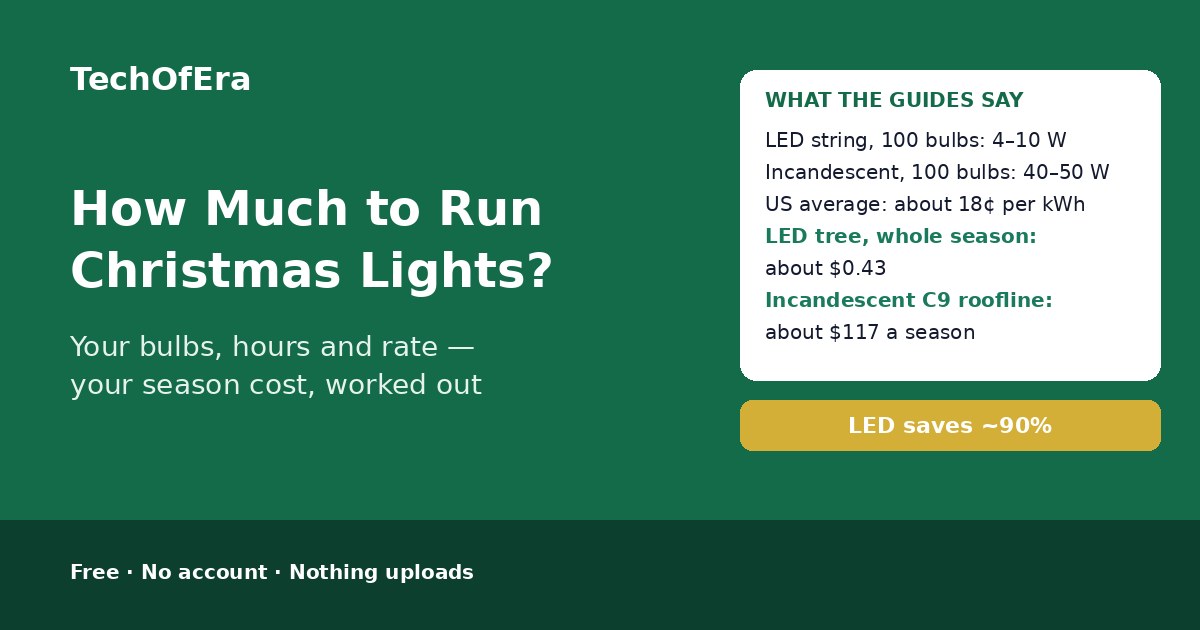
A small LED tree costs about $0.43 for the whole season. The same display in old incandescent bulbs can cost $117. Enter your bulbs, hours and electricity price and get your cost per hour, per day and for the season — plus what the same display would cost with the other kind of bulb. Free, in your browser, nothing uploads.

  • Cost per hour, day and season
  • LED vs incandescent saving
  • US & UK price presets
  • Free, no account, nothing uploads
How much does it cost to run Christmas lights? Work out your season cost in seconds.

Work out your Christmas lights cost

Try a preset:
0 of 7 answered

Your result

Answer the questions Your season total appears here as you answer.
Your window

Answer the questions above and your window will appear here — the cost per hour, per day and for the season, and what the same display would cost with the other kind of bulb.

Cost breakdown

Blockers

Things that do not fit

Things to check

Still to confirm

What to do next

    Your result summary


    Answer the questions above — the season total updates live.

    Privacy you can verify, not just trust

    Working out what your lights cost by uploading your electricity bill to a website would be backwards — the check should never be the leak. This one can't: your answers are checked with plain JavaScript on your device, and they never leave the device — the only third-party requests are the site's own analytics, which count page views. Don't take our word for it:

    New cross-origin requests during use: 0
    1. Press F12 to open developer tools, then the Network tab.
    2. Answer a question above. Watch: apart from the site's analytics, nothing new is requested — no uploads, and no data ever leaves your device.
    3. Extra credit: disconnect your internet after this page loads — the calculator still works.

    How the Christmas lights cost calculator works

    How much Christmas lights cost to run is one of the most-searched Christmas questions, and the guides that rank for it all say the same thing in different words — but none of them runs your numbers. What decides it is your light type, your bulb style, how many bulbs there are, how many hours a day they are on, how many days they run, and the price you pay per kilowatt-hour. The formula is the same in every guide: cost = (total watts / 1,000) x hours x price per kWh. A 100-bulb LED string uses about 4–10 watts; the same string in incandescent uses about 40–50 watts. The big C9 bulbs are the expensive ones: about 7 watts each as incandescent, about 0.36 watts as LED. The US average price is about 18 cents per kWh in 2026; the UK about 24p. The guide figures are planning estimates only: the watts on your box and the rate on your bill are the authority.

    To use it:

    1. Pick your currency. US dollars, British pounds or euros. Picking one sets the typical price per kWh for that region — US 18 cents, UK 24p, EU 30 cents — which you can still override with the rate on your own bill. The verdict and the breakdown use the currency you pick.
    2. Say what kind of lights they are. LED or incandescent. LED uses roughly a tenth of the power of incandescent for the same display — the single biggest thing that decides the cost.
    3. Say what size of bulb. Mini bulbs are the small ones on a tree; C7 and C9 are the big classic bulbs on a roofline — and the big ones use far more power. An incandescent C9 uses about 7 watts; an LED C9 about 0.36 watts.
    4. Say how many bulbs are in the display. Count the strings and multiply: a 100-bulb string is the usual size. A small tree is about 200 bulbs, a house outline about 1,000, a whole-house display 1,000–5,000.
    5. Enter the total watts, if you know them. Read the watts on the box or the string's tag and enter the total for the whole display. Leave it blank and the calculator estimates from the typical watts per bulb for your light type and bulb style — and says so.
    6. Say how many hours a day they are on. Most displays run 5–6 hours a night — dusk to bedtime. More than 8 hours and a timer is the cheapest saving there is: it halves the cost without changing a bulb.
    7. Say how many days they will run. December alone is 31 days; a long season from late November to early January is about 45.
    8. Say what you pay per kilowatt-hour. It is on your electricity bill. The US average is about 18 cents, the UK about 24p, the EU about 30 cents. This is the one number that moves the total most — check it rather than guessing.

    Worked examples, checked against the guides

    Small LED tree: 200 LED mini bulbs draw about 16 watts. At 5 hours a night for 30 days that is 2.4 kWh, which costs about $0.43 at 18 cents per kWh.

    LED house outline: 1,000 LED mini bulbs draw about 80 watts. At 6 hours a night for 31 days that is 14.88 kWh, which costs about $2.68 at 18 cents per kWh.

    Old incandescent roofline: 500 incandescent C9 bulbs draw about 3,500 watts. At 6 hours a night for 31 days that is 651 kWh, which costs about $117.18 at 18 cents per kWh. The same 500 bulbs as LED C9 draw about 180 watts and cost about $6.03 — a saving of about $111, or 95%.

    UK evenings: 500 LED mini bulbs draw about 40 watts. At 6 hours a night for 31 days that is 7.44 kWh, which costs about £1.79 at 24p per kWh.

    What makes this calculator different

    The pages that rank for this search are guides — realtor.com's power-bill piece with the Payless Power study ($15.36 for a full LED December display, $92.03 incandescent), Angi's cost guide ($1.76 for ten 100-light LED strands over 35 days, more than $10 incandescent), Govee's electricity guide with the formula and the worked scenarios, Mr. Electric's state-by-state cost map (about $25 for a typical outdoor display over five weeks, about $270 for a heavy one), and a Connecticut government guide. None of them runs your numbers: none takes your bulb count, your bulb style, your hours, your days and your rate — and none shows what the same display would cost with the other kind of bulb. The one interactive calculator in the results sits on a local installer's page for Bend, Oregon, with Oregon rates and four bare fields. This page is the answer the guides point at but never give: your display, your rate, your season total, and the LED saving beside it. It is a self-assessment, so it says plainly what it cannot know: it cannot read your electricity bill, count your lights, or tell you which lights to buy.

    When is this the right check?

    When the guides have left you no closer to an answer — because the answer genuinely depends on your display, not on what other households pay. When you are deciding whether to replace old incandescent strings before you hang them. When the bill has just landed and you want to know how much of it was the lights. When you are planning a big display and want to budget the season before you buy. And when you want a number you can check against your bill, hour by hour and day by day, instead of a national average that was never about your house.

    Honest limitations

    A self-assessment, not an electricity bill

    This calculator cannot read your electricity bill, count your lights, or tell you which lights to buy. It runs the answers you give against what the Christmas lights guides say — it cannot tell you what your meter actually recorded, and it is not shopping advice.

    Guide figures are estimates, not targets

    The typical watts per bulb and the typical prices per kWh are what the guides say as they read in November 2026. Your own box and your own bill matter more than any average — the verdict only works from the numbers you enter, so re-check them before you budget.

    The watts are estimated unless you enter them

    When you leave the watts blank, the calculator uses the typical figure for your light type and bulb style — LED mini 0.08 watts, LED C9 0.36 watts, incandescent mini 0.4 watts, incandescent C9 7 watts. Real strings vary: the watts on your box beat the estimate every time.

    Your rate is probably not the average

    The US average is about 18 cents per kWh and the UK about 24p, but Hawaii pays far more than North Dakota and a time-of-use tariff pays differently again. The calculator uses your rate when you enter it — and the average is only a stand-in until you do.

    Other decorations are not counted

    The calculator only knows about the lights you enter. Inflatables run a fan motor all the time they are up — about $1.68 a month each at the typical rate — and projectors, animated figures and heated driveways are separate loads. Add them as a second run if you have them.

    Facts from the Christmas lights guides, dated November 2026

    The facts here are the guides that rank for this question — realtor.com, Angi, Govee, Mr. Electric and the Connecticut government guide — as they read in November 2026. Guides change and prices do not: recheck the figures if anything about your display or your tariff changes.

    Frequently asked questions

    How much does it cost to run Christmas lights?

    A small LED tree — 200 mini bulbs, 5 hours a night for 30 days — costs about $0.43 for the season at the US average of 18 cents per kWh. A 1,000-bulb LED house outline at 6 hours a night for 31 days costs about $2.68. The same display in old incandescent bulbs costs roughly 5 to 10 times more: a 500-bulb incandescent roofline of big C9 bulbs costs about $117 for the season. The guides agree on the range, not the number: what you pay depends on your watts, your hours and your rate. This calculator works it out from your own display, because the guide figures are planning estimates, not targets.

    How much electricity do LED Christmas lights use?

    Very little. A 100-bulb LED string uses about 4 to 10 watts (Govee: 4 to 8 watts; an expert quoted by realtor.com: 5 to 10 watts). That is about 0.08 watts per mini bulb, and about 0.36 watts per big LED C9 bulb — Govee's own LED C9 string is rated 18 watts for 50 bulbs. A 1,000-bulb LED display therefore draws about 80 watts, and at 6 hours a night for 31 days uses about 15 kWh, which costs about $2.68 at the US average of 18 cents per kWh. This calculator uses those typical per-bulb figures when you do not enter the watts yourself, and says so.

    How much do incandescent Christmas lights cost to run?

    A 100-bulb incandescent mini string uses about 40 to 50 watts (Govee: 40 to 50 watts; Mr. Electric: 40 watts), about 0.4 watts per bulb. The big bulbs are far hungrier: a string of 25 C7 or C9 bulbs uses 125 to 250 watts (Govee), about 5 to 10 watts a bulb. So 500 incandescent mini bulbs draw 200 watts and cost about $6.70 for a season of 6 hours a night for 31 days at 18 cents per kWh — but 500 incandescent C9 bulbs draw 3,500 watts and cost about $117 for the same season. The same display in LED costs about a tenth as much, which is why the guides all say to swap.

    How do I work out the cost of my own display?

    Every guide uses the same formula: cost = (total watts / 1,000) x hours x price per kWh. Find the watts on the box or the string's tag, multiply by the hours the lights are on each day, divide by 1,000 to get kilowatt-hours, and multiply by the price per kWh on your electricity bill. This calculator does exactly that, and if you do not know the watts it estimates them from the typical per-bulb figure for your light type and bulb style — LED mini 0.08 watts, LED C9 0.36 watts, incandescent mini 0.4 watts, incandescent C9 7 watts — and labels the result as an estimate. The watts on your box and the rate on your bill are always the authority.

    Are LED Christmas lights really cheaper to run?

    Yes — by about 90%. LEDs use roughly a tenth of the power of incandescent bulbs for the same display, and the guides put the saving at 70 to 90%. Payless Power, quoted by realtor.com, priced a full December display at about $15.36 with LED lights and about $92.03 with incandescent at the typical US rate; a 100-bulb C9 string cost about $19.57 for December as incandescent and about $2.80 as LED. This calculator shows the same comparison for your own display: the same bulbs, hours and rate, with the other kind of bulb, so you can see the saving in your own currency.

    How much does it cost to run Christmas lights all night?

    The hours matter as much as the bulbs. A 1,000-bulb LED outline at 6 hours a night for 31 days costs about $2.68 for the season; left on all night — 12 hours — it costs about $5.36. The same display in incandescent C9 bulbs costs about $117 at 6 hours and about $234 at 12 hours. A timer that switches the lights off at bedtime is the cheapest saving there is: it halves the cost without changing a single bulb. This calculator flags any display running more than 8 hours a day and shows what 6 hours a night would cost instead.

    How much does it cost to run Christmas lights in the UK?

    At the typical UK price of about 24p per kWh, a small LED tree of 200 mini bulbs at 5 hours a night for 30 days costs about 58p for the season. A 500-bulb LED display at 6 hours a night for 31 days costs about £1.79. The same display in incandescent mini bulbs costs about £8.93, and in incandescent C9 bulbs about £156. The 24p figure is a planning estimate from the late-2026 price-cap level, stated as such — the rate on your own bill is the authority, and this calculator lets you enter it. Pick pounds in the currency box and the calculator uses the 24p preset until you change it.

    Does this calculator send my answers anywhere?

    No. This calculator is a self-assessment: it runs your answers — your light type, bulb style, bulb count, watts, hours per day, days in the season and price per kWh — against what the Christmas lights guides say as they read in November 2026, entirely in your browser, and nothing you enter leaves your device. The only third-party requests are the site's own analytics, which count page views. It cannot read your electricity bill, count your lights, or tell you which lights to buy, and it is not shopping advice. The decision is yours alone.